Browse articles on EyeWorld.org from the Cataract section. EyeWorld is the award-winning member publication of ASCRS. The magazine provides news and updates from the Society as well as clinical features in the areas of cataract, refractive, cornea, glaucoma, and practice management. It publishes quarterly with editorial direction from its medical editorial board and staff.
Jacques Daviel, MD, is credited with performing the first planned extracapsular cataract extraction, and recently, Christopher Leffler, MD, and colleagues added to the history surrounding this procedure. In an article published online ahead of print in JCRS, they announced previously unreported notices and details about Dr. Daviel’s first-in-human cataract extraction.
In cataract surgery, surgeons should always be prepared for potential challenges or complications, but some are more common and well documented than others. Two ophthalmologists discussed an uncommon cataract complication that they think is important to call attention to and what others should know when dealing with these.
In her introduction, Kendall Donaldson, MD, shared what “Rewind. Refresh. Refine.” means to her and how that is reflected in each of the articles in the Cataract section.
There is currently not an FDA-approved intracameral antibiotic in the U.S., but there are FDA-approved options for dropless pain and inflammation treatment after cataract surgery, and some surgeons, including three who spoke with EyeWorld, have chosen to employ a dropless approach off-label, based on available safety and efficacy data.
There are several all-in-one phacovitrectomy machines on the market that seek to streamline workflows, reduce equipment footprint, and improve efficiency. The decision to invest in a combined system depends on case mix, staffing patterns, and how often vitreous management is needed in the cataract OR. Three physicians weighed in on the topic.
The article recaps a symposium at the ASCRS Annual Meeting hosted by the combined societies of ASCRS, ESCRS, APACRS focusing on topics in AI, robotics, and surgical simulation, with representatives from all three societies presenting.

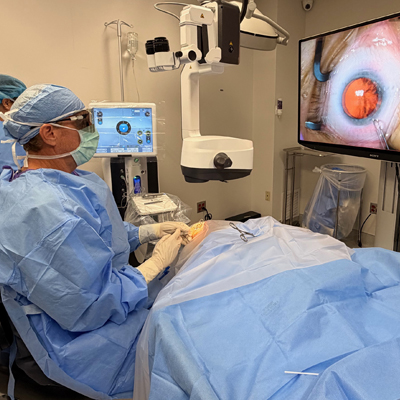
Dr. Devgan performed the first-in-human robotic cataract surgery in 2025 using the Horizon Surgical Systems Polaris platform.
Source: Uday Devgan, MD, FACS
Imagine this: A patient is undergoing cataract surgery, but the surgeon is a few meters away or someday even thousands of miles away, operating via a robotic system intended to increase precision, safety, and access to care. Physicians discussed the need for, economics of, and future of robotic cataract surgery.
Digital visualization technologies are pushing cataract surgery toward increased precision, enhanced safety, and personalized care. Three surgeons shared their experience with digital operating technologies that have hit the market in the last decade—both wearable headsets and heads-up display systems.
New Cataract Editor Kendall Donaldson, MD, previewed the articles in the Cataract section, which covered topics including digital visualization, robotic cataract surgery, and AI. “Let’s embrace this digital wave and continue to elevate the standards of care we provide to our patients,” she said.
In an article published in JCRS Online Case Reports,1 Andreas F. Borkenstein, MD, and colleagues discussed the “No ring approach technique for Nd:YAG capsulotomy in pinhole intraocular lenses: mask-sparing strategy to prevent occluder ring damage.” Dr. Borkenstein shared highlights from the report, why the technique is important, and when it applies.