Cataract: YES Connect
Spring 2026
by Ellen Stodola
Editorial Co-Director
The importance of learning different technologies and techniques in training cannot be overstated, yet it remains a challenge in residency programs for various reasons. Learning new technologies and techniques can be overwhelming, and it is important for trainees to have a repeatable algorithm for learning new technologies to minimize stress and maximize outcomes. Some programs may also have limited access to different technologies, so residents must advocate for themselves or seek fellowships that offer more opportunity. In-person meetings also offer exposure to a wide variety of technology that can be trialed in a low-stress environment, as well as teaching from the most skilled instructors in our field.
Ophthalmology is an exciting field that is perpetually innovating. This means that the technology and techniques we use in training will not be the same we use at retirement, and thus, getting comfortable with integrating new technology and techniques into your practice will serve you well throughout your career.
For this YES Connect column, we invited two brilliant young ophthalmologists who excel at just this to share their expertise and early career experience. J. Morgan Micheletti, MD, and Priya Patel, MD, shared their pearls on the importance and the practice of incorporating new technologies and techniques into your skillset during training, and I thank them for sharing their wisdom.
—Ryan G. Smith, MD, YES Connect Editor
Training programs are where ophthalmologists learn key surgical skills, and with the ever-expanding array of technologies and techniques in the field, it’s increasingly important for surgeons in training to gain exposure to a wide variety of procedures across specialties. J. Morgan Micheletti, MD, FACS, and Priya Patel, MD, discussed ophthalmic training, some of the different technologies ophthalmologists may be exposed to, and ways to stay up to date on the latest advancements in the field.
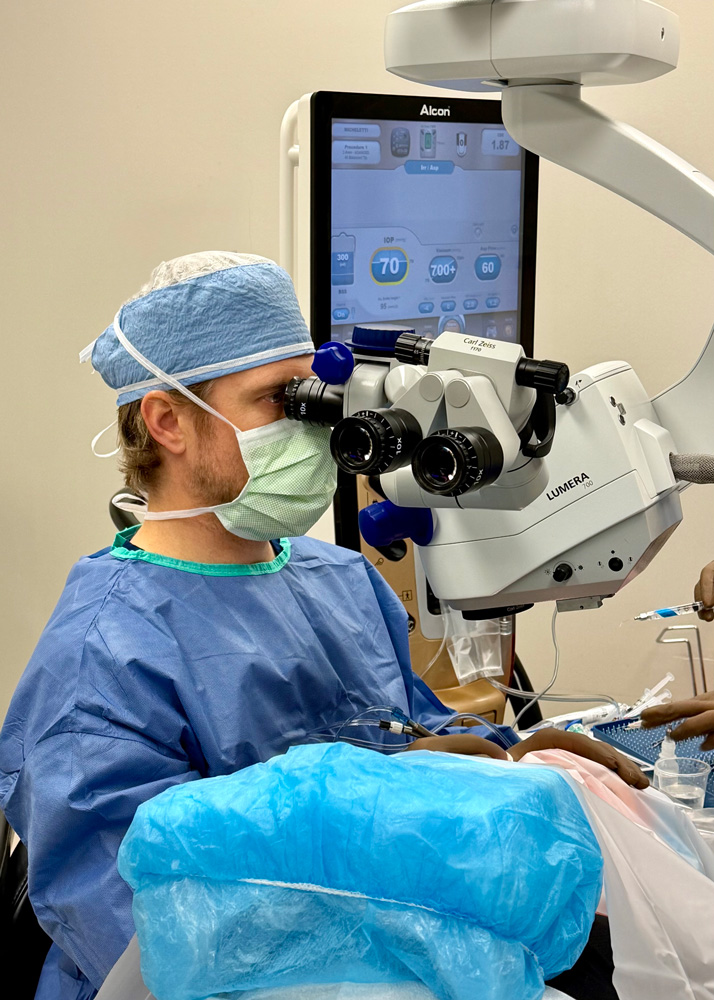
Source: J. Morgan Micheletti, MD, FACS
In residency, Dr. Patel said the main focus is to learn core clinical and surgical fundamentals. “You can’t be a great clinician and surgeon unless you have a good foundation and understand the essential concepts well,” she said. “In addition, the goal is to learn a little bit about everything—for example, we have to complete a minimum amount of procedures in each surgical subspecialty such that we are familiar with everything from strabismus surgery to vitrectomies.” At the end of the day, residency is about developing sound clinical judgment and honing diagnostic acumen and surgical skills, she said.
Dr. Patel noted that the depth of exposure varies depending on the training program, and this can be influenced by a number of factors including geographic location, program type, patient volume and demographics, and degree of autonomy. “High-volume surgical programs may offer greater exposure to advanced or complex cataract surgery, while academic centers may emphasize imaging, research, and emerging technologies, and both are important in their own way,” she said.
Additionally, she noted that there are opportunities to learn more in certain areas of interest. Residents can go through elective rotations, do research, and spend time on their own with attendings in their specialty of choice. Fellowship training allows for high volume in a specialty of choice to sharpen those skills.
Dr. Micheletti agreed that the primary focus of residency is fundamentals. “That starts with understanding the normal eye, then disease states, then clinical decision-making, and finally progresses into surgical safety and complication management,” he said. “Those foundations are what everything else is built on.”
He agreed with Dr. Patel that exposure can vary widely by program. “Technology availability differs, faculty interests differ, and patient populations differ. Some residents get extensive exposure to newer technologies, multifocal IOLs, or MIGS, while others may have more limited exposure in those areas,” he said. Ultimately, he said it’s up to the resident to develop a strong baseline understanding of safety and fundamentals, which then allows them to responsibly build into more advanced phaco techniques, premium IOL decision-making, and MIGS.
Dr. Micheletti added that supplemental experience through electives, wet labs, meetings, and visiting opportunities is important. “Fellowships are also an excellent option,” he said. “When I was a resident, I was not aware of private practice fellowships, but they can offer high-volume surgical and clinical experience, in addition to clinical trials and exposure to advanced technologies, and they are a valuable pathway for the right candidate. At my practice, we believe so strongly in this pathway that we started our own fellowship 3 years ago.”
Staying up to date and learning new techniques
“Learning from peers and careful case selection are also important to successfully integrating new techniques into your practice, and having the mindset of lifelong learning is essential to maintaining high-quality patient care.”
Priya Patel, MD
Staying current can be achieved with a combination of multiple meetings, journals, and ongoing peer-to-peer engagement, Dr. Micheletti said. “I think continued collaboration with colleagues is critical. While that often happens informally through group chats, case discussions, and shared experiences, structured collaboration at meetings is still a pillar of staying current,” he said. “In addition, for those interested, engagement with industry can broaden exposure, through involvement in early projects, advisory boards, or educational initiatives on the professional education side.”
Dr. Patel said staying up to date on new techniques, technology, and research applies particularly in ophthalmology because there is always something new being developed. “This was one of the things that attracted me to ophthalmology as a specialty,” she said. “We rely on a combination of CME, national meetings, wet labs, peer mentorship, and journal articles to keep ourselves up to date.”
As far as learning new techniques, Dr. Patel said a lot of this occurs after training. “This is one of the reasons why understanding and learning fundamental surgical skills during residency is important, as you can build on that knowledge and expertise as new techniques evolve,” she said. “Industry-supported education can be helpful when approached critically and supplemented by peer discussion. One of the most important aspects is making sure you are looking at your outcomes and reviewing your cases after the fact to see what was done well and what could have been done better.” Dr. Patel added that surgery is extremely nuanced, and you realize that every little thing can be consequential. Understanding this will make you a better surgeon, she said. “Learning from peers and careful case selection are also important to successfully integrating new techniques into your practice, and having the mindset of lifelong learning is essential to maintaining high-quality patient care.”
Different IOLs and techniques
Dr. Patel noted that patient expectations with cataract surgery continue to rise, making understanding of and experience with a variety of IOLs important. Different lens categories—monofocal, toric, EDOF, multifocal, adjustable—each require thoughtful patient selection, counseling, and postop management, she said.
“While the core surgical skills generally are transferable across lens platforms, the most important experience to be gained is understanding how to manage patient expectations as well as how your own surgeon’s factor integrates with each lens platform,” she said. “I think if you didn’t get the experience in residency with all the lens platforms, it is possible to do so when you are in practice, but again, it comes down to patient selection, counseling, and revisiting outcomes once surgery is complete.”
Gaining experience with all available IOL platforms is mandatory, according to Dr. Micheletti. “When I finished training, I intentionally avoided brand predilection and focused first on monofocal lenses, choosing the lens that best matched my refractive target,” he said. “That agnostic approach helped me understand the nuances of different platforms and gave me a base from which to build. Learning the foundational monofocal designs provides the necessary basis for expanding into EDOF, multifocal, and trifocal technologies. From there, surgeons can gradually learn the specific strengths and tradeoffs of each optical design.”
Phaco machines and platforms
Different phaco machines can offer different features during surgery. “The various phaco platforms certainly differ in characteristics such as fluidics, chamber stability, energy delivery, efficiency, and ergonomics,” Dr. Patel said. “The differences are based on which pump system[s] are integrated into the platform. Once the principles of these are understood, transitioning among machines is usually straightforward.” She added that familiarity with multiple platforms is helpful, but adaptability and understanding how the machine behaves in different surgical scenarios is more important than memorizing specific settings.
Dr. Micheletti compared the different phaco machines to golf clubs. A good golfer should be able to play well with different sets, even though each performs slightly differently. “However, each golfer may perform better with a specific set of clubs (machine) tailored specifically to them (proper settings),” he said.
MIGS procedures and devices
Another important area of training is MIGS, particularly with an increase in combined MIGS and cataract procedures.
“A relatively large percentage of the general patients we see in clinic have glaucoma,” Dr. Micheletti said. “In my experience, that translates to roughly 10–20% of cataract patients with glaucoma. As such, comfort with angle anatomy should now be considered a core skill for all surgeons as we should, at a minimum, be managing glaucoma alongside cataract surgery.” He thinks that angle surgery/MIGS, procedural pharmaceuticals, and interventional glaucoma should be compulsory for every modern eye surgeon in training.
“I do think it is important to have familiarity with MIGS coming out of residency,” Dr. Patel said. “While not every anterior segment surgeon will commonly perform MIGS as part of their practice, I think at the very least, knowledge of these procedures is essential for appropriate patient counseling and referral. Furthermore, doing MIGS solidifies your understanding of angle anatomy to a level that every ophthalmologist should know.” She noted that many residency programs include MIGS exposure now, though the extent can vary. “I think an easy place to start is doing a combined cataract procedure with either a goniotomy or a stent, and once you’re comfortable with working in the angle and using a gonioscopy lens intraoperatively, then you can move on to more involved procedures.”
Additional areas of training
Beyond IOL and phaco platforms, Dr. Patel noted that understanding advanced diagnostics and imaging is increasingly critical. “Technologies such as OCT and OCT angiography, corneal tomography, modern biometry, and data-driven outcomes tracking should play a major role in current ophthalmology training,” she said. “However, in my opinion, the most important skill physicians can develop is the ability to critically evaluate, adopt, and appropriately apply new technologies as they emerge.”
She added that integrating AI into ophthalmology clinical practice may be something that will be more commonplace in the future. “As far as non-clinical things that physicians should be trained on, I think billing and coding and professional advocacy are two areas that more programs could focus on.”
Article Sidebar
ASCRS Annual Meeting Preview
Boris Malyugin, MD, PhD, EyeWorld Refractive Editorial Board member, shared what he is looking forward to at the 2026 ASCRS Annual Meeting:
“I am planning to attend the 2026 ASCRS Annual Meeting in Washington, D.C., because it represents a unique opportunity to immerse myself in one of the most comprehensive professional gatherings dedicated to anterior segment surgery. I anticipate expanding my clinical knowledge, refining surgical techniques, and staying current with emerging evidence and technologies. I am particularly interested in attending the International Intra-Ocular Implant Club symposium, which focuses on complex cases and complication management.”
About the physicians
J. Morgan Micheletti, MD, FACS
Berkeley Eye Center
Houston, Texas
Priya Patel, MD
Omni Eye Services
Atlanta, Georgia
Relevant disclosures
Micheletti: Alcon, Bausch + Lomb, Diamatrix, Glaukos, Iantrek, Johnson & Johnson Vision, MicroSurgical Technology, New World Medical, Nova Eye Medical, Zeiss
Patel: None
Contact
Micheletti: morgan.micheletti@gmail.com
Patel: ppat27@gmail.com