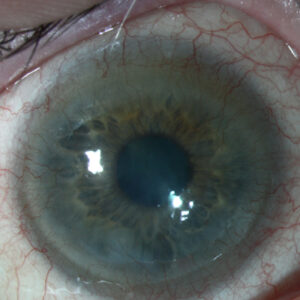
Cataract: Opening Doors
Winter 2025
by Liz Hillman
Editorial Co-Director
Patients with disabilities can experience unique challenges when in need of cataract surgery, but some ophthalmologists who find themselves being referred these patients say the challenge for the patient often begins before they ever sit in an exam chair. This vulnerable patient population can face distinct ethical, logistical, and systemic barriers to care.
Danielle Ledoux, MD, said patients with disabilities, especially cognitive and mental ones, are “no different than any other patient population, but the means by which you gather information is a little different,” causing some physicians to think they don’t have the capability or capacity to treat these patients. “So, I think there’s a care gap,” Dr. Ledoux said.
… there is no greater satisfaction than giving someone who could potentially not advocate for themselves the ability to receive the same healthcare as everyone else and give them their sight back.
Rosa Braga-Mele, MD
Rosa Braga-Mele, MD, said it’s easy to look at a person with a disability and think about how they’re going to need more of your time and/or be more challenging. “But what I think about is everyone deserves the same level of care. It may take me a little extra time, and it may be more of a challenge or require more planning and logistics, but there is no greater satisfaction than giving someone who could potentially not advocate for themselves the ability to receive the same healthcare as everyone else and give them their sight back. You can change their world completely.”
Barrier 1: understanding vision-specific quality of life
The first and perhaps most overlooked barrier to care for patients with disabilities, especially those who are neurodiverse or have cognitive disabilities, is the assessment. How do you determine visual disability in a patient who is non-speaking or has difficulty communicating?
“We don’t train people in how to understand vision-specific quality of life for someone who’s non-speaking,” said Susannah Rowe, MD, MPH. “We need to understand what people do with their eyesight when they don’t do paid work, they don’t read, and they don’t go to school.”
Without clear metrics for benefit—and with the potential for increased risk—the ethical path forward could be non-intervention. “The safest thing to say, because we’re taught ‘First, do no harm,’ is ‘Let’s just not do this.’ But that doesn’t serve the person who can’t see,” Dr. Rowe said.
Instead, Dr. Rowe advocates for a broader, more inclusive understanding of quality of life. “Do they like to go for a drive with their sister? Do they enjoy a TV show? Did they stop walking, potentially because they can’t see anymore? These are the markers we need to consider. It’s arguably even more important for someone who can’t tell you that directly.”
In many cases, input from family members and caregivers becomes essential. Their observations—changes in routine, loss of interest in activities, increased anxiety—can reveal the silent toll of cataract-related vision loss.
Madhura Shah, MD, a second-year resident, said there isn’t training in medical school for how to assess patients’ vision-related quality of life when they can’t communicate in the typical way. “We have a pretty rigid checklist in medical school for a primary care visit … but in this setting, I was seeing that you have to take a step back and try to understand why the patient is there and what needs to be done to improve their care,” Dr. Shah said.
The benefit of restoring vision for these patients can go beyond expectations. One of Dr. Rowe’s patients—a man with Down syndrome in his 50s—had been diagnosed with dementia prior to surgery, she recalled.
“He had white cataracts, and after surgery, his ‘dementia’ disappeared. It turned out that he didn’t have dementia; he just couldn’t see, and he couldn’t tell anyone. He started walking again, lost weight, the skin infections in his abdominal folds cleared up. He was no longer in a wheelchair,” she said, giving this as an example of the profound impact of restored vision.
Dr. Ledoux shared a similar anecdote of a boy who had cognitive impairment who had his cataracts removed by another pediatric ophthalmologist. When the patch and shield were taken off at a postop appointment, the boy, who had been wheelchair dependent, got up and walked out of the room. “The entire reason he was wheelchair dependent was that he’d stopped being able to see comfortably,” Dr. Ledoux said.
Dr. Ledoux said she sees this population as “a group of people who just needs regular care. Once you have a sense for the person and the family, when it comes time to take out their cataracts or whatever needs to be done [to improve their vision], it’s the same as any patient. It just takes a little longer—and I don’t think every part is longer. The biggest thing is patience and using different methodology for getting their vision checked.”
Barrier 2: risk assumptions and surgical feasibility
Even when need is established, perceived surgical risk can halt progress. Patients who are neurodiverse, non-speaking, or have behavioral conditions may not tolerate shields, postop drops, or standard protective protocols.
Dr. Rowe said she has performed more than 250 surgeries on such patients without postop patches or shields—and without complications. “We’re trying to help surgeons understand that it’s possible to do this work safely,” Dr. Rowe said. “The idea that something terrible is definitely going to happen if a patient doesn’t wear a shield or even if they rub their eyes isn’t supported by our evidence.”
Technological advances support this safer environment as well. “Sutureless, clear cornea surgery changed everything,” Dr. Rowe explained. “Highly effective phaco technology, intracameral antibiotics, and a truly atraumatic surgical technique mean that many of our patients don’t need steroids postop, and since we don’t put in stitches, we don’t need to take patients back to the OR later to remove them. The surgeries are gentler, faster, and more forgiving than they were even 10 years ago.”
Still, it requires effort—and a mindset shift, she said. Surgeons may need to operate standing up or adapt microscope positioning for patients who cannot lie flat. “I do cataract surgery standing up about once a month,” Dr. Rowe said. “It’s about meeting patients where they are, not asking them to accommodate to us.”
When Dr. Braga-Mele has a patient who is neurodiverse or has a mental disability, she said it can be hard to perform the examination and get biometry. Intraoperative aberrometry can be helpful in these cases, but if not available, you may have to use an average lens power. “You’re trying to make them better. If they have to wear glasses, it’s not the end of the world,” Dr. Braga- Mele said.
She added that some of these patients will require general anesthesia, and if they do, she’ll also consider bilateral same-day cataract surgery. Dr. Braga-Mele said she carefully cleans the capsule for these cases to reduce the risk of PCO (and thus later YAG). Even with small incision surgery, for these patients she will still use a suture at the end of the case.
Another issue is drops. Dr. Braga-Mele said too many drops (an antibiotic, steroid, and non-steroidal) can be challenging for the patient and their caregivers. Dr. Braga-Mele said a combination drop, avoiding an NSAID altogether, or intracameral antibiotics could be considered.
Barrier 3: economic disincentives and lack of confidence limiting access
Perhaps the most entrenched barrier is systemic: Economic structures in many ways disincentivize care for patients who fall outside the surgical norm, Dr. Rowe said.
“There are very real economic barriers,” she added. “Cataract surgery reimbursements are going down. Exceptions for complex surgery don’t apply to these patients because they’re tied to specific intraoperative tools, not time or expertise.”
A neurodiverse patient’s surgery might require more than 2 hours, yet reimbursement is the same as a more typical case, Dr. Rowe said. “We don’t have a mechanism to acknowledge that there’s a difference financially when taking care of these patients.”
She said she gets emails every week from patients around the U.S. who can’t find a surgeon to perform cataract surgery in their hometown. The result is a hollowing out of access. “These patients are covered by Medicaid, but if there’s no reciprocity, they can’t get surgery in Massachusetts. Transporting them across states is traumatic and often unfeasible.”
Dr. Ledoux said patients with mild to moderate cognitive delays and mental differences should be incorporated into their community ophthalmic and optometric practices. “We don’t want to see people’s lives decline because of unrecognized conditions that are easily intervenable like cataracts,” Dr. Ledoux said.
Dr. Shah recalled her department getting an email inquiry from the family of a woman in her 30s with special needs. They were having trouble finding an ophthalmologist in their Los Angeles suburb who would approach the surgery. Dr. Shah thinks ophthalmologists should get more exposure to cases involving patients with disabilities during residency so they might be more comfortable caring for them once in practice.
“Once while on call, I saw a 13-year-old with a developmental delay,” Dr. Shah said. “I think we all get very nervous and fall back to what we’re taught to do in medical school, which is again that very rigid outline of how we’re supposed to attain information. … I’m so grateful to have had this experience because instead of getting nervous, I view it as a liberating kind of thing. … We’re going to gather all the clues that we can. And if we don’t have any objective data, that’s OK because we’ll try to understand how they’re experiencing the world around them. Even if that’s different information, we’ll use it to come to the same kind of questions about diagnosis and treatment that we would have otherwise.”
A call to surgeons
To surgeons across the country, Dr. Rowe offered this message: “We need to do better. This is a national problem. There are thousands of patients like this who deserve access to high-quality care.”
The path forward will require advocacy, updated reimbursement codes, and better training. “You can’t build capacity when you’re trying to convince people to do something they’ll lose money on,” Dr. Rowe said.
But there is also a call for professional introspection.
“Our field has become so routinized that we sometimes forget we are still doctors. The question we must ask ourselves is: Are we using all of our training and expertise to truly meet our patients where they are?” Dr. Rowe said.
“Vision decline means something to the way [patients with mental or cognitive delays] function in life, as it does to all of us,” Dr. Ledoux said. “Perhaps because they also have these differences, they may have a harder fall when their vision starts to worsen. … Our role in helping improve these people’s lives is perhaps greater. I want [ophthalmologists] to feel inspired to do it.”
Article Sidebar
More education
Dr. Ledoux and Dr. Rowe recommended an online training module created by the Massachusetts Department of Public Health and the Massachusetts Department of Development Services.
“Ensuring Equitable Access to Vision Health Care for Individuals with Intellectual and Developmental Disabilities” is a free, on-demand resource. Click here to view the sessions.
Article Sidebar
Pearls for patients with disabilities
From Dr. Shah
- Observe how the patient interacts with their surroundings.
- Go out to the waiting room to get the patient yourself and watch them as they walk back with you. Observe their gait, if they shake your hand, etc.
From Dr. Ledoux
- Suture them all. You don’t want to worry about eye rubbers or accidental trauma.
- Consider dropless cataract surgery.
- Shield them for longer.
- If there is posterior haze present at the end of the case, consider performing a posterior capsulorhexis to avoid a later YAG.
- Have shiny or spinning objects in your office to help a patient focus so you can get a look at the retina.
Article Sidebar
Opening Doors

When asked about “opening doors,” Jonathan Rubenstein, MD, EyeWorld Cataract Editorial Board member, said he is excited to see developments in upcoming cell therapies in cornea, both cultured epithelial limbal stem cells and injection therapies of corneal endothelial cells to treat endothelial cell deficiency.
About the physicians
Rosa Braga-Mele, MD
Professor of Ophthalmology
University of Toronto
Toronto, Canada
Danielle Ledoux, MD
Specialized Pediatric Eye Care
Beverly, Massachusetts
Susannah Rowe, MD, MPH
Assistant Professor of Ophthalmology & Vision Sciences
Boston University Chobanian & Avedisian School of Medicine
Beverly, Massachusetts
Madhura Shah, MD
PGY-2
Weill Cornell Medicine
New York, New York
Relevant disclosures
Braga-Mele: None
Ledoux: None
Rowe: None
Shah: None
Contact
Braga-Mele: rbragamele@rogers.com
Ledoux: dledoux@specializedpediatriceyecare.com
Rowe: susannah.rowe@bmc.org
Shah: madhura.shah7@gmail.com