Browse articles from EyeWorld.org related to toric lenses. EyeWorld is the award-winning member publication of ASCRS. The magazine provides news and updates from the Society as well as clinical features in the areas of cataract, refractive, cornea, glaucoma, and practice management. It publishes quarterly with editorial direction from its medical editorial board and staff.

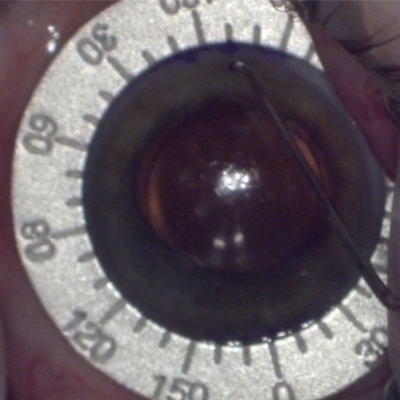
Belt and suspenders approach: Callisto and iris fingerprinting photos on the microscope for accurate alignment of toric lenses
Source: Robert Osher, MD
Manual marking, digital marking, manual and digital marking—toric IOL alignment methods continue to be an important topic. Both methods still have a place, and both have their pros and cons. Four physicians discussed their preferences.
Ophthalmology residents from Washington University in St. Louis reviewed “The effects of axis-flip of the refractive cylinder on vision and patient-reported outcome measures following toric intraocular lens implantation” from the Journal of Cataract & Refractive Surgery.
While there a lot of different technologies that can give patients excellent refractive results after cataract surgery, this area keeps expanding and improving. As more options become available, it increases the complexity of talking to patients. This is what the symposium Having “The Talk” focused on at the 2024 ASCRS Annual Meeting.
The rotational stability of toric IOLs and reposition rates have been well studied and reported. In most cases, any rotation that occurs postop is usually 5 degrees off axis or less. Four ophthalmologists shared their thoughts on the prevention and management of this issue.
Precise placement and subsequent stability of a toric IOL are of the utmost importance for success in correcting astigmatism. Capsule tears can threaten both factors. So what do you do when a capsule tear occurs during cataract surgery where you planned to implant a toric IOL?
The Weill Cornell ophthalmology residents reviewed “Real-world incidence of monofocal toric intraocular lens repositioning: analysis of the American Academy of Ophthalmology IRIS Registry” from the Journal of Cataract & Refractive Surgery.
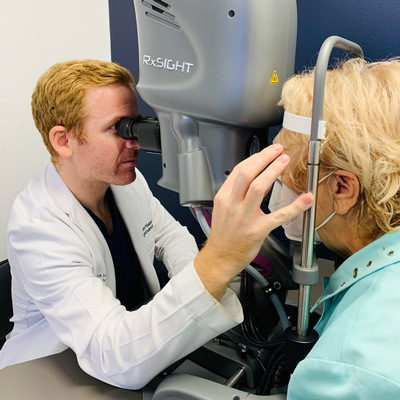
Dr. Naids uses the Light Delivery Device.
Source: Steven Naids, MD
The Light Adjustable Lens (LAL, RxSight) offers the unique opportunity to lock in the preferred vision after surgery. With recent updates, the technology can be an attractive option for a variety of refractive cataract patients. Several surgeons discussed how they use this IOL in their practice.
Glaucoma should not necessarily be an immediate contraindication to premium cataract surgery technologies, such as toric and presbyopia-correcting IOLs and FLACS. Reay Brown, MD, Paul Harasymowycz, MD, and Joey Hsia, MD, said there are situations where these IOL technologies are suited for glaucoma patients, but the decision to offer them is not as straightforward.
When it comes to premium lenses, patients have high expectations for great outcomes. Three physicians discussed some of the technologies they use preoperatively, intraoperatively, and postoperatively to help achieve excellent outcomes.
How to manage toric IOL rotation postoperatively and preventative measures to take intraoperatively