Browse articles from EyeWorld.org related to IOLs. EyeWorld is the award-winning member publication of ASCRS. The magazine provides news and updates from the Society as well as clinical features in the areas of cataract, refractive, cornea, glaucoma, and practice management. It publishes quarterly with editorial direction from its medical editorial board and staff.
➤ PMA submitted to FDA for small-aperture IOL
➤ Preclinical results for new class of non-prostaglandin analogs for IOP lowering
➤ A Phase 2 clinical trial begins enrollment for topical presbyopia-correcting drop
➤ Home OCT technology used in clinical trial to reduce participant visits to offices
➤ ASCRS Journal Club on March 11
➤ 2021 ASCRS Annual Meeting update
➤ FDA approves new monofocal IOL
➤ First patient dosed in Phase 2 trial for investigational DED therapy
➤ Phase 2a trial initiated for add-on wet AMD therapy
➤ Commercial launch of Alcon’s Vivity IOL
➤ Topline results from Phase 2 trial for treatment of contact lens discomfort
➤ Company registers new artificial intelligence visual field exam device with FDA
➤ Positive Phase 3 results for faricimab for DME
➤ Research begins to create a MIGS patient-reported outcomes instrument
➤ ASCRS events
Cataract surgery is one of the most common surgeries performed annually and is only expected to increase in coming decades due to an aging population. Despite advances in surgical technique, which have significantly improved efficiency, patient safety, and predictability of cataract surgery refractive outcomes, postoperative visual disturbances such as dysphotopsias continue to be a significant contributor to patient dissatisfaction, even in routine cases performed by experienced surgeons.

Dislocated single-piece IOL
Source: Karolinne Maia Rocha, MD, PhD
In some cases, it may be necessary to refixate or remove an IOL after cataract surgery. Several surgeons discussed how they determine when this course of action is needed and techniques they use.
Patients often seek their ophthalmologist’s expert opinion for the IOL they would recommend if they were in the patient’s situation. As a resident at Northwestern University, Hercules Logothetis, MD, and his mentor Robert Feder, MD, actually asked ophthalmologists about the technology they would choose for themselves.1
Monovision is a proven and trustworthy option to attain spectacle independence in patients undergoing cataract surgery. According to Ehud Assia, MD, the best results are attained by waiting for the outcomes of the first-eye surgery before moving on the create monovision.
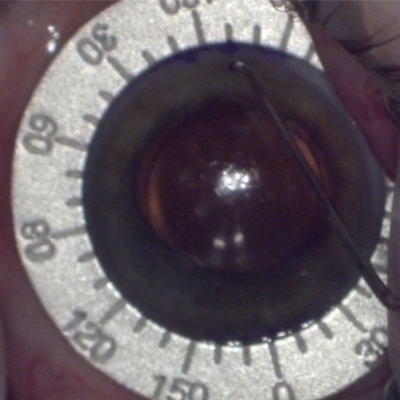
How to manage toric IOL rotation postoperatively and preventative measures to take intraoperatively
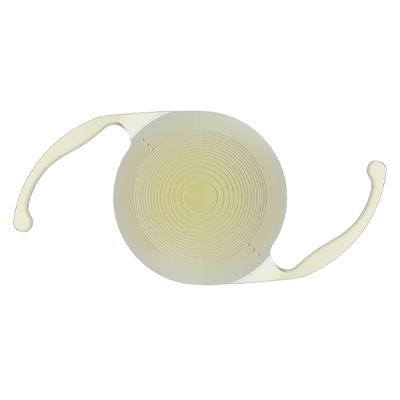
When multifocal lenses were first introduced, they were heralded as a means of providing both near and distance vision improvements for patients undergoing cataract surgery. These IOLs feature two main foci, but patients continually demanded better intermediate vision. In today’s world, one could argue intermediate vision is even more crucial than near for performing daily tasks such as using a computer, tablet, or smartphone.
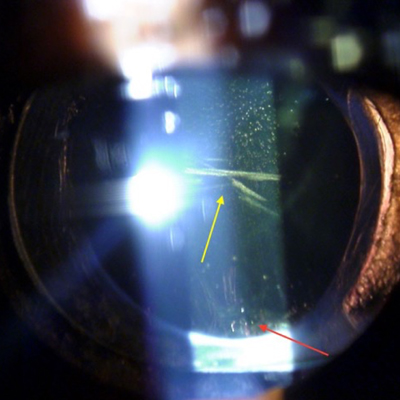
Eric Donnenfeld, MD, Rockville Centre, New York, said: This patient has three significant problems that are all likely contributing to his problem of glare and halo: IOL opacifications, hyperopic refractive error, and a fixed dilated pupil. The cataract surgery was otherwise done well and the 1-piece acrylic IOL is in the bag.