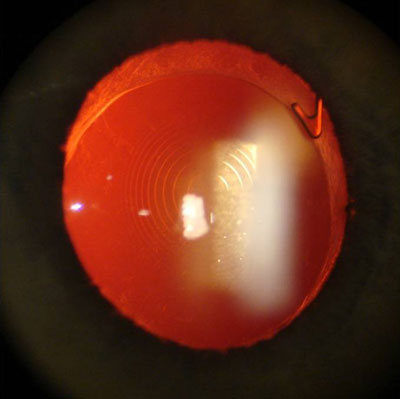
Browse articles from EyeWorld.org related to IOLs. EyeWorld is the award-winning member publication of ASCRS. The magazine provides news and updates from the Society as well as clinical features in the areas of cataract, refractive, cornea, glaucoma, and practice management. It publishes quarterly with editorial direction from its medical editorial board and staff.
The correction of high myopia is limited, but phakic IOLs do provide a surgical option. "For many years we have been looking for a quality anterior chamber phakic IOL that could be easily performed in a clean room rather than an operating room," said Eric D. Donnenfeld, MD, partner at Ophthalmic Consultants of Long Island, Rockville Centre, N.Y., and clinical professor of ophthalmology, New York University Medical School.
The visual disturbances exacerbated by ocular surgery can range from annoying to disabling.
The best way to treat negative dysphotopsia remains a hot topic among surgeons. Negative dysphotopsia that occurs right after cataract surgery is usually best left to resolve on its own. However, if the problem continues a few months after surgery, ophthalmologists must step in to provide a treatment. Their treatment approach usually depends on what they suspect is the cause.
A look at the pros/cons of monofocal vs. multifocal IOLs with a focus on a head-to-head comparison study conducted in 2011.
Research has shown that best-corrected visual acuity isn’t much different between aspheric and spherical IOLs after cataract surgery. One report looked at differences between an aspheric IOL and a spherical IOL.
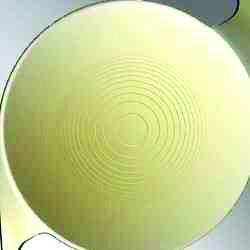
ReSTOR lens
Source: Alcon
Ever since their conception, multifocal intraocular lenses (IOLs) have been measured against their predecessor, monofocal lenses. With the appearance of accommodating lenses on the market in recent years, inevitable comparisons are now being drawn between multifocal lenses and the latest advancement in IOL technology. EyeWorld takes a look at the pros and cons of the lenses.
Each multifocal IOL design uses a different strategy to produce simultaneous near and distance images. Experimental work suggests that the optic design makes a difference for night vision.