Browse articles from EyeWorld.org related to refractive surgery. EyeWorld is the award-winning member publication of ASCRS. The magazine provides news and updates from the Society as well as clinical features in the areas of cataract, refractive, cornea, glaucoma, and practice management. It publishes quarterly with editorial direction from its medical editorial board and staff.
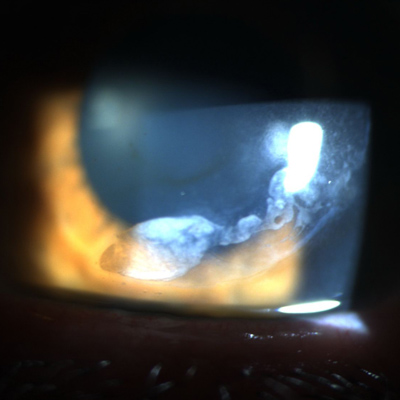
Epithelial ingrowth that occurred after a LASIK flap was relifted for an enhancement Source: Preeya K. Gupta, MD
Results of a study showed that for LASIK patients needing enhancement for which a flap lift may be difficult, PRK is safe and effective.
The correction of high myopia is limited, but phakic IOLs do provide a surgical option. "For many years we have been looking for a quality anterior chamber phakic IOL that could be easily performed in a clean room rather than an operating room," said Eric D. Donnenfeld, MD, partner at Ophthalmic Consultants of Long Island, Rockville Centre, N.Y., and clinical professor of ophthalmology, New York University Medical School.
What can be done for patients with post-LASIK corneal neuralgia?
Refractive lens exchange is a growing treatment option in the U.S., with hyperopic presbyopes over age 50 being the ideal candidates. Physicians stress the importance of patient education for this procedure.
Pre-existing strabismus and a family history of this are two red flags to look for when trying to head off diplopia in cataract patients, according to Kammi B. Gunton, M.D., assistant surgeon, Wills Eye Institute, Philadelphia. Investigators led by Dr. Gunton reported on the incidence and causes of diplopia following cataract and refractive surgery in the September 2010 issue of Current Opinions in Ophthalmology.
Making sense of an unusual occurrence
Diffuse lamellar keratitis (DLK) results in the accumulation of inflammatory cells in the interface between the LASIK flap and corneal stroma, and can be one of the most serious complications of LASIK if not treated quickly and properly.
For the treatment of dry eye syndrome, punctal plugs are an important tool. Fortunately, serious complications with the use of these plugs are extremely rare. However, like any medical procedure, it does have some risks. According to Robert Maloney, MD, after refractive surgery many patients have reduced tear production and complain of symptomatic dry eyes.
Ophthalmologists must navigate through uncharted areas when they treat their pregnant patients.
Investigators study how autoimmune patients fare with LASIK.