Browse articles from EyeWorld.org related to dysphotopsia. EyeWorld is the award-winning member publication of ASCRS. The magazine provides news and updates from the Society as well as clinical features in the areas of cataract, refractive, cornea, glaucoma, and practice management. It publishes quarterly with editorial direction from its medical editorial board and staff.
Ophthalmology is constantly evolving to meet new and unmet needs. EyeWorld asked members of its Cataract Editorial Board and the ASCRS Cataract Clinical Committee to weigh in on: If I could ask industry to produce one new product, this is what it would be and why.
➤ Study: Specific form of AMD linked to high risk of heart disease
➤ Primary endpoints achieved in study of dry eye therapy
➤ First patient enrolled in study for new pharmacologic presbyopia therapy
➤ Company submits IND for advanced AMD treatment candidate
➤ Acquisition of topical dosing technology
➤ Patent granted for oral drug candidate targeting retinal diseases
➤ Complimentary access to video journal
➤ ASCRS news and events
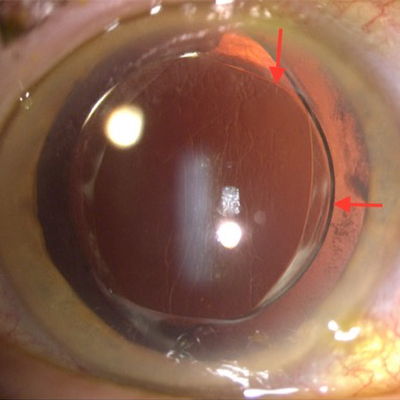
Slit lamp photo of secondary reverse optic capture with the optic prolapsed over the nasal and temporal capsule and the haptics in the capsule bag
Source: Nicole Fram, MD
Negative dysphotopsia is an issue that patients may face following cataract surgery. While it frequently resolves on its own, several physicians said it’s important to discuss it with patients and explain what’s going on.
Cataract surgery is one of the most common surgeries performed annually and is only expected to increase in coming decades due to an aging population. Despite advances in surgical technique, which have significantly improved efficiency, patient safety, and predictability of cataract surgery refractive outcomes, postoperative visual disturbances such as dysphotopsias continue to be a significant contributor to patient dissatisfaction, even in routine cases performed by experienced surgeons.
Missed target, dysphotopsia, malpositioning, patient dissatisfaction: There is a myriad of reasons for an IOL exchange. In these cases, the surgeon needs to give the patient hope for a better outcome while also setting realistic expectations.
The best way to treat negative dysphotopsia remains a hot topic among surgeons. Negative dysphotopsia that occurs right after cataract surgery is usually best left to resolve on its own. However, if the problem continues a few months after surgery, ophthalmologists must step in to provide a treatment. Their treatment approach usually depends on what they suspect is the cause.
The visual disturbances exacerbated by ocular surgery can range from annoying to disabling.