January 2018
Cataract: YES connect
by Liz Hillman
EyeWorld Staff Writer

Patient expectations for cataract surgery are growing at a feverish pace. While the tools to deliver exceptional refractive outcomes are also increasing, there will inevitably be unhappy patients with suboptimal outcomes along the way. Current solutions include excimer corneal ablation, IOL exchange/reposition, and piggyback lenses. Choosing between these options is not always easy.
Surgeons attempting IOL exchange must be prepared for various complications and surgical situations. Picking a lens for exchange requires an understanding of what went wrong in the first place. Sometimes it is a matter of toricity axis error; other times there was a pre-operative measurement error.
In this month’s “YES connect” column Nicole Fram, MD and Zaina Al-Mohtaseb, MD, share how they prepare for and execute an IOL exchange. Every IOL exchange surgery is different, which can be intimidating for young surgeons. However, solving the intraoperative puzzle for each case can be rewarding and these patients often become practice builders who outwardly appreciate your surgical expertise.
—Zachary Zavodni, MD, YES connect co-editor
Tips and tricks for determining when and how to perform IOL exchange
Missed target, dysphotopsia, malpositioning, patient dissatisfaction: There is a myriad of reasons for an IOL exchange.
In these cases, the surgeon needs to give the patient hope for a better outcome while also setting realistic expectations, said Nicole Fram, MD, clinical instructor of ophthalmology, David Geffen School of Medicine, Jules Stein Eye Institute, University of California, Los Angeles.
According to one study that looked at multifocal IOL exchanges in 35 eyes, 60% had blurred vision as the surgical indication for exchange, 57% experienced photic phenomena, 9% had photophobia, 3% had a loss of contrast sensitivity, and 29% had multiple complaints.1
Zaina Al-Mohtaseb, MD, assistant professor, Baylor College of Medicine, Houston, said it’s important to explain to IOL exchange patients that there’s a higher risk for complications compared to their initial cataract surgery and that they might require further surgeries in the future.
Exchange assessment
Dr. Fram said it’s important for the physician to distinguish among issues arising from corneal pathology, neuropathy, or retinopathy. “The first steps … include a careful refraction, ocular surface and slit lamp evaluation, and dilated fundus exam. Ancillary testing, such as corneal topography, endothelial cell counts, macular SD-OCT, and retinal acuity meter, are critical to planning and diagnosis of comorbid conditions,” Dr. Fram said.
While a missed refractive target may be addressed with PRK or LASIK enhancement, if the patient already had multiple laser treatments or severe dry eye, an IOL exchange may be preferred, Dr. Fram said.
Dr. Al-Mohtaseb calculates a new refractive power by measuring topography and biometry and considers the remnant refractive error from the original implanted lens.
“We looked at the refractive outcomes of our multifocal IOL exchange and noted that by considering the IOL calculations and refractive outcomes of the original cataract surgery when choosing the second IOL, the mean numerical and absolute refractive prediction errors were significantly lower,” Dr. Al-Mohtaseb said.
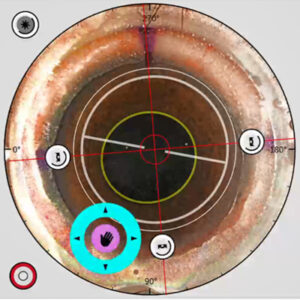
Dr. Fram also tries to get some of the original calculations and baseline information from referring doctors, in addition to running her own biometry, corneal topography, and refraction. Using the refractive vergence formula may be inconvenient for some surgeons. One can calculate the new IOL biometry in a pseudophakic setting or use the Barrett Rx formula, which requires the patient’s new and old biometry. For bag-to-bag exchange, one can use a shortcut by multiplying the refractive error spherical equivalent by 1.2 for a myopic error or 1.5 for a hyperopic error to obtain the new IOL power. Additionally, intraoperative aberrometry can be useful when the patient is aphakic or when there is a clean bag-to-bag exchange of a PCIOL.
Patients with positive or negative dysphotopsias require a “more complex discussion,” Dr. Fram said. A negative dysphotopsia can be improved by performing reverse optic capture, elevating the optic above the anterior capsule, while positive dysphotopsias are often improved by changing the IOL design from a square edge to round or switching from an acrylic to a silicone or collamer lens. Unfortunately, there are no truly round IOLs on the market, and changing the material is the best approach at this time.
Dr. Fram and Dr. Al-Mohtaseb cautioned about IOL exchange with an open posterior capsule. Dr. Al-Mohtaseb said if the posterior capsule is open, anterior vitrectomy might be needed, and a part of the lens should be grasped or stabilized with a pars plana safety basket suture or “Masket basket” to avoid dropping it during IOL manipulation. Dr. Fram said if there is no capsule support or basket suture, she’ll leave the bisected optic connected just until the end to avoid losing it.
How to manage the exchange
Incision location should be considered when approaching IOL exchange, Dr. Fram said. For bag-to-bag IOL exchange, a temporal clear corneal incision more than 3 months postop may be difficult to open or too anterior, thus favoring a superior limbal or scleral tunnel.
From there, Dr. Fram said several paracenteses should be made to provide 360 degrees of access to the IOL. Elevate the anterior capsule with a dispersive OVD on a cannula. Once you see the OVD track posterior to the optic, you can begin viscodissection of the haptic/optic junction, which Dr. Fram said can be an area of significant fibrosis. One should avoid rotating the IOL to reduce stress on the zonules and gently lift up instead.
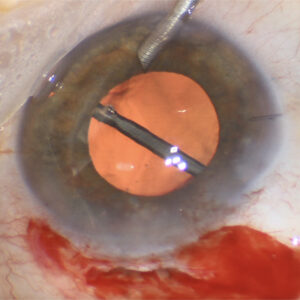
Afterward, prolapse the IOL into the anterior chamber. Dr. Fram said the IOL can be folded, using forceps, over a long spatula 180 degrees away from the main 3 mm incision, or the haptics can be amputated with microsurgical scissors, taking precautions to remove the optic only and leave the cut end of the haptics in the bag.
“Interestingly, manipulation and removal of the retained haptics is easier once the optic is removed,” Dr. Fram said. “If the entire IOL is removed, the surgeon should remember to dissect and reinflate the capsular bag with OVD to ensure it is open to the equator. If the previous haptics must remain, the new IOL can be placed in the sulcus with optic capture as long as the anterior capsule remains curvilinear and properly sized.”
After freeing the optic and haptics, Dr. Al-Mohtaseb uses a Sinskey hook in addition to the OVD cannula to lift the lens into the anterior chamber. She prefers to cut the lens in half, while holding it with forceps, and leaves one haptic out of the wound to avoid losing it until it’s removed through the wound. Sometimes, Dr. Al-Mohtaseb will insert the new IOL underneath the original one to act as a platform during the cutting of the old lens.
If it’s a toric IOL, websites like astigmatismfix.com or other devices can help surgeons decide whether the lens needs to be rotated or exchanged. If it needs to be exchanged, Dr. Fram said the ideal time is between 1 and 3 weeks postop. Dr. Al-Mohtaseb said prior to rotating a toric she’ll mark its current axis and the new axis. Dr. Fram added that the key to toric IOL exchange is removing all OVD. For this reason, she prefers ProVisc (sodium hyaluronate, Alcon, Fort Worth, Texas) because it comes out easier than a dispersive and can be used with intraoperative aberrometry.
Fixating a new IOL
In some cases, the new IOL cannot be placed within the capsular bag, necessitating another fixation technique. Dr. Al-Mohtaseb mentioned research that showed similar outcomes among iris sutured, scleral sutured, and anterior chamber IOL techniques.2
Her preferred technique is the flanged intrascleral double-needle technique pioneered by Shin Yamane, MD, Yokohama, Japan. Benefits of this technique are its small wound; its potential to use an already implanted three-piece lens or other off-the-shelf lens; and its elimination of potential suture exposure, among other reasons.
If the bag cannot be saved with a capsular tension ring or ring segments, Dr. Fram said her fixation technique depends on the degree of capsule support. If there is diffuse zonulopathy and an intact anterior or posterior curvilinear capsulorhexis, one could place haptics in the sulcus and optic capture through the anterior or posterior capsulotomy as described by Howard Gimbel, MD, and popularized by David F. Chang, MD, and Lisa Arbisser, MD.3
If there is more than 270 degrees of capsule support and poor zonules not amendable to a CTR or optic capture, a lens could be put in the sulcus and haptics sutured to the iris using 10-0 polypropylene in a McCannel or Siepser fashion, which Dr. Fram said would ensure centration of the IOL over time.
Finally, if there is no capsule viability and it needs to be removed, Dr. Fram advised a triamcinolone-assisted pars plana anterior vitrectomy and intrascleral haptic fixation, using either the Yamane or glued IOL technique or scleral suture fixation with off-label Gore-Tex.
Final tips for young eye surgeons
In cases of IOL exchange, Dr. Fram said one should go slowly and have a plan A, B, and C at the ready. New techniques should be practiced with a simulated eye model before heading to the OR, she added.
“The most important thing is to know your own limits,” Dr. Al-Mohtaseb said. “If there is significant zonular loss or if the IOL I want to remove is too dislocated (which I can tell when I lay the patient back in clinic), I ask my retina colleagues to do a combined case with me in which they remove the lens and I insert the secondary IOL using the Yamane technique. It is always better to be safe than heroic in these cases.”
References
- Kim EJ, et al. Refractive outcomes after multifocal intraocular lens exchange. J Cataract Refract Surg. 2017;43:761–766.
- Brunin G, et al. Secondary intraocular lens implantation: Complication rates, visual acuity, and refractive outcomes. J Cataract Refract Surg. 2017;43:369–376.
- Gimbel HV, et al. Intraocular lens optic capture. J Cataract Refract Surg. 2004;30:200–6.
Editors’ note
The physicians have no financial interests related to their comments.
Contact information
Al-Mohtaseb: zaina@bcm.edu
Fram: nicfram@yahoo.com