Browse articles from EyeWorld.org related to complications in ophthalmology. EyeWorld is the award-winning member publication of ASCRS. The magazine provides news and updates from the Society as well as clinical features in the areas of cataract, refractive, cornea, glaucoma, and practice management. It publishes quarterly with editorial direction from its medical editorial board and staff.
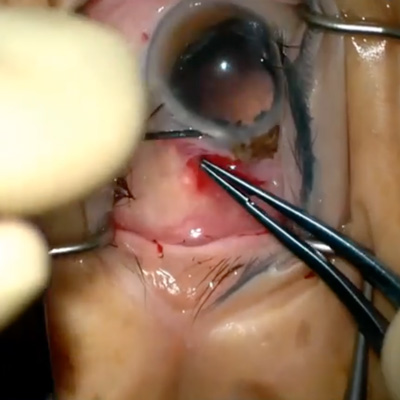
Dr. Rao experienced iris prolapse at the start of a cataract case involving a nanophthalmic eye. Despite several management efforts, the iris continued to come out of the wound. Dr. Rao applied lessons learned in this first eye when he operated on the second.
Source: Naveen Rao, MD
Iris prolapse can occur at any time during cataract surgery when the pressure inside the eye is higher than the pressure outside and when there is an open wound. Naveen Rao, MD, shared a complicated case involving iris prolapse, and Michael Snyder, MD, offered commentary on risk factors and how to handle such a case if it occurs.
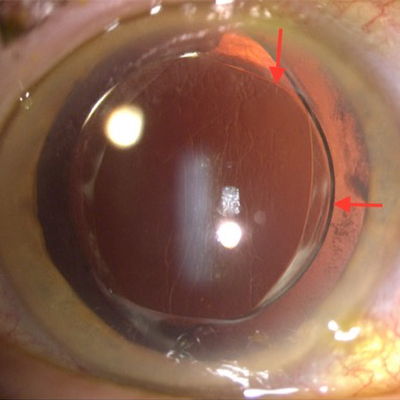
Slit lamp photo of secondary reverse optic capture with the optic prolapsed over the nasal and temporal capsule and the haptics in the capsule bag
Source: Nicole Fram, MD
Negative dysphotopsia is an issue that patients may face following cataract surgery. While it frequently resolves on its own, several physicians said it’s important to discuss it with patients and explain what’s going on.

Nathan Radcliffe, MD
Glaucoma Editor
Nathan Radcliffe, MD, shared his thoughts on the management of glaucoma and previewed the articles in the section.
A tube shunt erosion or exposure is a complication that can occur oftentimes many years after surgery. Several experts discussed what to look for, why this complication occurs, and how to address it.
A patient may be at risk for a bleb leak after trabeculectomy, either in the early postop period or years after surgery. One surgeon shared considerations for this potential complication, how she monitors patients, and what to do if a bleb leak does occur.
Malignant glaucoma is a rare complication, but it’s still something surgeons need to be on the lookout for after surgery, especially in the early postoperative period.
“Ophthalmology Quicksand Chronicles,” an ASCRS podcast hosted by Nicole Fram, MD, and Elizabeth Yeu, MD, features an expert guest on each episode who shares their “quicksand moments” in the OR, lessons learned from those moments, and how these vulnerable situations ultimately helped them evolve as surgeons.
“Ophthalmology Quicksand Chronicles,” an ASCRS podcast hosted by Nicole Fram, MD, and Elizabeth Yeu, MD, features an expert guest on each episode who shares their “quicksand moments” in the OR, lessons learned from those moments, and how these vulnerable situations ultimately helped them evolve as surgeons.
Dropped nuclei are one of the more unpleasant complications that can happen during cataract surgery. While uncommon, the consequences of a dropped nucleus are significant. Three experts shared their experiences and management strategy.
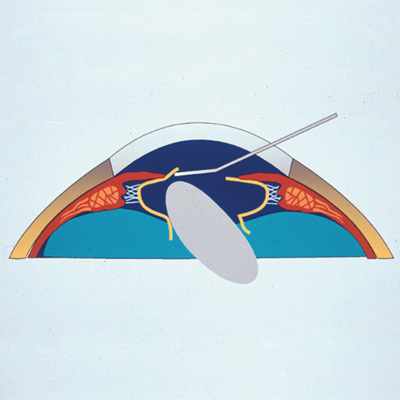
Hydrorupture of posterior capsule; the nucleus does not usually drop immediately, only when the phaco tip is inserted, pressurizing the anterior chamber
Source (all): Ronald Yeoh, MD
Ronald Yeoh, MD, first coined the term “pupil snap sign” in 1996. Since then, he has been calling attention to the somewhat subtle sign to help surgeons recognize when there has been a posterior capsule rupture that puts the nucleus at risk of dropping into the vitreous.