All articles from EyeWorld.org on the topic of cataract surgery. EyeWorld is the award-winning member publication of ASCRS. The magazine provides news and updates from the Society as well as clinical features in the areas of cataract, refractive, cornea, glaucoma, and practice management. It publishes quarterly with editorial direction from its medical editorial board and staff.
➤ New visual prosthesis heads to clinical trial
➤ FDA grants Fast Track designation to investigational wet AMD therapy
➤ Patient enrollment complete in Phase 3 trial for investigational, first-in-class eye drop for DED
➤ FDA agrees to pivotal trial design for investigational treatment of geographic atrophy secondary to AMD
➤ ASCRS news and events
Matthew Santos, MD, ophthalmology resident, Washington University in St. Louis, summarizes “Effect of anti- inflammatory regimen on early postoperative inflammation after cataract surgery” from the March issue of the Journal of Cataract & Refractive Surgery.
Three physicians discuss how they help patients on their journey as they seek out a toric or presbyopia-correcting IOL.
Dropped nuclei are one of the more unpleasant complications that can happen during cataract surgery. While uncommon, the consequences of a dropped nucleus are significant. Three experts shared their experiences and management strategy.
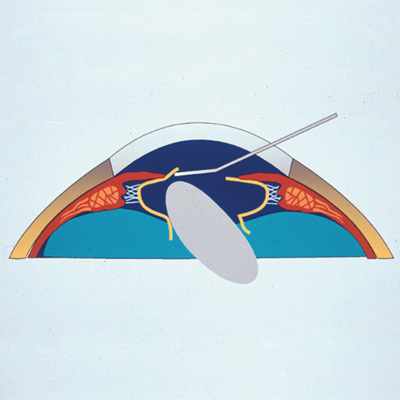
Hydrorupture of posterior capsule; the nucleus does not usually drop immediately, only when the phaco tip is inserted, pressurizing the anterior chamber
Source (all): Ronald Yeoh, MD
Ronald Yeoh, MD, first coined the term “pupil snap sign” in 1996. Since then, he has been calling attention to the somewhat subtle sign to help surgeons recognize when there has been a posterior capsule rupture that puts the nucleus at risk of dropping into the vitreous.
When a patient comes in prior to cataract surgery, it’s important to do a careful evaluation to see what conditions they might have and how this could impact IOL selection. Two physicians discussed conditions to be aware of when considering presbyopia-correcting IOLs and how to talk to patients prior to surgery.
➤ FDA approves elements of artificial vision system for blind patients
➤ Expanded indication for MIGS device
➤ 5-year pivotal trial data for MIGS device
➤ Topline results from Phase 2 study of investigational MGD treatment
Achieving competency in cataract surgery is an essential component of ophthalmology residency training. This ASCRS/EyeWorld Journal Club took a look at a paper by Liebman et al. that evaluates quantification of the resident cataract surgery learning curve and identification of the case threshold at which residents experience marginal educational benefit.
OCT is a quick and non-invasive imaging modality with a high sensitivity in diagnosing macular conditions. The ASCRS/EyeWorld Journal Club reviewed a paper by Leung et al. that analyzed a cases series to evaluate the utility of macular OCT in cataract surgery preop assessments.
The ASCRS Master Class in Refractive Surgery, 20/Happy in 2020, will be available for purchase as a nine-module digital set eligible for 18 hours of AMA PRA Category 1 Credits. Recordings will also remain available through the year for attendees who registered for the live program.