All articles from EyeWorld.org on the topic of cataract surgery. EyeWorld is the award-winning member publication of ASCRS. The magazine provides news and updates from the Society as well as clinical features in the areas of cataract, refractive, cornea, glaucoma, and practice management. It publishes quarterly with editorial direction from its medical editorial board and staff.
Zaina Al-Mohtaseb, MD, joined Ophthalmology Quicksand Chronicles podcast hosts Nicole Fram, MD, and Elizabeth Yeu, MD, to share her “quicksand moment” with a uveitic cataract.
Thomas Meirick, MD, and Parisa Taravati, MD, University of Washington, summarized “Effect of residual astigmatism on uncorrected visual acuity and patient satisfaction in pseudophakic patients” from the August edition of the ASCRS Journal Club, which was recorded live at the 2021 ASCRS Annual Meeting.
Andres Parra, MD, Stein Eye Institute, University of California, Los Angeles, reviewed “Repositioning surgery of different intraocular lens designs in eyes with late in-the-bag intraocular lens dislocation” from the September edition of the ASCRS Journal Club.
To assess the effect of the ESCRS randomized clinical trial on antibiotic prophylaxis practice patterns, the ASCRS Cataract Clinical Committee has conducted member surveys at 7-year intervals, starting in 2007, on the topic of antibiotic prophylaxis for cataract surgery. In this article, David F. Chang, MD, described the results from the latest survey conducted in 2021.
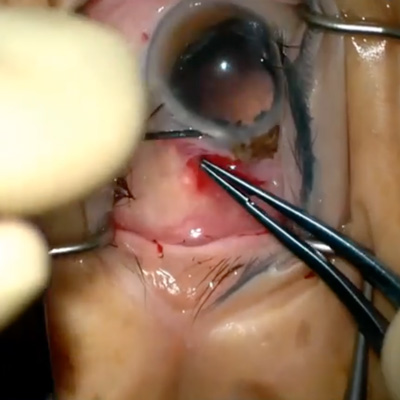
Dr. Rao experienced iris prolapse at the start of a cataract case involving a nanophthalmic eye. Despite several management efforts, the iris continued to come out of the wound. Dr. Rao applied lessons learned in this first eye when he operated on the second.
Source: Naveen Rao, MD
Iris prolapse can occur at any time during cataract surgery when the pressure inside the eye is higher than the pressure outside and when there is an open wound. Naveen Rao, MD, shared a complicated case involving iris prolapse, and Michael Snyder, MD, offered commentary on risk factors and how to handle such a case if it occurs.
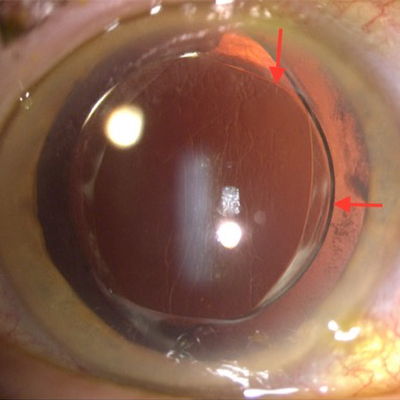
Slit lamp photo of secondary reverse optic capture with the optic prolapsed over the nasal and temporal capsule and the haptics in the capsule bag
Source: Nicole Fram, MD
Negative dysphotopsia is an issue that patients may face following cataract surgery. While it frequently resolves on its own, several physicians said it’s important to discuss it with patients and explain what’s going on.
The term intraoperative refractive guidance systems describes the technology offered to patients as an additional, out-of-pocket benefit for their cataract surgeries. Within this class of technologies are systems that give surgeons guidance on refractive issues during the case, including spherical power, cylinder power and alignment, and more.
There is often discussion about the conditions an eye should meet in order to be successful with a premium, advanced technology IOL, but what about patients who desire independence from spectacles but who have less than perfect eyes? With more options available in the presbyopia-correcting IOL market, some can be suitable even if the patient has existing ocular pathology.
➤ FDA approves nasal spray for dry eye
➤ Survey: 70% of adults don’t plan on receiving an eye exam this year
➤ Positive results in Phase 3 study for Acanthamoeba keratitis treatment
➤ Research on first-in-class therapy for retinal degenerative disease
➤ ASCRS news and events
➤ New and updated products for cataract workflow announced
➤ FDA approves first biosimilar in ophthalmology
➤ Acquisition of gene therapy company
➤ Licensing agreement for compounds targeting Demodex mites
➤ ASCRS news and events