Browse articles on EyeWorld.org. EyeWorld is the award-winning member publication of ASCRS. The magazine provides news and updates from the Society as well as clinical features in the areas of cataract, refractive, cornea, glaucoma, and practice management. It publishes quarterly with editorial direction from its medical editorial board and staff.
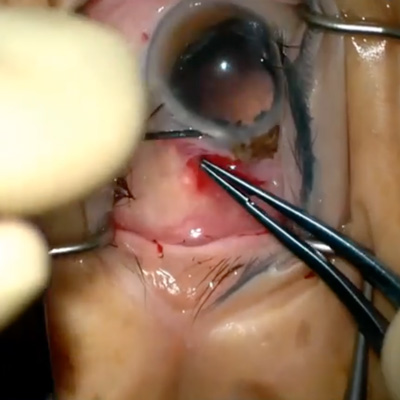
Dr. Rao experienced iris prolapse at the start of a cataract case involving a nanophthalmic eye. Despite several management efforts, the iris continued to come out of the wound. Dr. Rao applied lessons learned in this first eye when he operated on the second.
Source: Naveen Rao, MD
Iris prolapse can occur at any time during cataract surgery when the pressure inside the eye is higher than the pressure outside and when there is an open wound. Naveen Rao, MD, shared a complicated case involving iris prolapse, and Michael Snyder, MD, offered commentary on risk factors and how to handle such a case if it occurs.
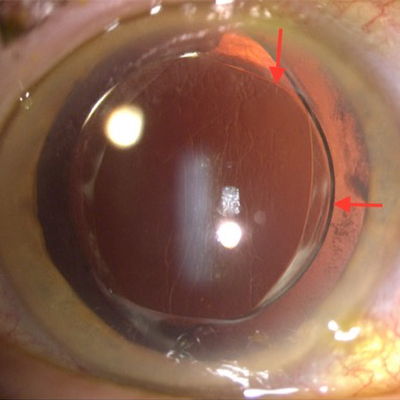
Slit lamp photo of secondary reverse optic capture with the optic prolapsed over the nasal and temporal capsule and the haptics in the capsule bag
Source: Nicole Fram, MD
Negative dysphotopsia is an issue that patients may face following cataract surgery. While it frequently resolves on its own, several physicians said it’s important to discuss it with patients and explain what’s going on.
The term intraoperative refractive guidance systems describes the technology offered to patients as an additional, out-of-pocket benefit for their cataract surgeries. Within this class of technologies are systems that give surgeons guidance on refractive issues during the case, including spherical power, cylinder power and alignment, and more.
There is often discussion about the conditions an eye should meet in order to be successful with a premium, advanced technology IOL, but what about patients who desire independence from spectacles but who have less than perfect eyes? With more options available in the presbyopia-correcting IOL market, some can be suitable even if the patient has existing ocular pathology.
Refractive Editor Vance Thompson, MD, shared some of the highlights in this issue’s Refractive section.
LASIK was established by the PROWL studies as safe and effective, with a high level of satisfaction, but there are patients who are unhappy with their outcomes, though rarely. Why this happens and how to best manage these patients is what three surgeons shared with EyeWorld.
Luke Rebenitsch, MD, described a case where he initially performed same-day hyperopic LASIK with the KAMRA inlay for distance and presbyopia correction in a 46-year-old patient. Several years later, he elected to implant IOLs once the patient started experiencing a hyperopic shift and lens-associated degradation in vision.
While common, EBMD is often missed, so it’s important to look for it. It can be one of the more frequently diagnosed causes of blurry vision before or after cataract surgery.
Myopia has been described as an epidemic in many regions for some time. Though considered easily correctable with glasses, myopia and high myopia are associated with a risk of developing cataracts sooner and a higher risk for glaucoma and retinal issues.

Clara C. Chan, MD
Cornea Editor
Cornea Editor Clara Chan, MD, discussed challenges of the past year, as well as the challenge of handling complicated cases.