Refractive
April 2023
by Ellen Stodola
Editorial Co-Director
The options and strategies for mixing and matching IOLs have evolved over time. Two surgeons discussed their approaches for using different lenses to help give patients the best outcomes.
For Blake Williamson, MD, the first presbyopia-correcting IOLs he used were the ZKB00 and the ZLB00 (Johnson & Johnson Vision) when he was in training at Tulane University. “The very first patient I ever did a premium presbyopia-correcting lens on, I mixed and matched because the guidance I was getting from the surgical rep and my attending is you get the best of both worlds,” he said. “We did a combination ZKB00 in the dominant eye and ZLB00 in the non-dominant eye.”
“One of the most exciting things has been the continued development of new lens technologies that allow for customization of vision for patients. While we would seek a lens that is identical to our natural crystalline lens, we are closer to this goal than we ever have been and continue to make strides every day.”
Cullen Ryburn, MD
Since this was his approach from training, Dr. Williamson said this is likely why he’s always been pro mixing and matching. “That’s how I learned, so to me, it was never controversial,” he said, adding that he isn’t generally concerned about confusing the patient by having two different lenses in the eye. “That never came into play because all we talked about to the patient was the desired outcome of having freedom from glasses and good functional vision at all ranges.”
After Dr. Williamson got out of training and into practice, the Symfony IOL (Johnson & Johnson Vision) launched. “This is a wonderful lens, but sometimes patients needed more near vision, and that’s why I went back to doing the ZLB00 in the non-dominant eye and Symfony in the dominant eye,” he said. Recently, Dr. Williamson’s practice has gained access to the Synergy (Johnson & Johnson Vision). He has gotten good results with bilateral Synergy. It is an EDOF, but it has a very high add, so what he learned is that the distance vision isn’t quite good enough for patients to be happy, he said. “I’m now using the Synergy OptiBlue in the dominant eye.”
With each new lens iteration, Dr. Williamson said there’s talk of “this lens is the perfect lens that can satisfy every patient at near and far,” but what he’s finding is that a combination seems to work the best. “Even with ongoing improvements in technology, and even with the current iterations, I find that my happiest patients tend to have the mix and match technique applied to their vision,” Dr. Williamson said. When discussing this with patients, Dr. Williamson said he tells them that he’s going to use a combination of lenses designed to give the best possible vision at distance and up close.
In addition to the Johnson & Johnson Vision options that he tends to use, Dr. Williamson said he has heard of colleagues using this approach with Alcon lenses. A lot of surgeons have had success with the PanOptix (Alcon) and the Vivity (Alcon), he said. With the PanOptix, sometimes the overall quality of vision may not be as good; the Vivity is similar to a monofocal, but you might not have near vision like with the PanOptix, he said. “I’m learning that a lot of colleagues are mixing and matching those two, where they’ll do the Vivity in the dominant eye and the PanOptix in the non-dominant.”
Dr. Williamson called mixing and matching his “fastball for anyone who comes in and says that they don’t want to have to wear reading glasses.” But there are some patients who don’t mind the possibility of wearing readers. Additionally, Dr. Williamson said he will not use the Synergy lens in patients who are post-refractive, post-LASIK, or post-RK. In these cases, he will use bilateral Symfony because he likes that it has a wider landing range and is a bit more forgiving; for those patients, he doesn’t offer mix and match.
“The perfect candidate for mix and match is someone who has a healthy eye, virgin cornea, has not had prior refractive surgery, a healthy macula, and is wanting the best possible near vision without compromising too much distance,” he said. “That tends to be the majority of my patients wanting presbyopia correction. If they’re going to pay that much money, most of them are sure they do not want to wear reading glasses as much as possible.”
Cullen Ryburn, MD, said that he used mixing and matching more in the past but doesn’t use this strategy as much with current technology. “I most commonly mixed the ZKB00 and ZLB00 or ReSTOR 2.5 [Alcon] and ReSTOR 3.0 [Alcon] to give patients more glasses freedom,” he said.
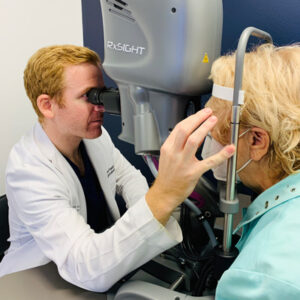
When the Symfony lens came onto the market, there was a noticeable quality of visual improvement from patient feedback, he said, but at the expense of near vision. Some patients were happy with blended Symfony and ZLB00, but the different higher order aberrations between the eyes caused significant nighttime visual complaints for some patients, Dr. Ryburn said, adding that newer trifocals and the Light Adjustable Lens (LAL, RxSight) have been a step forward in visual range, quality, and happiness.
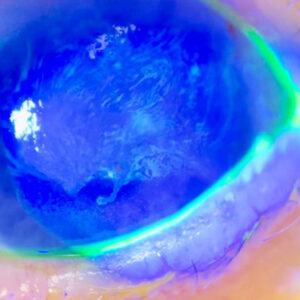
However, Dr. Ryburn noted that there are some scenarios where he will still mix and match. “Currently, I am most likely to mix and match IOLs if there is an ocular pathology limiting vision. For example, someone with a corneal scar causing irregular astigmatism in one eye may be a good candidate for a small aperture lens (i.e., IC-8 Apthera [Bausch + Lomb]) in one eye with a different technology lens in the fellow eye. Another example is a patient with a history of refractive amblyopia who has worn a multifocal contact lens happily in the past and is highly motivated for spectacle independence. In that situation, I would be comfortable offering an EDOF or trifocal lens in the eye with good visual potential and consider a monofocal or monofocal toric in the amblyopic eye depending on visual potential.”
Dr. Williamson said the advent of the LAL has added a component of mixing and matching, although “technically it’s not mixing and matching because it’s the LAL in both eyes.” He added that he’s had success doing micro-monovision with the LAL. “We understand that whenever you do adjustments on the LAL, you build in a bit of depth of focus, and by targeting the non-dominant eye at –0.75 or something like that, you tend to get good near vision,” he said.
Dr. Ryburn agreed that the LAL has been a great technology for achieving spectacle independence by blending the non-dominant eye into a mini-monovision eye. “By targeting plano and adjusting the lens myopic, there is induction of spherical aberration that allows for an extended depth of field,” he said. “Typically, this allows for a significant retention of distance vision in the non-dominant eye while also aiding near vision.”
Dr. Ryburn said another situation of blending lenses includes a EDOF or trifocal lens in a patient who previously had a monofocal lens in the fellow eye. “With appropriate counseling, I have seen these patients be very happy with the extended visual range,” he said. “One of the most exciting things has been the continued development of new lens technologies that allow for customization of vision for patients. While we would seek a lens that is identical to our natural crystalline lens, we are closer to this goal than we ever have been and continue to make strides every day.”
In the future, Dr. Williamson expects to see more options from the pipeline. He noted innovations from STAAR Surgical in presbyopia-correcting lenses. He also suggested that an improvement to the Eyhance lens (Johnson & Johnson Vision) could be beneficial. “If they could figure out a way to make it a premium lens and make it so there’s more near vision, I could see the Eyhance taking off where you can do that in both eyes.”
Dr. Williamson thinks that mixing and matching is a good option for surgeons to have and said that it doesn’t need to be controversial. “I’m always stunned by the fact that doctors are so hesitant to mix and match, and my comment to them is you’re already mixing and matching. You’ve been mixing and matching since the day you did cataract surgery because every eye is different. You’re doing biometry and putting a different power lens in each eye,” he said. “I think the stigma or confusion needs to go away because I think it’s here to stay.”
About the physicians
Cullen Ryburn, MD
Vance Thompson Vision
Billings, Montana
Blake Williamson, MD
Williamson Eye Center
Baton Rouge, Louisiana
Relevant disclosures
Ryburn: None
Williamson: Bausch + Lomb, Carl Zeiss Meditec, Johnson & Johnson Vision
Contact
Ryburn: cullen.ryburn@vancethompsonvision.com
Williamson: blakewilliamson@weceye.com