Browse articles from EyeWorld.org related to LASIK. EyeWorld is the award-winning member publication of ASCRS. The magazine provides news and updates from the Society as well as clinical features in the areas of cataract, refractive, cornea, glaucoma, and practice management. It publishes quarterly with editorial direction from its medical editorial board and staff.
Luke Rebenitsch, MD, described a case where he initially performed same-day hyperopic LASIK with the KAMRA inlay for distance and presbyopia correction in a 46-year-old patient. Several years later, he elected to implant IOLs once the patient started experiencing a hyperopic shift and lens-associated degradation in vision.
EyeWorld looks back on key milestones in the magazine’s history and in ophthalmology as it celebrates 25 years.
Vance Thompson, MD, Refractive editor, discusses highlights of the section and how this issue is “a wonderful invitation to our extended family in ophthalmology and a representation of important topics that will be represented at the Annual Meeting.”
When choosing the best refractive surgery option, there are a variety of factors that surgeons consider, including patient age, overall goals, and expectations. Three surgeons discussed which procedures they use and some of the specifics of laser refractive surgery, phakic IOLs, and lens replacement surgery.
The ASCRS/EyeWorld Journal Club reviewed this large, retrospective, non-comparative case series by Leccisotti and Fields that evaluated the incidence, clinical course, and prognosis of DLK in patients undergoing low-energy femtosecond LASIK in combination with sterile techniques to limit interface contamination.
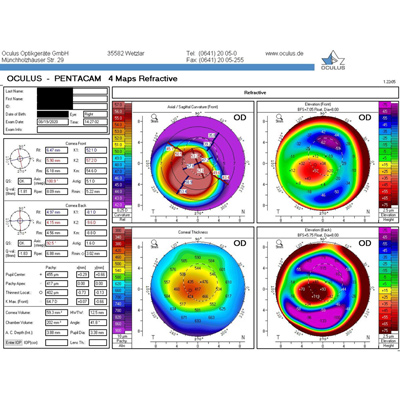
Corneal ectasia after laser vision corrected was first reported in 1998, and since them, preop screening and treatment parameters have improved to help avoid the complication. The incidence of post-LASIK ectasia is not officially known. Experts discussed this incidence and how to determine candidates for refractive surgery.
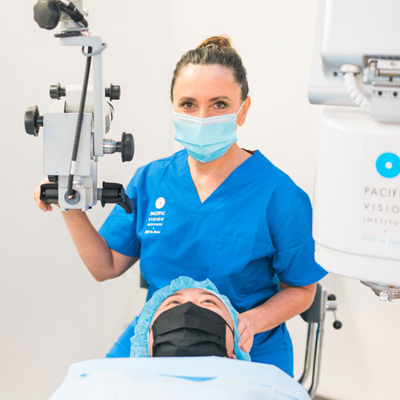
Dr. Faktorovich gives patients a choice to wear a mask or not during their procedure. All patients are screened with a COVID-19 questionnaire prior to entering the clinic and their temperature is checked. Disposable surgical blankets are used to cover patients. Source: Ella Faktorovich, MD
After being forced to close for several months because of the COVID-19 pandemic, many ophthalmologists had to make adjustments to practices in the clinic and surgery when they reopened. EyeWorld spoke to several surgeons about what they’ve seen in terms of LASIK numbers since reopening, with many noting that they’ve actually seen an uptick in this procedure.
The SMILE (small incision lenticule extraction) procedure (Carl Zeiss Meditec, Jena, Germany) is increasing in popularity, with many studies on its results and how it compares to LASIK. Though it does not have as long of a track record as LASIK, which has been used for around 2 decades, SMILE is gaining ground, with particular application for patients with myopia.
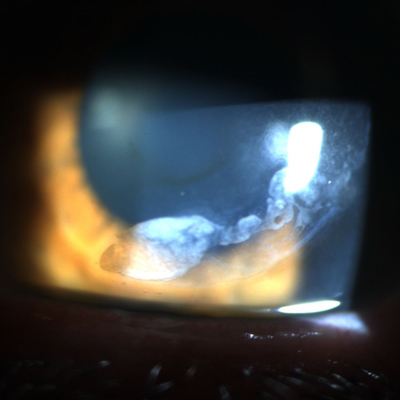
Epithelial ingrowth that occurred after a LASIK flap was relifted for an enhancement Source: Preeya K. Gupta, MD
Results of a study showed that for LASIK patients needing enhancement for which a flap lift may be difficult, PRK is safe and effective.
What can be done for patients with post-LASIK corneal neuralgia?