Browse articles from EyeWorld.org related to keratoconus. EyeWorld is the award-winning member publication of ASCRS. The magazine provides news and updates from the Society as well as clinical features in the areas of cataract, refractive, cornea, glaucoma, and practice management. It publishes quarterly with editorial direction from its medical editorial board and staff.
➤ Roberto Zaldivar, MD, delivers the Steinert Lecture ➤ Richard Lindstrom, MD, gives Obstbaum Lecture ➤ Video cases offer a ‘Reay of Hope’ at Glaucoma Day ➤ Cornea Day covers topics in keratoconus, corneal ectasia, lamellar surgery
➤ Results from pivotal amblyopia trial
➤ Phase 2 clinical program for third-generation keratoconus treatment
➤ Study compares tolerability of standard drop vs. novel drug delivery device
➤ Phase 3 clinical studies for investigational presbyopia drop complete
➤ Orphan drug designation granted for fungal keratitis treatment
➤ Full rights regained for investigational dry AMD therapy
➤ ASCRS news and events

Eric D. Donnenfeld, MD
Chief Medical Editor
“In this issue of EyeWorld, the official member publication of ASCRS, we highlight multiple areas of interest, including a number of sessions to be presented at the Annual Meeting that should not be missed,” said Eric Donnenfeld, MD, EyeWorld chief medical editor.
“If there was ever a top 10 list of issues on which eyecare as a whole could ‘up its game,’ it should include the fact that we all need to be more aggressive about educating patients on the fact that they can create their own self-induced keratoconus by repetitive pressure on their eyes,” according to EyeWorld Refractive Editor Vance Thompson, MD.
With keratoconus, it’s important to diagnose patients as early as possible in order to treat them before more drastic procedures, like a corneal transplant, might be needed. Crosslinking has aided in the early treatment of keratoconus, and now, the use of genetic testing is another tool for doctors to add to their armamentarium.
To patients, eye rubbing might seem innocuous, but to the ophthalmologist, it’s an action that can have sight-threatening consequences and is something that patients should be warned against.
➤ New 5-year data with MIGS device
➤ Phase 2 results with new epi-on crosslinking technology
➤ FDA grants IDE, authorizes trial of new viscodilation system
➤ Robotic surgery for glaucoma
➤ First patient dosed in Phase 3 trial of investigational drop for DME
➤ New glaucoma device approved in European market, plus Phase 2 results
➤ ASCRS news and events
➤ Discussion of same-day bilateral cataract surgery ➤ DMEK in complex eyes ➤ Do’s and Don’ts of corneal crosslinking for keratoconus ➤ Reconstruction of the ocular surface ➤ Late-breaking developments in retina ➤ Long-term follow-up with port delivery system of ranibizumab for AMD
➤ Eyecelerator@AAO kicks off ➤ Digital health in ophthalmology ➤ Cornea spotlight ➤ Reimbursement ➤ Focused session on myopia ➤ Eyecelerator closes with awards and ‘eyes on the future’
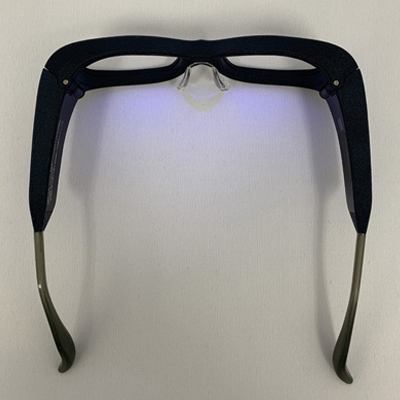
While the Dresden protocol of epithelium removal, riboflavin loading, and UV light treatment remains the gold standard for crosslinking to stop progression of keratoconus, over the years there has been significant research on new techniques and adjuncts to enhance the effect, make the procedure less invasive, and/or expand its indications. One of these potential therapies for keratoconus still under investigation uses violet light-emitting glasses (KeraVio, Tsubota Laboratory).