ONLINE EXCLUSIVE
Cornea
November 2021
by Liz Hillman
Editorial Co-Director
While the Dresden protocol of epithelium removal, riboflavin loading, and UV light treatment remains the gold standard for crosslinking to stop progression of keratoconus, over the years there has been significant research on new techniques and adjuncts to enhance the effect, make the procedure less invasive, and/or expand its indications.
These have included methods that leave the epithelium on, the addition of supplemental oxygen, pulsed energy treatments, oral riboflavin, use of iontophoresis, and more. A paper published earlier this year listed about 20 existing corneal crosslinking protocols.1
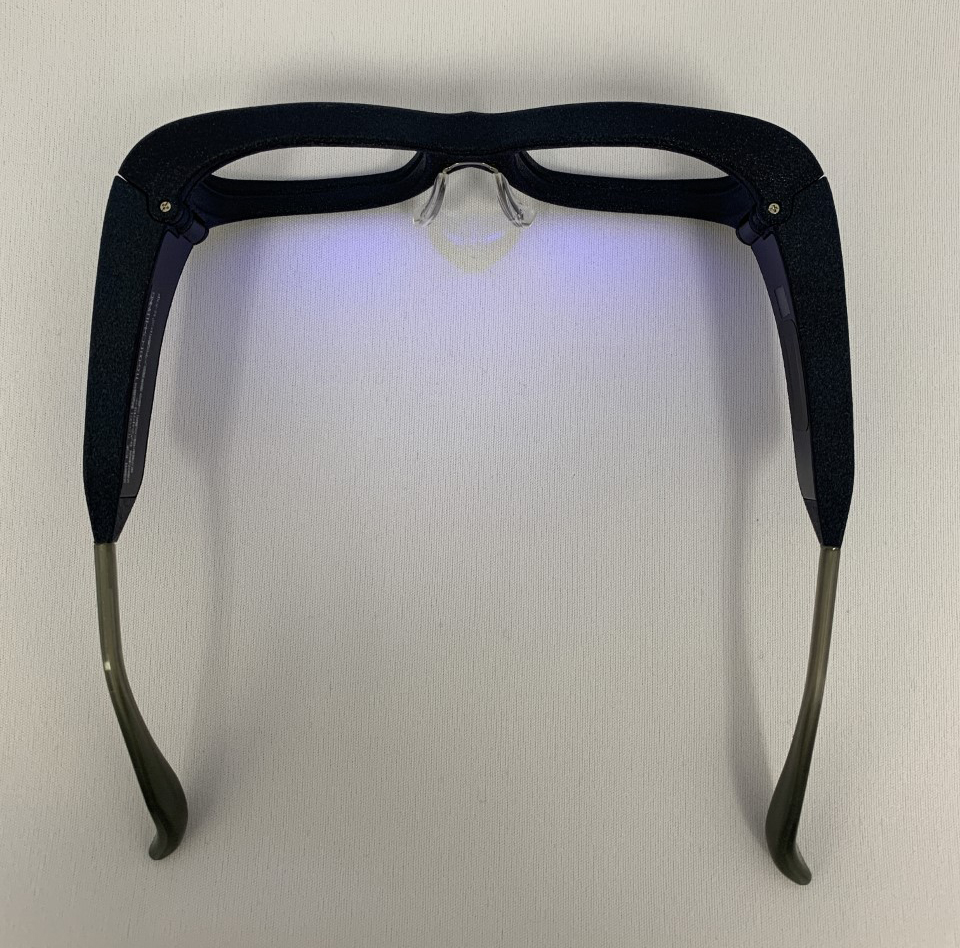
Source: Hidenaga Kobashi, MD
One of these potential therapies for keratoconus still under investigation uses violet light-emitting glasses (KeraVio, Tsubota Laboratory). Hidenaga Kobashi, MD, and coauthors published a paper in the British Journal of Ophthalmologythat detailed this novel technology.2 The paper described KeraVio in combination with riboflavin in rabbits, with the riboflavin administered six times during the 3-hour period while the glasses were worn. The paper also described a clinical, in-human pilot study in patients 15 years or older with keratoconus or post-refractive cornea ectasia who had exhibited progression within 12 months. Human participants in the study wore the glasses for 3 hours daily for 6 months and had riboflavin drops administered every 30 minutes during the treatment.
The authors reported a decrease of more than 2 D in Kmax values at 6 months in 20% of the eyes; it remained within 2 D in 65% of the eyes and increased by 2 D in 15% of the eyes. The corneal stromal demarcation line was identified in 80% of eyes at a depth of 206.3±54.9 μm at 1 month. Based on these 6-months results, the authors concluded that this daily treatment could stop disease progression without safety concerns.
Dr. Kobashi elaborated on the findings in an interview with EyeWorld, first commenting on the use of riboflavin every 30 minutes in the initial studies.
“To simplify the treatment procedure, we [later] hypothesized that KeraVio use without adding riboflavin might be effective in preventing disease progression, if there was original physiological riboflavin in the human cornea,” he said, noting that a physiological riboflavin was in fact identified in the corneal stroma. “Additionally, we evaluated the corneal stiffness after the violet light irradiation without riboflavin drops using the KeraVio procedure.”
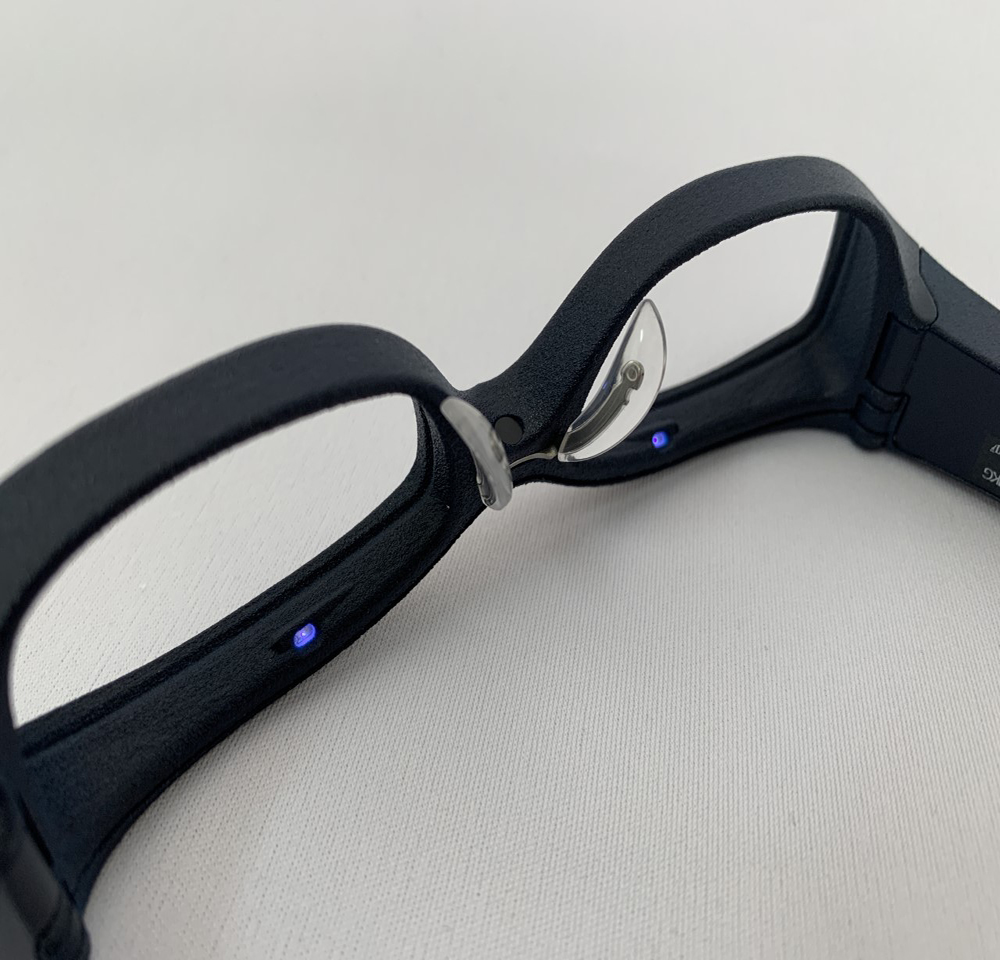
Source: Hidenaga Kobashi, MD
When asked about patient activity while wearing the glasses, Dr. Kobashi said that patients are allowed to be ambulatory and there aren’t restrictions to their activities. As for use of violet light, Dr. Kobashi said according to the international lighting vocabulary of the International Commission on Illumination, the lower limits of visible light wavelengths are defined as 360–400 nm, which overlaps with the upper end of the UV-A spectrum.
“This range is visible as violet light, but it is also recognized as UV-A,” he said.
Dr. Kobashi said that a treatment like KeraVio could avoid complications associated with traditional crosslinking procedures, such as ocular pain and possible corneal infections. It could also potentially be offered at younger ages. He noted that the efficacy of KeraVio as a treatment has not been compared to traditional crosslinking.
Currently, there is a clinical trial in recruiting stages with KeraVio to continue to investigate how violet light irradiation without riboflavin drops may increase the corneal stiffness using physiological riboflavin.
About the physician
Hidenaga Kobashi, MD
Department of Ophthalmology
Keio University School of Medicine
Tokyo, Japan
References
- Wu D, et al. Corneal cross-linking: the evolution of treatment for corneal diseases. Front Pharmacol. 2021;12:686630.
- Kobashi H, et al. Clinical outcomes of KeraVio using violet light: emitting glasses and riboflavin drops for corneal ectasia: a pilot study. Br J Ophthalmol. 2021;105:1376–1382.
Relevant disclosures
Kobashi: Tsubota Laboratory
Contact
Kobashi: himon@hotmail.co.jp