Browse articles from EyeWorld.org on the topic of the cornea. EyeWorld is the award-winning member publication of ASCRS. The magazine provides news and updates from the Society as well as clinical features in the areas of cataract, refractive, cornea, glaucoma, and practice management. It publishes quarterly with editorial direction from its medical editorial board and staff.
➤ Last patient visit in proof-of-concept cell therapy
➤ Phase 2 data for allergic eye inflammation drop published
➤ NDA resubmission to the FDA for topical ocular reproxalap
➤ Positive topline results from Phase 2b suprachoroidal wet AMD therapy
➤ Complimentary access to video journal
➤ Partnership news
➤ ASCRS news and events
In her introduction to the Cornea section, Julie Schallhorn, MD, pointed out that more and more, physicians are turning to chat groups and listservs when they face a hurdle. “I challenge our readers to think critically about the experiences and the anecdotes they encounter on listservs, chat groups, and social media,” she wrote.
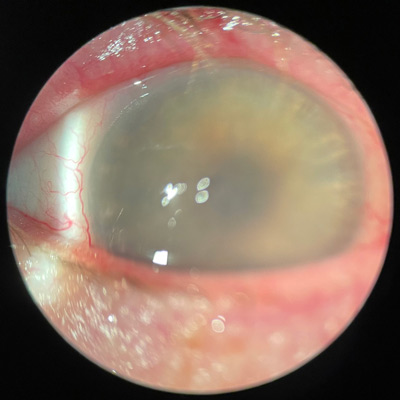
This is a failed DSAEK after 10 years. It was a late onset failure after a flu vaccine.
Source: W. Barry Lee, MD
Three physicians discussed the recent uptick in primary graft failures, the data, and the potential culprit.
Punctal occlusion remains an important resource to help dry eye patients. Several ophthalmologists shared how they use punctal occlusion in practice, available options, and a new product in this space.
➤ Research: quest for cataract reversal continues
➤ First allogenic cell therapy for treating corneal endothelial disease
➤ Enrollment complete in Phase 2b geographic atrophy treatment study
➤ European agency maintains negative opinion for intravitreal pegcetacoplan for geographic atrophy
➤ Companies partner to further development of new glaucoma drug
➤ ASCRS news and events
When planning cataract surgery, it’s important to pay particular attention to patients who may have a compromised cornea or endothelial damage. Two cornea specialists spoke with EyeWorld about considerations for cataract surgery in these eyes.
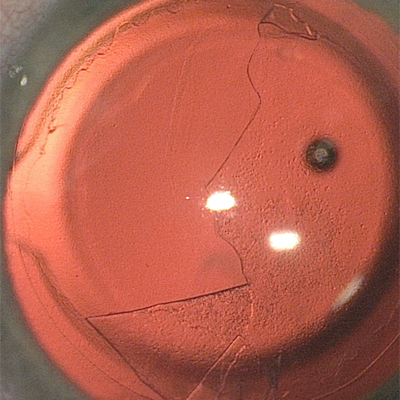
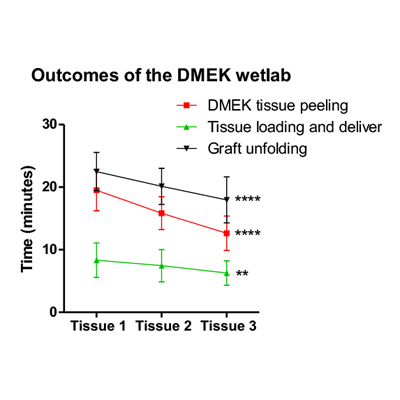
The learning curve for DMEK is steep, but most training opportunities are reserved for those in a cornea fellowship. Objective data on the efficiency of wet labs, which don’t pose a risk to patients, don’t waste valuable tissue, and are available to those at earlier skill levels, was recently published.
➤ ASCRS mourns death of I. Howard Fine, MD
➤ New non-diffractive monofocal and toric IOLs
➤ 36-month results from clinical trials for new glaucoma device
➤ FDA grants IND to stem cell therapy intended to treat photoreceptor diseases
➤ Company launches ophthalmology-specific contract research organization
➤ ASCRS news and events
ASCRS EyeWorld Weekly: View the current issue
➤ Claes Dohlman, MD, PhD, dies at 101 years old
➤ Trial to evaluate neuropathic corneal pain drug
➤ FDA clears new OCT technology
➤ Study: supplements slow progression of late-stage dry AMD
➤ Young eye surgeon scholarship opportunity
➤ Acquisition news
➤ ASCRS news and events

This is a photo of a patient with ABMD and cataract. Note the irregular lines that resemble a coastline (map), small punctate opacities (dot), and thickened epithelial ridges (fingerprint)—hence the name map-dot-fingerprint dystrophy. This patient had both irregular astigmatism and recurrent epithelial erosions. Superficial keratectomy with diamond burr polishing was performed to prepare the cornea for future cataract surgery.
Source: Rahul Tonk, MD, MBA
“My eyes are irritated … they weren’t before cataract surgery.” “My vision fluctuates … it goes in and out.” These just a couple of phrases an ophthalmologist might hear when ABMD is missed prior to cataract surgery, causing them to wish they had found and treated it preoperatively.