Cornea: Strike!
Fall 2024
by Ellen Stodola
Editorial Co-Director
Punctal occlusion remains an important resource for dry eye patients. Several physicians discussed how they use it in practice, available options, and a new product in this space.
Punctal occlusion is fundamental for dry eye and has been for decades, said Darrell White, MD. “If you have a patient who has a low tear film, you can increase the amount of tears on the surface of the eye by doing something to maintain the tears’ contact time longer by reducing outflow. … We’ve used a number of different types of plugs.”

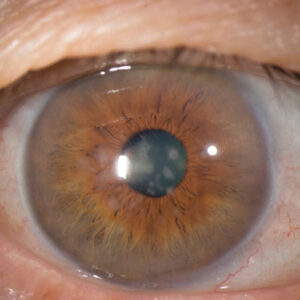
Source: Eric Donnenfeld, MD
Mina Massaro-Giordano, MD, agreed that punctal occlusion plays a role in dry eye management. While she said that it’s important to get the inflammation under control before moving forward, she added that “there’s always going to be some degree of inflammation.” She tries to get inflammation under the best control she can before putting a plug in because once you do that, the tears are lubricating and on the surface for a longer period of time. You don’t want inflamed tears bathing the eye, she said.
The important thing to decipher is what makes a good candidate. Dr. Massaro-Giordano checks all four puncta. “If they’ve had chronic inflammation of the lid, their punctum opening is tiny to begin with, you might not be able to put a plug in,” she said. “If there is a gaping hole, the tears they make are going to be sucked down that drain, and it makes sense to put a plug in, but if it’s too small, it might not make sense.” It’s also important to look at the architecture of the lid, as well as the patient’s history to see if plugs have been tried in the past.
“I usually start with the lower punctum, maybe one eye over the other, to see if they notice a difference,” she said. Sometimes you put a plug in and they tear too much. There’s a lot of trial and error that goes into placing plugs because you also have to choose the right type of plug. There are plugs that will block the punctum completely, but sometimes that will cause too much tearing. In this case, Dr. Massaro-Giordano will choose a plug that has a small hole in it. There are also permanent and temporary options.
In the past, physicians would reserve plugs for patients who had tear insufficiency dry eye or autoimmune conditions, Dr. Massaro-Giordano said, but they can be helpful for many patients. In addition to dry eye, punctal occlusion can work for other ocular conditions like neurotrophic keratitis, for those who just had a refractive procedure where the nerves are temporarily cut, for patients who have recurrent erosion, or for pregnant patients when you want less systemic absorption of a medication.
Eric Donnenfeld, MD, called punctal occlusion one of the fundamental options for dry eye management. He added that treating the inflammation first is important in these patients before using punctal occlusion as a way of improving the volume of tears available to the patient. It is an effective and cost-effective therapy. “[There’s] very little downside to doing the procedure, and I think there’s an enormous benefit. I think this is underutilized by a lot of clinicians,” he said.
There are different punctal occlusion options available. You can use a collagen punctal plug, an indwelling plug that goes into the punctum and has the advantage of no external exposure. This option is usually very comfortable, he said, but the downside is that it dissolves over time, becoming less effective, and it does not conform to the canaliculus. But it’s comfortable and effective, and the average plug lasts for a couple months.
There are also more permanent plugs made of silicone or acrylic. This is an external plug that fits into the punctum with a cap on top, and it should stay in place indefinitely. It provides a longer duration of punctal occlusion, but the external cap is sometimes irritating, and there is often fluorescein staining on the adjacent conjunctiva. Additionally, biofilm or bacteria often build up with this approach, potentially leading to infection.
Permanent punctal occlusion is an option for patients with very dry eyes, Dr. Donnenfeld said. “You can cauterize the punctum with a handheld cautery, and that will cause a closure of the punctum, which tends to be permanent and comfortable.”
There’s a fourth option that includes a medication, he said. This is Dextenza (dexamethasone ophthalmic insert, 0.4 mg, Ocular Therapeutix), which is commonly used in the context of cataract surgery. Dextenza provides the dual benefit of punctal occlusion and steroid elution that lasts about a month.
A new product in the space
A newly approved option in the punctal occlusion space is Lacrifill (Nordic Pharma), a crosslinked hyaluronic acid. “Lacrifill is an exciting new technology that I think, in many cases, will replace traditional punctal occlusion because it has some significant advantages,” Dr. Donnenfeld said. It’s crosslinked hyaluronic acid that is inserted into the inferior punctum and will wrap around to superior punctum, so you can get both puncta, he said, adding that this option is comfortable, lasts for 6 months, and can be irrigated out at any time. “Whereas a collagen plug sits in the punctum and fluid can leak around the edge, this conforms to the anatomy of the canalicular structure [and] provides a more efficient and effective punctal occlusion.”
Dr. Donnenfeld said trials have shown that patients who got Lacrifill compared to a conventional plug had higher Schirmer’s scores. He started using the product in his practice in June 2024 and said it’s nice that one vial is enough to fill both puncta. “It’s comfortable and fast, and I think it provides a better way of occluding the punctum,” he said.
Dr. White also touted the benefits of the newly approved Lacrifill. This type of option has been used for 10–15 years as a dermal filler for cosmetic and reconstructive purposes. “We know that it’s inert in the vast majority of cases, and the beauty is we’re not putting it under anything. We’re putting it into an open canal,” he said. Lacrifill offers many of the benefits of punctal occlusion, such as reduced outflow and therefore an increased amount of the patient’s natural tears. “We know from the FDA trial that it’s going to stay there at least 6 months,” Dr. White said, adding that there’s an option to flush it out if the patient is having issues with excess tearing.
When deciding which patients are best for Lacrifill, Dr. White said it comes down to the type of dry eye disease. In the simplest of terms, there are two different types of dryness, he said. Aqueous deficient dry eye occurs when the patient has symptoms from dryness because they don’t have enough tears. The other type is evaporative dry eye, where tears don’t work well enough (a quality problem, not a quantity problem). Those patients who have evaporative dry eye, who don’t have a secondary decrease in tear volume, probably don’t need any sort of punctal occlusion, Dr. White said. The patients who have aqueous deficient dry eye are good candidates.
Dr. White also thinks Lacrifill will make it easier to treat dryness in the perioperative period between cataract and refractive surgery. As part of the perioperative treatment, patients could have Lacrifill put in before they have their final measurements. “If they have dryness, even if we get good measurements, I think we’ll start to see in the premium space physicians putting Lacrifill in because we make the eye dryer when we do surgery. If you put Lacrifill in prior to surgery, you can mitigate those effects,” he said.
Dr. Massaro-Giordano said she’s excited about Lacrifill, particularly its ability to mold to the patient’s unique anatomy. You don’t have to worry about it being too big or small or falling out, she said, and it helps with increased tear levels for at least 6 months. “I think this is welcome in the dry eye world. … [It’s] novel and needed in our armamentarium,” she said, especially for those who have failed with plugs.
About the physicians
Eric Donnenfeld, MD
Ophthalmic Consultants of Long Island
Garden City, New York
Mina Massaro-Giordano, MD
Professor of Clinical Ophthalmology
Scheie Eye Institute
University of Pennsylvania
Philadelphia, Pennsylvania
Darrell White, MD
SkyVision Centers
Westlake, Ohio
Relevant disclosures
Donnenfeld: Nordic Pharma, Ocular Therapeutix
Massaro-Giordano: Alcon, Dompe, Tarsus Pharmaceuticals
White: Nordic Pharma
Contact
Donnenfeld: ericdonnenfeld@gmail.com
Massaro-Giordano: mina@pennmedicine.upenn.edu
White: dwhite2@skyvisioncenters.com