Browse articles on EyeWorld.org from the Refractive section. EyeWorld is the award-winning member publication of ASCRS. The magazine provides news and updates from the Society as well as clinical features in the areas of cataract, refractive, cornea, glaucoma, and practice management. It publishes quarterly with editorial direction from its medical editorial board and staff.
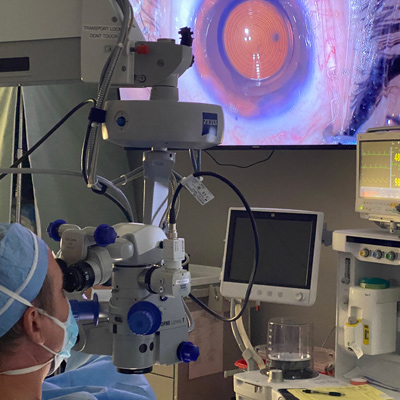
Dr. Waring implants a hybrid diffractive extended depth of focus and multifocal toric IOL during a refractive lens exchange.
Source: George Waring IV, MD, FACS
The large number of patients worldwide with presbyopia creates a unique opportunity for eyecare providers to improve patients’ quality of life, according to George Waring IV, MD, FACS. He and Shamik Bafna, MD, discussed some of the surgical and pharmacological options.
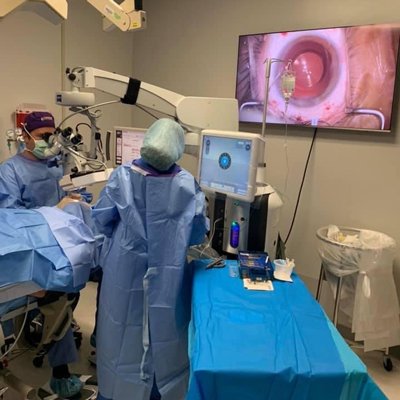
Dr. Williamson implants the first Synergy in Louisiana.
Source: Blake Williamson, MD
This “YES connect” column examined trifocal, combined multifocal-EDOF, and accommodating technology on the horizon with input from three experts.
Improvements in IOL technologies have increased interest in refractive lens exchange, and there is more confidence among surgeons in its ability to deliver expected outcomes. Two surgeons shared their experiences in this area.
Vance Thompson, MD, Refractive editor, discusses highlights of the section and how this issue is “a wonderful invitation to our extended family in ophthalmology and a representation of important topics that will be represented at the Annual Meeting.”
Enhanced monofocal and “ringless” EDOFs are a couple of the names floating around for a newer type of IOL designed to extend depth of focus while maintaining, as much as possible, the quality of distance vision provided by a monofocal IOL. This article explores physician experience with these new IOL options.
When choosing the best refractive surgery option, there are a variety of factors that surgeons consider, including patient age, overall goals, and expectations. Three surgeons discussed which procedures they use and some of the specifics of laser refractive surgery, phakic IOLs, and lens replacement surgery.
Though it has been available in the U.S. for a fraction of time compared to the well-established laser vision correction procedures PRK and LASIK, SMILE has quickly become the dominant procedure in the practices of many refractive surgeons.
Refractive Editor Vance Thompson, MD, discusses the impact from COVID-19 over the past year, as well as changes to practice and ophthalmology as a whole.
Astigmatic keratotomy (AK) and limbal relaxing incisions (LRIs) are tools that can be used by surgeons to help correct low levels of astigmatism. Two surgeons discussed how these can reduce astigmatism and how they’re using them in practice.
Epithelial thickness mapping was FDA approved in the U.S. in 2017, but awareness about its utility is growing. Three international ophthalmologists shared their experience with the technology and offered insights on where they think it fits in ophthalmic practices now and in the future.