Refractive: YES Connect
September 2021
by Liz Hillman
Editorial Co-Director
Curing presbyopia is still the “holy grail” of anterior segment surgery. While there have been incredible steps forward in the last 3 decades, we are still left with much to desire out of the current technologies. Recent advancements from many companies have me excited for the future. We are slowly achieving true spectacle independence. This article will highlight new technologies that I know have a bright future and potential to truly shape presbyopia therapy. I think if these technologies do as they say, we will finally see a shift in the presbyopia market share.
—Michael Patterson, DO
YES Connect Co-Editor
There has been a lot of movement in the presbyopia-correcting IOL space. In the July issue of EyeWorld, the YES Connect column took a look at “ringless” extended depth of focus (EDOF) technologies. This column moves the conversation forward along the presbyopia-correction spectrum, examining trifocal, combined multifocal-EDOF, and accommodating technology on the horizon.
Trifocals
The AcrySof IQ PanOptix (Alcon) became the first trifocal approved for use in the U.S. in August 2019. In the 2 years post-approval, surgeons who have adopted it, like Elizabeth Yeu, MD, have become familiar with its pros and cons.
Source: Blake Williamson, MD
Dr. Yeu was part of the FDA pivotal trial for PanOptix and said that of the multifocal IOL options, it’s what she uses most frequently in her practice when patients desire spectacle independence and are good candidates.
Prior to PanOptix, Dr. Yeu said there was a significant gap at intermediate vision in multifocal IOL technology. Surgeons mixed and matched IOLs to try to accommodate for this, or patients had to move their arms in and out to try to find the sweet spot. PanOptix, Dr. Yeu said, reduced her need to mix and match IOLs. Its near sweet spot at –2.5 D or 40 cm and intermediate at –1.5 or 60 cm, coupled with distance vision, provides “the most ideal range for anyone who is, from the perspective of an optic and arm’s length, less than 6’10”,” she quipped.
Another benefit of PanOptix, Dr. Yeu continued, is its platform. While the lens is AcrySof material, it’s based on its own new platform, which uses 88% of light, half of which is directed toward distance. “It has incredible light utilization,” Dr. Yeu said.
She said that for a light-splitting technology, the concerns over contrast sensitivity are less than observed in the clinical trial.
You still have to respect the patient selection rules as you normally would for multifocality, she noted, which include a stable ocular surface and no other intraocular pathology.
“If those rules are observed, it works extremely well in patients,” Dr. Yeu said.
The addition of Vivity (Alcon), a non-diffractive EDOF, to the market earlier this year, Dr. Yeu said, has expanded who she is comfortable offering PanOptix to. Here’s how: She has been mixing and matching Vivity and PanOptix for patients who are very concerned with the night dysphotopsia profile of the trifocal. Patients who are younger and 20/20 with mild cataracts complaining of glare would give her pause with PanOptix alone, Dr. Yeu said, but coupling it with Vivity in the dominant eye mitigates the dysphotopsia profile of PanOptix in the non-dominant eye.
“Patients have loved that,” she said. “It’s not my go-to, but it has expanded who I am able to offer it to.”
Overall, Dr. Yeu said there is a high level of satisfaction among patients and surgeons with PanOptix.
“This lens technology has created that easy button. It allows for it to be an easier conversation that we can have our counselors partake in. It helps to enable proper education and expectations for the patient, and it meets those expectations, even exceeds them,” she said.
Combination multifocal-EDOF
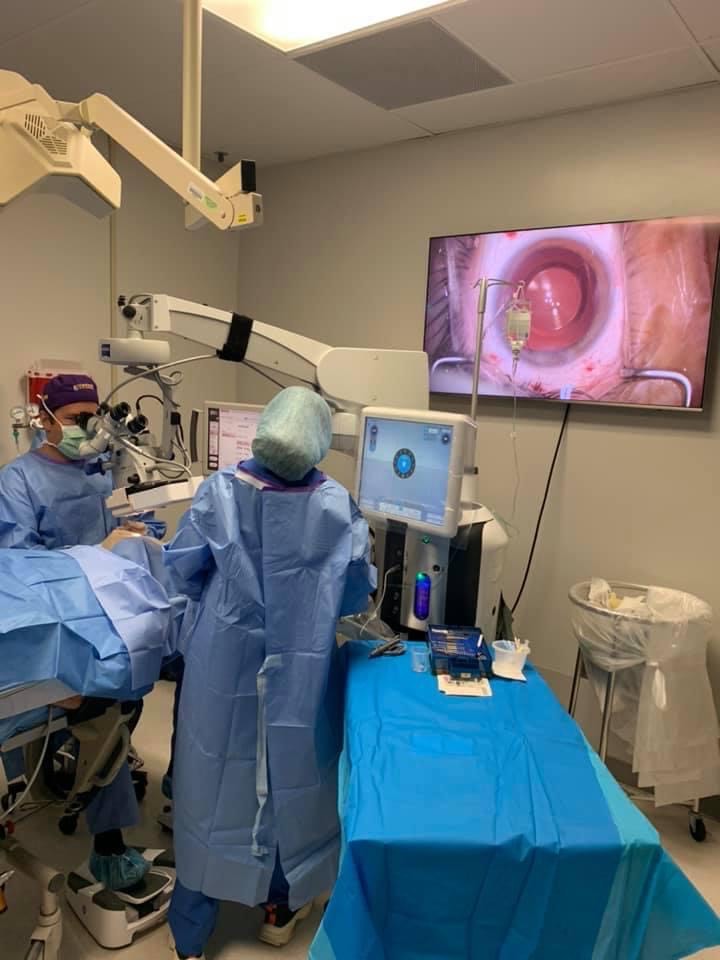
TECNIS Synergy (Johnson & Johnson Vision), which combines multifocal diffractive and extended depth of focus technology, received FDA approval in May. Blake Williamson, MD, and Eric Donnenfeld, MD, were performing their first cases with these lenses when EyeWorld spoke to them in June.
Dr. Williamson said, overall, his procedures went great and his patients with the lens were doing “extremely well” postop.
The preoperative workup for Synergy, he said, is similar to that with other diffractive IOLs. Intraoperatively, he said he was excited about the injector, which he noted is preloaded and only requires a little balanced salt solution (no viscoelastic). Inside the eye, he said you could count about 15 rings, and he thought the central button was a decent size.
“It was a bit smaller than the Symfony [Johnson & Johnson Vision], but it was still easy for me to align it on the coaxial Purkinje,” Dr. Williamson said.
He also implanted a couple of the toric versions of Synergy. He said the upgraded haptic arms were sticky.
“It was a little hard to rotate, which was a good sign because that tells you it’s going to stay in place,” he said.
Dr. Williamson described Synergy as like the baby of the ZMB00 (Johnson & Johnson Vision) and Symfony.
“The reason why the ZMB00 was difficult is you had huge gaps in between. It had great near and functional distance, but it didn’t have much intermediate, so you slap an EDOF on there and you don’t have the drop-off in midrange vision,” he said, adding that he thinks Synergy will provide the best near vision on the market.
He said the lens has technology that corrects for chromatic aberration, giving higher contrast in low light situations. It blocks violet light, which is a shorter wavelength. Shorter wavelengths, Dr. Williamson explained, cause more problems with light scatter.
“By selectively blocking out the violet wavelength of light, they’re finding this lens performs well in low light situations,” he said.
Dr. Donnenfeld said he thinks Synergy will be similar to PanOptix in many ways, though he also said Synergy appears to have a little more reading vision and better contrast sensitivity under scotopic conditions.
“I think what it comes down to is it will give excellent quantity of vision. The question is going to be what is the dysphotopsia profile? We don’t have a lot of experience on what that will be like,” Dr. Donnenfeld said.
Accommodating IOLs
There is not yet a truly accommodating IOL available in the U.S., but Dr. Donnenfeld said Juvene (LensGen) will soon start clinical trials on its path to potentially earning FDA approval.
“All lenses that give presbyopic solutions currently split light to some extent, and by doing that, they reduce contrast sensitivity. A truly accommodating lens would be a lens that would focus so that all the light would be given to the distance that you’re looking at and there would be no loss of contrast, no glare, no halo,” Dr. Donnenfeld said.
This is what Juvene could achieve. Accommodating lenses from other companies are at different stages of development as well. Dr. Donnenfeld has experience with Juvene as an investigator with it for a study in Mexico.
“We have a long track record with it, and what we find is that it gives a defocus curve of about 2.5 D of reading without splitting light. When patients are asked about quality of vision, they don’t complain of glare, halo, starbursts, or the dsyphotopsias that you see with a multifocal lens. … The contrast sensitivity with and without glare is the same as a monofocal lens,” he said.
As a biomimetic lens, Dr. Donnenfeld said it fills the capsular bag. Going out to 5 years, capsules of eyes that have received this lens are completely clear (without opacification), and Dr. Donnenfeld said there is minimal risk for posterior vitreous detachment or floaters.
“Presbyopic, accommodating lenses are the future. We’re going through a period of time now where we’ve seen dramatic improvements with multifocal lenses, but in the future, I think that accommodating lenses will replace our traditional multifocals, and the technology will continue to improve,” he said.
Advice for young eye surgeons
Drs. Yeu, Williamson, and Donnenfeld offered their advice to young eye surgeons on when new lens technologies become available.
Dr. Yeu said surgeons should be comfortable with management of dissatisfied patients.
“We have to have things in place so we can help manage those patients in the instance that we’re not able to meet their expectations,” she said. “If [a young eye surgeon is] comfortable with that, I would say talk to someone you trust in terms of technologies, especially with early adopters.”
For surgeons who have some trepidation about newer technologies, Dr. Yeu said to look at lenses that have been out for longer vs. what’s brand new. These lenses, she explained, go through their own learning curve once they enter the market, with surgeons learning over time how they perform in the real world in terms of quality of vision, patient satisfaction, and side effects. The longer track record, she said, is what can give surgeons confidence with PanOptix.
“There are several years of good data out there, and it performs well. If a [young eye surgeon] wanted to jump into multifocality, it’s a great time to jump into multifocal IOLs,” Dr. Yeu said.
Dr. Donnenfeld said getting into toric IOLs first is a great way to enter the premium IOL space. Then he said to consider low-add EDOF lenses, describing them as having less risk of patient dissatisfaction. After these, he said he would start with trifocals because they give true spectacle independence. While these are high-reward lenses, he said surgeons need to pick ideal candidates. The low-hanging fruit when you’re starting in this space, Dr. Donnenfeld said, are hyperopic patients with a significant cataract.
Dr. Williamson offered the same point about selecting a hyperopic patient for earlier cases with presbyopia-correcting IOLs.
“That’s a person you’ll make happy no matter what you do,” Dr. Williamson said.
His other advice is to understand that different optics and different materials perform differently, and the patient education and informed consent need to be tailored as such.
“The most important thing you can do as a young surgeon is master the preop consult and preop expectation setting,” Dr. Williamson said.
He also said to tell patients they will experience glare and halos with these lenses; make it very clear what the side effects will be and that they might experience them for a few months.
“… pick the right patient and let them know ahead of time what the shortcomings of the lens may be; if you do that, you’re going to save yourself from 99% of pitfalls postoperatively,” Dr. Williamson said.
With more and more presbyopia-correcting IOLs coming to the market, will they increase the market share? Dr. Williamson thinks so to some extent, but he doesn’t think these technologies will earn a significant portion of the market overall. Why? First is cost; Dr. Williamson said some patients can’t afford premium lenses or don’t want to pay out of pocket for their IOLs. The second reason is meeting expectations; some physicians, he said, are not comfortable with setting these expectations and/or needing to meet them for patients who are choosing to pay out of pocket.
“As the lenses get better and as we get better at selecting the right patients and the right diagnostics, I think you’ll see adoption go up,” he said, adding that younger generations of ophthalmologists coming into practice could be a force to increase adoption of presbyopia-correcting IOLs.
About the physicians
Eric Donnenfeld, MD
Ophthalmic Consultants of Long Island
Garden City, New York
Blake Williamson, MD
Williamson Eye Center
Baton Rouge, Louisiana
Elizabeth Yeu, MD
Virginia Eye Consultants
Virginia Beach, Virginia
Relevant disclosures
Donnenfeld: Alcon, LensGen, Johnson & Johnson Vision
Williamson: Johnson & Johnson Vision
Yeu: Alcon, Johnson & Johnson Vision
Contact
Donnenfeld: ericdonnenfeld@gmail.com
Williamson: blakewilliamson@weceye.com
Yeu: eyeulin@gmail.com