Browse articles on EyeWorld.org. EyeWorld is the award-winning member publication of ASCRS. The magazine provides news and updates from the Society as well as clinical features in the areas of cataract, refractive, cornea, glaucoma, and practice management. It publishes quarterly with editorial direction from its medical editorial board and staff.

ReSTOR lens
Source: Alcon
Ever since their conception, multifocal intraocular lenses (IOLs) have been measured against their predecessor, monofocal lenses. With the appearance of accommodating lenses on the market in recent years, inevitable comparisons are now being drawn between multifocal lenses and the latest advancement in IOL technology. EyeWorld takes a look at the pros and cons of the lenses.
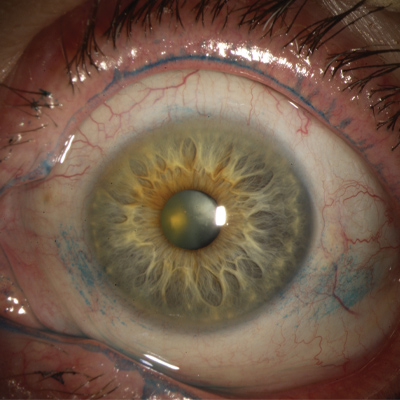
Three different staining patterns can help practitioners determine dry eye severity.
Patients with herpes simplex virus (HSV) keratitis can present some of the most challenging cases that eye surgeons treat, said Edward J. Holland, M.D., Cincinnati Eye Institute, University of Cincinnati.
Practitioners share ideas to prevent patient complaints.
Each multifocal IOL design uses a different strategy to produce simultaneous near and distance images. Experimental work suggests that the optic design makes a difference for night vision.
For the treatment of dry eye syndrome, punctal plugs are an important tool. Fortunately, serious complications with the use of these plugs are extremely rare. However, like any medical procedure, it does have some risks. According to Robert Maloney, MD, after refractive surgery many patients have reduced tear production and complain of symptomatic dry eyes.
Gels and ointments aren’t only for the most severe dry eye cases, said Robert Latkany, M.D., founder and director, Dry Eye Clinic, New York Eye and Ear Infirmary, New York.
Oculoplastic surgeons warn that the surgical augmentation of eyelashes can lead to severe complications. But they note the procedure may be warranted in cases of severe chemical burns or for reconstructive surgery.
Preop discussion of function helps patients think of their visual goals.
As cataract surgery becomes “gentler,” how will a surgeon’s postop treatment strategy change?