Cover Feature: Cornea Pharmaceutical Corner
May 2007
by Vanessa Caceres
EyeWorld Contributing Editor
Dry eye gels and ointments provide wide-ranging relief
Still, selecting the right product for each patient takes time
Gels and ointments aren’t only for the most severe dry eye cases, said Robert Latkany, M.D., founder and director, Dry Eye Clinic, New York Eye and Ear Infirmary, New York.
“Some people with mild dry eye do wonderful with them … These are very valuable assets for dry eye treatment when used appropriately and correctly,” he said.
However, gel and ointment use with any dry eye patient may take some trial and error as you help patients find one that is easy to apply, works effectively, and can treat more complicated ocular surface problems.
“The bottom line is you need a preparation that lasts a long time and doesn’t blur the vision,” said John D. Sheppard, M.D., professor of ophthalmology, microbiology, and immunology, Eastern Virginia Medical School, Norfolk.
A daytime gel is worth a try if a patient uses artificial tears once an hour and still needs more relief, said Esen K. Akpek, M.D., associate professor of ophthalmology, and director, Ocular Surface Diseases and Dry Eye Clinic, Wilmer Eye Institute, Johns Hopkins University, Baltimore. Dr. Akpek commonly hands out samples of Celluvisc lubricant eyedrops (Allergan, Irvine, Calif.), Refresh Liquigel (Allergan), or GenTeal Gel (Novartis Ophthalmics, Basel, Switzerland) because those are the most readily available in her clinic. She said her patients also seem to like those particular brands.
Ease of use and less blurriness are big patient concerns when selecting gels, Dr. Latkany said. “Some people love the GenTeal gel because it’s not too thick, and it has a lasting effect,” he said. The more moderate and severe patients will withstand some daytime blurriness if they get relief from their symptoms, said Peter A. D’Arienzo, M.D., Manhasset, N.Y.
Sometimes dry eye patients need nighttime ointments, which are thicker than the gel variety, to coat the eye. Dr. Sheppard prefers Refresh P.M. (Allergan) or Muro 128 (Bausch & Lomb, Rochester, N.Y.) in patients with basement membrane disease. He also will prescribe FML (fluorometholone, Allergan) in its ointment form in a patient with chronic inflammatory disease. Dr. Akpek also recommends Lacrilube (Allergan) to patients with lagophthalmos.
Patients with severe dry eye may occasionally try these nighttime-geared ointments during the day, Dr. Latkany said. Still, that’s not always the most practical solution. “It’s like putting thick Vaseline in the eye, but these are patients that have reached a dead end,” he said.
“You can use these products in the day, but nighttime is better,” Dr. D’Arienzo said. If a patient wants to use ointments during the day, Dr. Akpek will tell him to avoid driving, reading, or using the computer until the blurriness has diminished.
Gel and ointment misuse
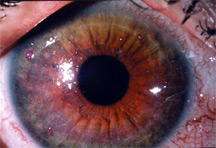
Source: Peter A. D’Arienzo, M.D.
Despite their benefits, dry eye gels and ointments can cause some problems if they’re not appropriately used, physicians said.
First, good eyelid hygiene is essential when using these products.
“It’s this thick gooey substance that might clog the meibomian gland orifice, which may contribute to further dysfunction of the meibomian glands,” Dr. Latkany said.
To counter this, he has his patients apply warm compresses on the lids and follow-up with a gentle massage around the edges of the eyelids and then a cold water rinse, all to clean the meibomian gland area.
Second, patients should avoid gels and ointments with preservatives if they will use them frequently, Dr. Akpek said. “Generally, if they’re using a product four times a day, it should be the preservative-free version,” she said. “Otherwise, it could cause surface damage.” This is why manufacturers are making gels and ointments with gentler preservatives or no preservatives at all, she said.
Dr. Latkany prefers his patients always use preservative-free gels and ointments. Still, “if a patient tries something over the counter with preservatives and he says he loves it and he has no reaction, I just watch him regularly,” he said.
Third, gels and ointments—as well as artificial tears—are often misused or underused by patients. For example, a patient with allergies will use tears or gels for his symptoms, but he does not treat the allergies, Dr. Akpek said.
If the gel has a preservative, it can worsen the allergy symptoms, Dr. Latkany said.
“The allergens tend to stick to the goo,” he said.
Other times, the patient may have a more serious problem for which dry eye is only a symptom and not the sole health issue.
“In rare instances, I have a patient referred for dry eye but he has another underlying condition that needs to be treated such as mucous membrane pemphigoid or thyroid disease,” she said.
“They may have ocular surface disease or a seemingly trivial injury that progresses … The patients are placating their needs through self-care,” Dr. Sheppard said.
Conversely, patients sometimes do not use the gels and ointments when they should—they don’t like the feel of the product, and it’s difficult to apply them. Sometimes they even scratch themselves with the applicator tip.
“As symptoms improve, patients tend to pull back on the most difficult application,” Dr. Sheppard said. “They don’t feel they need to continue their efficacious nighttime regimen.” Those patients may not feel so bad, but the condition still needs treatment, he said.
Future gels and ointments
Although a host of reliable gels and ointments are available over the counter, dry eye specialists still see a role for future improvements with these products.
“The ideal one would have no blur, provide two-hour long relief, and it would be preservative-free. That would be a goldmine,” Dr. Latkany said.
A gel or ointment with sustained medication release would also be a powerhouse product, said Dr. Sheppard.
“These aren’t medications. They don’t change the underlying cause of dry eye, which is inflammation, neurotrophic disease, and perhaps lid disease and meibomian disease,” Dr. Sheppard said. “Hopefully in the future, there will be a way to put sustained medication release in the ointments.”
A dry eye product that addres-ses all three layers of the tear film—the aqueous, lipid, and mucin layers—would be ideal, Dr. D’Arienzo said. For example, some of his patients simultaneously use Soothe (Alimera Sciences, Atlanta) and Systane (Alcon, Fort Worth, Texas) because they provide relief to different areas of the tear film.
Dr. Sheppard also would like manufacturers to include a simple instruction booklet for the ointment user.
“Someone needs to come up with an easy method for instillation,” said Dr. Sheppard, who often sees patients use too much of the gel or ointment because it is difficult to apply.
Editors’ note
Drs. Akpek, D’Arienzo, and Latkany have no financial interests related to their comments. Dr. Sheppard is on the advisory board, speakers bureau, and does clinical research for Allergan (Irvine, Calif.), Alcon (Fort Worth, Texas), Bausch & Lomb (Rochester, N.Y.), Santen (Napa, Calif.), and Novartis (Basel, Switzerland).
Contact Information
Akpek: 410-955-5494, esakpek@jhmi.edu
D’Arienzo: 516-627-0146, eyedoc63@aol.com
Latkany: 212-832-2020, relief@dryeyedoctor.com
Sheppard: 757-622-2200, docshep@hotmail.com