ONLINE EXCLUSIVE
Glaucoma
January 2023
by Liz Hillman
Editorial Co-Director
Constance Okeke, MD, wears many hats. She’s a wife, mother, surgeon, researcher, assistant professor, consultant, and a soon-to-be two-time book author. EyeWorld caught up with Dr. Okeke to learn more about her latest written endeavor and get some insights on what the process of book writing is like for a busy ophthalmologist.
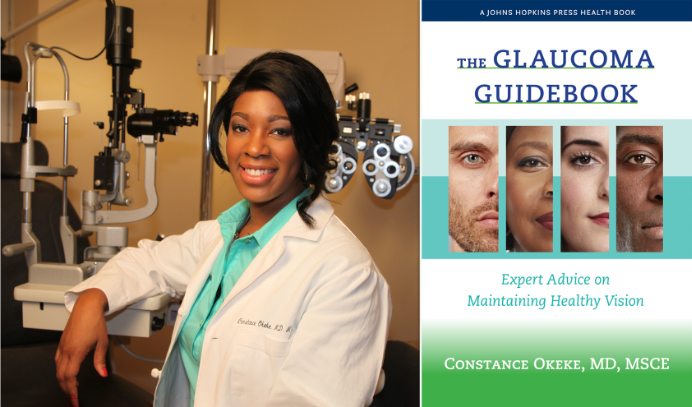
Dr. Okeke’s first book, The Building Blocks of Trabectome Surgery published in 2017, was intended for the medical/ophthalmologist/optometric audience. Her second book, The Glaucoma Guidebook: Expert Advice on Maintaining Healthy Vision, which will be available this month, is intended for patients.
Source: Constance Okeke, MD
“I had a look at the books within the market for glaucoma regarding the patient, and there is not a lot. When you think about topics for chronic diseases like diabetes or high blood pressure, there is an enormous amount of material for the general population,” Dr. Okeke said, citing the need for more patient-accessible information on the topic of glaucoma.
She also said she saw the need from a representation standpoint.
“We know there is an increase in patient satisfaction and comfort when doctors look like their patients. It helps in being able to trust more, which can have a positive impact on how patients adhere to recommendations. So having someone who is a doctor of African descent on the cover relaying this information is helpful in reaching this high-risk audience. Overall for all ethnicities, glaucoma education for the public is an unmet need, and I think that this book fulfills a need there,” Dr. Okeke said.
“In writing the book, it was a goal to make it approachable and easy to read. I wanted to educate not intimidate the reader with words that were not easy to absorb,” she said. The Glaucoma Guidebook uses analogies and patient perspectives to relate to the lay reader.
Dr. Okeke didn’t set out to write a whole book about glaucoma for the lay audience. She said the idea started out as a top 10 list—her best pearls of advice for patients with glaucoma. After she began the list, she realized she could expand it.
“I was encouraged by my husband to pursue it in a book format because as I read through the list, I knew these were points that I wish I could tell every patient. By putting it into a book, I have the opportunity to advise the masses and encourage action that can prevent blindness,” she said.
Dr. Okeke’s first piece of advice for ophthalmologists interested in writing a book, whether it be nonfiction, like a medical book, or even a work of fiction, is to “go for it.”
“If you have a book idea, and it’s one that doesn’t go away, that is a book that needs to be birthed. Writing a book is a labor of love. You love your topic; you want to share your topic with the world, and you think getting your information out will be a service. If you have that passion about something, I would encourage you to write it because when you do it’s a great accomplishment,” Dr. Okeke said.
Start with a brain dump of your ideas on a blank paper in no particular order, she said. Then take a look at the points and see if there are any themes that can be lumped together. Next take the themes and create a good outline. From there, continue adding detail until you start to form chapters. She noted that some people are good typists, while others might find it easier to record their spoken thoughts and have it transcribed. Dr. Okeke said that after writing her books, she reads them out loud.
“My writing tends to be similar to how I would talk to someone, very conversational. … I’ve had people say … reading the book is like having a conversation with me,” she said. “That’s the intended style. Everyone has their own style, but that’s what I’ve found mine to be.”
Dr. Okeke said she’s had a lot of “beta readers” to help refine her work, giving her advice and critiques, which she has taken to heart. These have included medical editors, students, residents, colleagues, and patients, as well as those on the publisher’s staff.
“Their feedback was great, and I used … their suggestions to make it better. I think sometimes people can be very protective about their writing, … but I’m not like that,” Dr. Okeke said. “The whole purpose is for it to be well received, and getting constructive criticism … can make the book better.”
Dr. Okeke said that the time it takes to bring a book from concept to the market should be taken into account. If there is a significant timeliness to your topic, you may need to write it quickly to get it out while there is still relevant interest. Evergreen topics, like glaucoma, can go through the more typical book publishing timeline. Dr. Okeke initially thought of self-publishing, but due to the amount of legwork needed for a self-published book, she ended up going through a formal publisher.
With her first book, Dr. Okeke approached a publisher with a well thought-out outline and finished the book after entering into a contract for it. Her second book was complete when she approached the publisher. Even still, it took a lot longer than she expected to bring the book to publication. Being patient with the process is one of the challenges, she said.
“Recognize that there is a process, and you have to accept that and flow with it. … There are all these steps involved with refining the book I had already written—reviews, reediting, reevaluating, and formatting,” Dr. Okeke said. “There are all these steps involved that I wasn’t aware of, but when I allowed myself to let go of the timeline and enjoy the process, I was appreciative of the reality that I was working with such a dedicated and professional publisher, Johns Hopkins University Press. Each person in the department took pride in what they were doing, and I enjoyed the organization of the process and let go of what the deadline had to be.”
Dr. Okeke said her hope with her latest endeavor is to reach glaucoma patients but also doctors who don’t necessarily treat glaucoma as intensely as a glaucoma specialist might.
“There are things we’ve learned over the years that we can hand to other doctors in terms of concepts for how we approach patients that I think are very beneficial. I see the book as a pathway to empowerment for the glaucoma patient as it builds a foundation of understanding and provides steps to take action and become a self advocate. I think it will help in the doctor-patient relationship and help patients take better care of themselves.”
Contact
Okeke: iglaucoma@gmail.com