Browse articles from EyeWorld.org related to the retina. EyeWorld is the award-winning member publication of ASCRS. The magazine provides news and updates from the Society as well as clinical features in the areas of cataract, refractive, cornea, glaucoma, and practice management. It publishes quarterly with editorial direction from its medical editorial board and staff.
➤ Researchers develop living 3D lab model of human retina
➤ Real-world data shows home AMD monitoring program is better than standard of care
➤ FDA approves new ophthalmic viscosurgical device
➤ Positive topline data for photobiomodulation for dry AMD
➤ Positive topline data for bevacizumab-vikg for retinal indications
OCT is a quick and non-invasive imaging modality with a high sensitivity in diagnosing macular conditions. The ASCRS/EyeWorld Journal Club reviewed a paper by Leung et al. that analyzed a cases series to evaluate the utility of macular OCT in cataract surgery preop assessments.
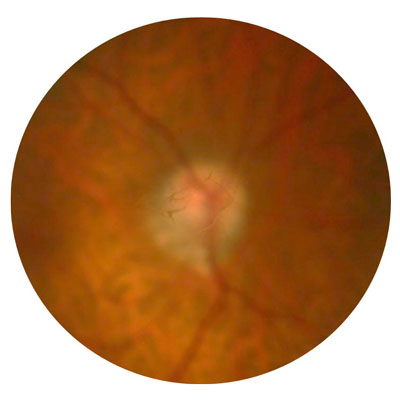
A 75-year-old patient developed a posterior vitreous detachment 3 weeks after uncomplicated cataract surgery in his right eye.
Source: Christina Weng, MD, MBA
When performing cataract surgery, it’s important to be aware of other conditions and comorbidities, including issues with the retina. Several physicians discussed how to handle patients with retina abnormalities prior to cataract surgery.
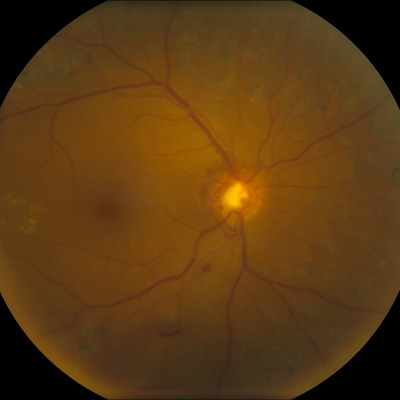
Proliferative diabetic retinopathy and cataract
Source: Keith Warren, MD
Cataract surgery in a patient with diabetes requires special considerations, careful examination, and it may be helpful to have a retina specialist involved.
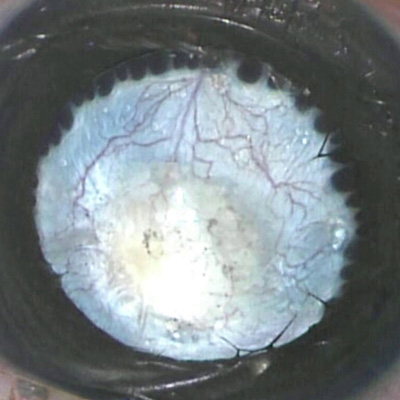
An eye with combined persistent hyperplastic primary vitreous (PHPV) with cataract in a 3-month-old child showing vascularized posterior capsule and stretched ciliary processes.
Source: Jagat Ram, MD
This rare, congenital, developmental anomaly requires specific and nuanced management to prevent various complications that can occur if left untreated.
Retinal surgeons are exploring novel ways to prevent post-vitrectomy cataracts.
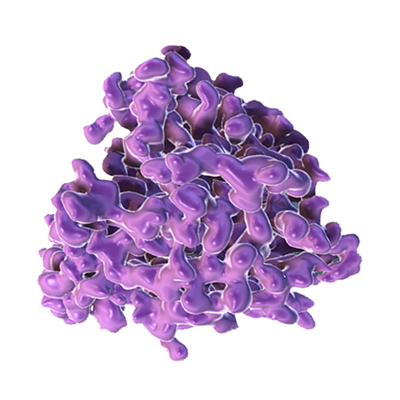
A graphic of the ocriplasmin molecule
Source: ThromboGenics
Ocriplasmin (ThromboGenics) is a first-in-class small molecule delivered through an intravitreal injection that targets fibronectin, laminin, and type IV collagen fibers that adhere the vitreous to the retina. The goal is to create a clean separation of the posterior vitreous cortex and the inner limiting membrane of the retina, thus avoiding a vitrectomy.
Retina experts discuss the things cataract surgeons should evaluate preoperatively and the scenarios they should be on the lookout for intra- and postoperatively.
Patients may view their quality of life negatively after retinal detachment surgery even if surgical outcomes are good, a new study concludes. The negative perception of quality of life is significantly associated with a deterioration of post-op contrast sensitivity, the investigators wrote.

In eyes that have undergone vitrectomy, practitioners must revise their cataract technique Souce: Louis D. “Skip” Nichamin, M.D.
How to best help this complex breed of cataract patients