Browse articles from EyeWorld.org from the refractive archives. EyeWorld is the award-winning member publication of ASCRS. The magazine provides news and updates from the Society as well as clinical features in the areas of cataract, refractive, cornea, glaucoma, and practice management. It publishes quarterly with editorial direction from its medical editorial board and staff.
Sessions on Monday at the ASCRS Annual Meeting included the Innovators General Session, the Winning Pitch Challenge, and various other symposia. The ASOA Annual Meeting held its second General Session.
Both the ASCRS Annual Meeting and the ASOA Annual Meeting began on Saturday, with opening sessions and a variety of symposia, courses, labs, and other sessions.
Friday programming ahead of the official kickoff of the 2021 ASCRS Annual Meeting featured three Subspecialty Day programs on refractive, glaucoma, and cornea.
➤ FDA approves enhanced monovision IOL
➤ Report: Demand for refractive surgery up amid pandemic
➤ Study: Antifibrotic activity of rho-kinase inhibitors
➤ Companies partner to explore nanoparticle applications for ophthalmic therapies
➤ ASCRS Journal Club on April 8
The ASCRS/EyeWorld Journal Club reviewed this large, retrospective, non-comparative case series by Leccisotti and Fields that evaluated the incidence, clinical course, and prognosis of DLK in patients undergoing low-energy femtosecond LASIK in combination with sterile techniques to limit interface contamination.
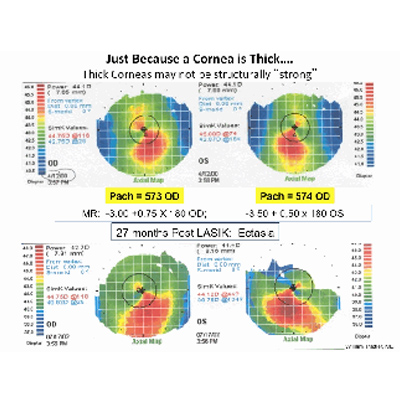
Corneal thickness is not directly related to corneal strength. This patient had a thick cornea but was obviously weak biomechanically, which can be seen on topography as FFKC pre-op. This patient developed ectasia 27 months after LASIK
Source: William B. Trattler, M.D.
The belief that LASIK shouldn't be performed on thin corneas because of the risk of sight-threatening ectasia isn't scientifically valid, according to one researcher. Abnormal corneal topography is the most important preop risk factor for the complication, said William Trattler, MD.