Refractive Surgery
May 2011
by Jena Passut
EyeWorld Staff Writer
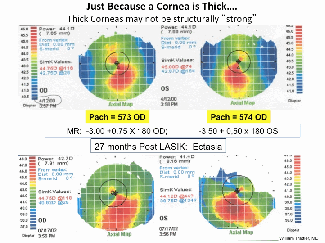
Source: William B. Trattler, M.D.
The belief that LASIK shouldn’t be performed on thin corneas because of the risk of sight-threatening ectasia isn’t scientifically valid, according to one researcher.
Abnormal corneal topography is the most important pre-op risk factor for the post-surgical complication, said William B. Trattler, M.D., director, cornea, Center for Excellence in Eye Care, Miami.
“Most patients who have thin corneas are not abnormal,” Dr. Trattler said.
Corneal ectasia, which is a progressive bulging of the cornea, much like that of keratoconus, can severely reduce both uncorrected and best corrected visual acuity. Researchers have preliminarily identified risk factors for the complication, although a list of true risk factors is still being hotly debated. Some proposed risk factors include forme fruste keratoconus, residual stromal bed less than 250 µm, high myopia, and pre-op corneal thickness less than 500 µm.
Dr. Trattler cited a retrospective review of 1,700 patients who were scored using the Randleman scoring system.
“We found that if the topographies are normal, the Randleman criteria aren’t that helpful for predicting who’s at risk for ectasia,” he said. “I think that the bottom line answer is that corneal topography is reason numbers 1-10 as a sign for who is at an increased risk for ectasia.”
Dr. Trattler said if the patient’s corneas are biomechanically weak, they will warp and develop keratoconus.
“When patients have asymmetry and signs of early kerataconus, you know that those corneas are already weakened, and that is different from patients who are younger or who have thin corneas,” he said. “There is no evidence that thin equals weak.”
Dr. Trattler said results from corneal crosslinking prove his point, since crosslinked corneas become more compact.
“As they become more compact, the corneas stiffen and get stronger,” he said. “The same cornea before and after crosslinking is stronger, but also thinner.”
It is common knowledge that with age, corneas become stiffer. Thickness, however, is a different story.
“There’s no relationship between aging and thickening or thinning. It stays about the same,” Dr. Trattler said. “If you have a patient who is 500 µm and 18 years old, the cornea is going to be about the same thickness but much stiffer when the patient is 70.”
African-American patients, too, naturally have thin corneas, but are not at increased risk for ectasia after LASIK or for developing keratoconus.
“If thickness was related to weakening, we would expect more African Americans to develop keratoconus than Caucasians, but this has never been shown to be the case,” Dr. Trattler said.
He cited a study presented at the 2011 ASCRS•ASOA Symposium and Congress in San Diego in which he evaluated the pre-op topographies of 104 patients with post-LASIK ectasia.
Only 15 of those patients had pre-op pachymetry measurements of less than 500 µm, and 12 of those 15 patients had either keratoconus, forme fruste keratoconus, or pellucid marginal degeneration.
“The point here is that most patients who develop ectasia have pre-op corneal thickness of more than 500 µm. For those patients with thin corneas, the ones that I have seen typically have pre-op topographic abnormalities that would exclude them from surgery in 2011,” Dr. Trattler said.
Dr. Trattler said three of the eyes in the series did have thin corneas and bilateral normal pre-op topography and developed ectasia, however, “these three eyes were in patients with very high myopia, and they did not have intraoperative pachymetry when they had their surgery more than 10 years ago. It is likely that these cases of ectasia were caused by the metal microkeratome creating a thicker-than-expected flap.”
More tissue is often removed by the laser to treat the refractive error in high myopes with a thinner cornea, which results in a patient having a residual stromal bed that is too thin—below 250 µm.
“Since these cases occurred more than a decade ago, we do not know the actual flap thickness,” Dr. Trattler said. “But if thin corneas were an independent risk factor, we would expect many more cases of ectasia to be popping up in patients who had thin pre-op corneas and normal topography.”
Dr. Trattler said corneal topography measurements can identify patients who may have signs of subclinical keratoconus or other corneal abnormalities. Those patients would not be good candidates for LASIK, he said.
Editors’ note
Dr. Trattler has financial interests with Abbott Medical Optics (Santa Ana, Calif.).
Contact information
Trattler: 305-598-2020, wtrattler@gmail.com