Read featured archived EyeWorld articles on EyeWorld.org. EyeWorld is the award-winning member publication of ASCRS. The magazine provides news and updates from the Society as well as clinical features in the areas of cataract, refractive, cornea, glaucoma, and practice management. It publishes quarterly with editorial direction from its medical editorial board and staff.
It’s important to address underlying conditions prior to cataract surgery, and dry eye is one such condition. Physicians must identify and treat it to ensure the tear film is optimized and measurements are correct.
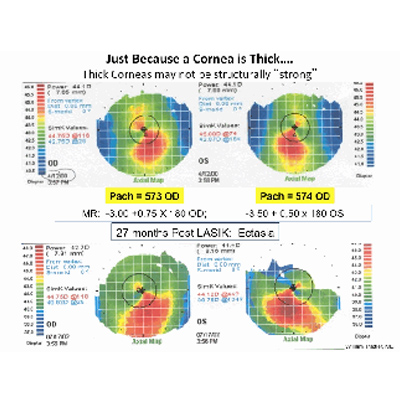
Corneal thickness is not directly related to corneal strength. This patient had a thick cornea but was obviously weak biomechanically, which can be seen on topography as FFKC pre-op. This patient developed ectasia 27 months after LASIK
Source: William B. Trattler, M.D.
The belief that LASIK shouldn't be performed on thin corneas because of the risk of sight-threatening ectasia isn't scientifically valid, according to one researcher. Abnormal corneal topography is the most important preop risk factor for the complication, said William Trattler, MD.
Presenting with a "completely dilated and non-reactive" pupil on postop day 1 can be nerve-wracking for the surgeon. Here's how one physician dealt with the complication.