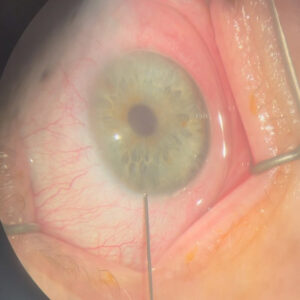
Cornea: Opening doors
Winter 2025
by Ellen Stodola
Editorial Co-Director
Amniotic membrane products can be a valuable tool to help open doors in the treatment of corneal diseases. These products can aid in the treatment of a variety of diseases and can be added to other treatments to help patients find relief. Neel Desai, MD, and John Hovanesian, MD, discussed the different types of products available and best applications.
Dr. Hovanesian has been using amniotic membranes for more than 25 years, since before they were widely commercially available. “Early on, there was a division between the methods of preparing the membrane; one is to freeze, and one is to dehydrate it,” he said. “Both provide viable surgical products; both are equally valuable in my mind as methods of restoring a healthy ocular surface. I think the difference really comes down to what form factor suits the surgeon and application in the patient.”
Dr. Desai agreed that historically, we’ve distinguished amniotic membrane products based on the preservation process. The cryopreserved category is overwhelmingly represented by BioTissue products with their proprietary cryopreservation process that preserves all layers of the amnion as well as HC-HA/PTX3, a high molecular weight complex that provides an initial boost of anti-inflammatory and pro-healing effects.
In contrast, dehydrated membrane products used to be lumped together. “But in the last year or so, I’ve come to realize that’s not a fair lens to view the world in anymore,” Dr. Desai said, noting the introduction of a decellularized, multi-layer amniotic membrane product, Biovance 3L Ocular (DefEYE). With conventional dehydrated membrane, he said, there are numerous options, and these membranes are typically dehydrated in a heat-based process to make them more efficient in terms of time and cost. The Biovance 3L Ocular decellularized basement membrane is processed without heat, which preserves key extracellular matrix proteins and cytokines that promote healing.
Whereas both cryopreserved membrane and conventional dehydrated membranes retain all cellular layers of the donor amnion and some chorionic cells (which are quite inflammatory), the Biovance 3L Ocular product uniquely removes all pro-inflammatory cellular debris and only retains the most beneficial bioactive layer of the amnion—the basement membrane.
After placement of a cryopreserved membrane, the recipient’s healing process can only proceed as fast as the amniotic membrane scaffold is cleared by macrophages and other phagocytic cells. These cells remove donor cellular debris and apoptotic cells that were retained in the cryopreservation process. Any impaired efferocytosis or dysregulated apoptosis can incite inflammation and delay healing. As a decellularized, multi-layer basement membrane, Biovance 3L Ocular does not require cellular clearance and does not carry the same risk of inflammation and delay in healing, Dr. Desai said. This has been shown to produce better cellular viability and adherence, which triggers higher concentrations of both growth factors and anti-inflammatory cytokines that result in profound clinical implications for wound healing, he said.
Dr. Desai’s experience with these products has changed his view on the biological science, the wound healing process, and the clinical results with these products. “I think that based on these more clinically relevant factors, decellularized, multi-layer basement membrane creates and deserves its own category because it’s unique from both cryopreserved and conventional dehydrated membranes,” he said.
Dr. Desai equates the effect of the HC-HA/PTX3 in cryopreserved membranes to having fertilizer in the soil where you want your seeds to thrive. These biological factors eventually become exhausted and the recipient’s healing process must take over. Before doing so, however, the seeds must compete against or clear away retained debris and unwanted organic material within the soil. Meanwhile, he said conventional dehydrated membrane is like having dirt where all the beneficial nutrients have been denatured out by heat and yet there’s retention of debris and competing organic material.
Decellularized basement membrane deserves its own category, according to Dr. Desai, akin to having a purified, nutrient-rich soil to plant seeds in. Though it doesn’t have the temporary initial fertilizer, HC-HA/PTX3, as it only retains the basement membrane, the extracellular matrix proteins and cytokines more efficiently provide a matrix scaffold and promote rapid production of growth factors and anti-inflammatory cytokines that support an enhanced cell-mediated response, letting the recipient’s healing process begin without delay.
When to use these products
Dr. Desai considers amniotic membranes in any circumstance where faster functional healing is desired and passive wound coverage may be insufficient. He previously used cryopreserved membranes exclusively because he didn’t see the same clinical results with conventional dehydrated membranes. But in the past year or so, he has begun to use the decellularized basement membrane. “I’m impressed that the results seem to be equivalent to the cryopreserved membranes for both clinical and surgical applications,” he said, adding that he’s seeing slightly faster healing and greater patient comfort.
The decellularized basement membrane has no ring because it’s multi-layered, laminated, and bi-directional. It adheres to the cornea or to an epithelial defect quite well without the use of glue or a contact lens.
In discussing how to choose when to use amniotic membrane, Dr. Desai noted what he called his “unified theory of ocular surface diseases.” What makes some of these ocular surface diseases distinct is the severity and the longevity of the inflammatory degenerative process. You can see some of the continuity among different dry eye diseases on the spectrum, he said, mentioning things like keratitis, epithelial basement membrane disease, the development of Salzmann’s nodules, and the development of recurrent erosion syndrome. Further on the spectrum, there is pterygium growth and recurrences, conjunctivochalasis, and neurotrophic keratitis. All of these conditions are potential indications for the use of an amniotic membrane, Dr. Desai said.
With dry eye disease, these patients typically have a relatively mild condition that could be progressive. “We want to provide some anti-inflammatory benefit to them right away and get them some relief,” he said. “But at the same time, we don’t want to add more discomfort by putting something in that has a ring on it.”
Using the cryopreserved Prokera (BioTissue), the benefit is that it has an initial anti-inflammatory boost, so it’s going to be soothing. “It puts the inflammatory fire out and buys time to let conventional therapies work,” he said, adding that the downside is it has a ring. CAM360 (BioTissue), a gamma-irradiated membrane, which requires a contact lens or collagen shield for retention, could be used for greater comfort.
Dr. Desai expressed concerns that the most severe dry eye patients he sees, where the benefits of amniotic membrane products might be most applicable, are inherently more prone to infections, especially under contact lenses. Therefore, he prefers other interventional approaches to mild and moderate dry eye as first-line therapy in addition to immunomodulatory therapies and lubricants before utilizing amniotic membrane products. For the most severe cases, Dr. Desai has begun using decellularized basement membrane, which avoids these potential risks. “We usually place the Biovance 3L Ocular membrane and a pressure patch that the patient can remove themselves at day 3. The decellularized basement membrane remains self-retained without significant risk of slippage, dissolving over the course of 3–7 days on its own,” Dr. Desai said.
The decellularized Biovance 3L Ocular works well for things like basement membrane disease, Salzmann’s nodules, and recurrent erosion syndrome, Dr. Desai said. These are conditions where we create an epithelial defect by debriding the cornea, leaving an open wound that we want to heal quickly. In the case of recurrent erosion syndrome, there is a wound that’s not healing at all, and those cells are not adherent to a healthy basement membrane anymore. “For this particular category, I think this is the ideal place to be using the decellularized, multi-layer graft because of the greater cellular adherence, the better viability of those cells, and the faster healing, as well as the comfort.”
For surgical indications like pterygium and conjunctivochalasis, Dr. Desai said he has published on pterygium techniques, specifically the Tissue Tuck technique he developed, using cryopreserved amniotic membranes. His study on the Tissue Tuck technique showed just a 0.7% recurrence rate in primary pterygia without the use of MMC and an average case time of just under 14 minutes.1
“I’ve been experimenting with the Biovance 3L Ocular decellularized basement membrane for these surgical cases and indications. The Tissue Tuck technique was already an improvement over conjunctival autograft in terms of speed, efficiency, comfort, and healing. The decellularized membrane heals faster, is more comfortable, and has as low a recurrence rate as the cryopreserved membrane,” he said.
For neurotrophic keratitis, you can use either a cryopreserved option, like Prokera, or the decellularized basement membrane. For Dr. Desai, the choice depends on the stage of neurotrophic keratitis.
He noted that stage 1 is defined as either a punctate keratitis or a stage 1 with reduced corneal sensitivity; stage 2 NK is defined by a sterile epithelial defect but no stromal involvement. For both of these milder stages, he prefers the decellularized basement membrane.
For stage 3 NK, you could have an epithelial defect but also a corneal ulcer or melt involved and some stromal dissolution because of this inflammatory effect. “That’s a little bit more severe, and I want the added boost of a cryopreserved membrane,” he said, adding that he’ll also prescribe Oxervate (cenegermin-bkbj, Dompe) with this.
“For stage 1 and 2, I’ll use decellularized basement membrane while we wait for Oxervate to be delivered. For stage 3, I’ll use Prokera or Prokera Plus, the multi-layer cryopreserved, and prescribe Oxervate,” he said.
Dr. Hovanesian published the THINK study,2 which showed that a fairly large portion of patients presenting for cataract surgery with dry eye have early-stage neurotrophic keratitis. He said it’s been known for decades that this type of material has powerful anti-inflammatory and anti-fibrotic properties, which makes it useful for promoting healthy healing in a diseased ocular surface. He noted its use in neurotrophic keratitis or any condition where there is an epithelial defect that is not prone to healing on its own.
“… applying an amniotic membrane becomes an interventional treatment that has 100% compliance because you know you’ve put it on. That buys us time to give the conventional treatments a chance to work.”
Neel Desai, MD
Pterygium surgery is another area where this is useful, he said. While pterygium surgery can be done without amniotic membrane, you can use it as a graft, and it’s a little easier of a surgery to learn. However, he noted that recurrence rates using amniotic membrane may be higher than with other pterygium techniques.
Dr. Hovanesian also cautioned against the overuse of amniotic membranes. He noted that particularly in dry eye, you want to be careful you’re not using amniotic membrane when it’s not needed. You need to think about “what’s the right science for my patient” first, he said. While these can be a good option, some patients might have a painful response to treatment with amniotic membrane because they don’t actually need an amniotic membrane.
“When we think about using amniotic membrane products of any kind in the context of things like ocular surface disease, dry eye disease, or anterior basement membrane disease, I think it’s important to realize that using … amniotic membranes is not a replacement for conventional therapies,” Dr. Desai said. “We still will rely on our primary MDs and ODs to prescribe and utilize all of the conventional therapies for dry eye disease.”
He added that it’s important to use things like immunomodulatory therapy, steroid therapy, artificial tears, lid margin treatments, warm compresses, etc. Amniotic membrane products are not a replacement, but they are an adjuvant to accelerate treatment and healing in those cases. Oftentimes, conventional therapies will take weeks, if not months, to work, Dr. Desai said, noting that “applying an amniotic membrane becomes an interventional treatment that has 100% compliance because you know you’ve put it on. That buys us time to give the conventional treatments a chance to work.”
Editors’ note: This is not an exhaustive discussion of all amniotic membrane products available in the U.S. It is limited to companies and products mentioned by the physician sources.
About the physicians
Neel Desai, MD
The Eye Institute of West Florida
Tampa, Florida
John Hovanesian, MD
Harvard Eye Associates
Laguna Hills, California
References
- Desai NR, Adams B. Cryopreserved amniotic membrane using the TissueTuck technique: a sutureless approach for pterygium surgery. Cornea. 2023:42:181–185.
- Hovanesian JA. The THINK Study: testing hypoesthesia and the incidence of neurotrophic keratopathy in cataract patients with dry eye. Clin Ophthalmol. 2024;18:3627–3633.
Relevant disclosures
Desai: BioTissue, DefEYE
Hovanesian: None
Contact
Desai: desaivision2020@gmail.com
Hovanesian: DrHovanesian@harvardeye.com