Refractive
July 2021
by Ellen Stodola
Editorial Co-Director
When choosing the best refractive surgery option, there are a variety of factors that surgeons consider, including patient age, overall goals, and expectations. Three surgeons discussed which procedures they use and some of the specifics of laser refractive surgery, phakic IOLs, and lens replacement surgery.
William Trattler, MD, said that over the last decade, surgeons have come to use LASIK for a variety of patients, from high myopes to hyperopes, in a wide range of ages. Now there are other options as well, he said, noting refractive lens exchange and the option to offer phakic IOLs to patients with lower refractive errors.
When potential refractive surgery patients come in for a consultation, Dr. Trattler said it’s important to be prepared with all the options. “Every patient is going to need a unique strategy to figure out how to make them happiest,” he said. “These are patients that you’ll probably see years after surgery, so you want to give them something to make them happy in the long term as well as short term.”
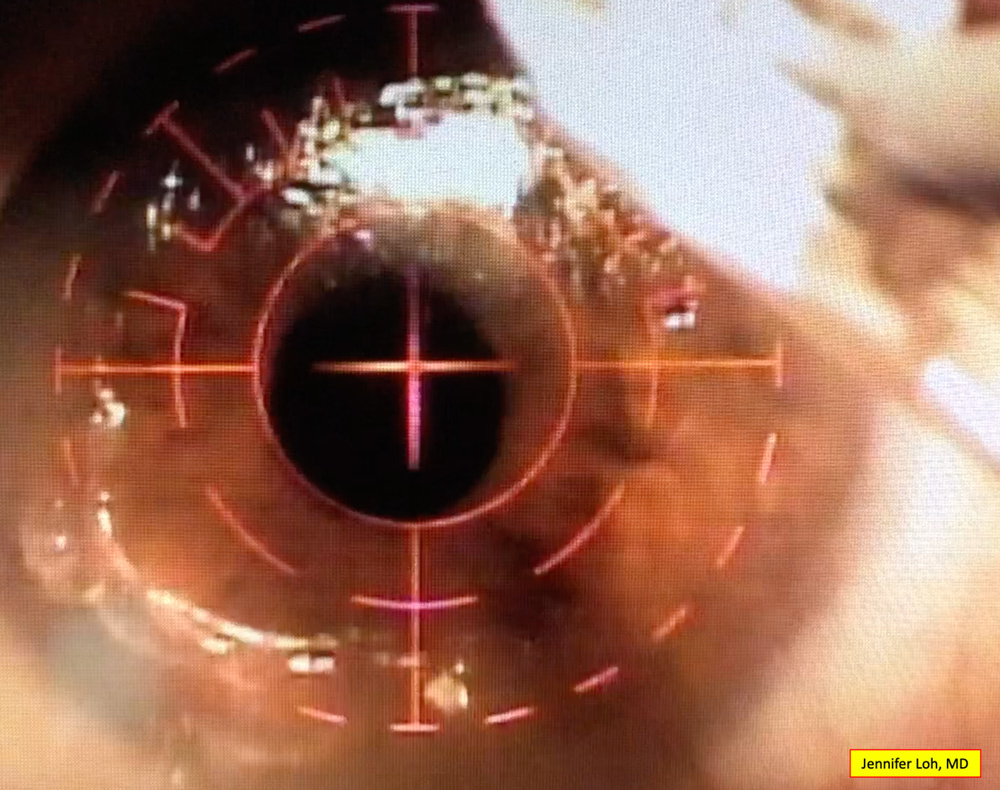
Source: Jennifer Loh, MD
Dr. Trattler said procedure decisions may be easier for the younger patient. For those younger than 40, typically if they’re myopic and under –9 or –10 D, he’ll offer them laser vision correction, which could be PRK, LASIK, or SMILE. That decision depends on surgeon preference, Dr. Trattler said, but these are all good procedures. If the patient has more than –9 or –10 D, that’s when you start thinking ICL. Laser vision correction can be used for high myopes, but its risk profile increases, he said.
A newer version of the ICL is approaching FDA approval and will make the procedure easier, he added. The new version has a small hole in the lens optic that allows for aqueous flow. This eliminates the need for placement of peripheral iridectomies. International surgeons who have been using the technology have commented that this update improves the safety of the ICL, he said.
When considering patients of presbyopic age, choices become more nuanced. For those patients who are hyperopic in their 20s to 30s, Dr. Trattler said they’re typically able to accommodate through their hyperopia, except when the hyperopia is severe. But once patients reach their 40s, hyperopia starts to impact vision, and patients will request refractive surgery consultations. Hyperopic patients in their 40s and 50s may be good candidates for a refractive lens exchange. Dr. Trattler added that with improved technology, patients are usually happy with this option. He said a lens like PanOptix (Alcon), Vivity (Alcon), Symfony (Johnson & Johnson Vision), or Eyhance (Johnson & Johnson Vision) could be considered. Alternatively, a monovision or blended vision strategy with monofocal or monofocal toric IOLs can be considered.
LASIK can still be an option for patients in their 40s and 50s, he said, while ICLs are usually not the procedure of choice except with a high level of myopia.
“I try to create an individualized, custom approach for each patient,” Dr. Trattler said.
He noted that many patients associate the word “LASIK” with improvement of vision to the point of not needing glasses. Many patients don’t understand the different tools and technologies in addition to LASIK that are available to accomplish this goal.
Laser vision correction wouldn’t necessarily be the right choice for a patient in their 60s. This patient might be a better candidate for a refractive lens exchange or could need cataract surgery. “If they’re not going to be a good fit for a certain technology, it’s OK to tell them that,” he said.

Source: William Trattler, MD
When considering the ICL, Dr. Trattler said that a key criteria is that the eye has a certain size anterior chamber depth. If you have an eye that has a shallow anterior chamber, there will not be sufficient space for the ICL.
Allison Jarstad, DO, offers LASIK, PRK, and refractive lens exchange to her patients.
“When creating a treatment plan, I have a holistic approach and take the patient’s age, the stability of their refraction, and the entire eye into consideration. A laser procedure is usually the better option for younger eyes that are refractively stable,” she said. She prefers laser refractive procedures as long as the corneal topography shows no evidence of keratoconus or FFK. “I like to leave an RSB of 300 µm to be safe, but I am pretty conservative,” she said. “If there’s anything suspicious on topography and if the patient is young (early 20s), I will monitor for 6 months to a year prior to proceeding with laser vision correction. If the patient is older (40s or 50s), I counsel them on the much lower but possible risk of post-refractive ectasia.”
Dr. Jarstad prefers PRK over LASIK for patients with glaucoma in order to avoid an IOP elevation when creating the LASIK flap. She opts for PRK in patients with ABMD since they often benefit from a superficial keratectomy.
For patients outside of the range of laser refractive correction and who want to avoid intraocular surgery, treating a majority of their refractive error can still yield good results. She sometimes offers PRK on top of a fully healed PKP graft in a young person who doesn’t have evidence of a cataract but has postoperative myopia or astigmatism.
If there is topographic evidence of mild keratoconus or FFK, Dr. Jarstad recommends a phakic IOL. However, she cautioned that you need to ensure that the patient receiving a phakic IOL has a deep enough anterior chamber, which usually is the case in highly myopic patients. She also mentioned the importance of obtaining a specular microscopy to ensure a healthy endothelial cell count. For iris-claw phakic IOLs you want to make sure the iris tissue is without atrophy or any abnormalities, Dr. Jarstad added.
Though she does not implant phakic IOLs, Dr. Jarstad said she has removed them at the time of cataract surgery for many patients. “I think they are a great option in younger patients who are extremely myopic and are unable to undergo LASIK,” she said. “If their pachymetry is too thin for LASIK or PRK or if their treatment is outside the parameters of our laser, I will discuss a phakic IOL and refer these patients to a colleague who implants them.”
For patients over age 50 who have no evidence of cataract and would like to have refractive surgery, Dr. Jarstad will consider LASIK with monovision, but she also counsels them on refractive lens exchange with either monovision or a multifocal or EDOF IOL.
When considering LASIK vs. lens replacement, Dr. Jarstad said it’s important to look for narrow angles as this will impact the surgical plan. If the angles are narrow in an otherwise healthy eye, she prefers refractive lens exchange. “I explain to the patient that they can have bilateral PIs then LASIK (four procedures) vs. RLE (two procedures). If the anterior chamber is narrow and I can’t perform a dilated exam, I always obtain an Optos and do my best to evaluate the retina with a 90 D lens at the slit lamp to rule out retinal pathology,” she said. “I also like to get a macular OCT for my RLE patients prior to operating.”
Kathryn Hatch, MD, said she uses all of these refractive surgical options for her patients, and she stressed that the decision among the three has a lot to do with a patient’s goals.
For a younger phakic patient with good accommodation under the age of 45, she said lens replacement surgery is not typically used, though she noted there may be some occasional outliers.
Dr. Hatch usually offers lens replacement surgery for patients age 55 and older, but it also depends on the prescription. “I have plenty of patients between age 50 and 65 who can have laser vision correction and do great with that,” she said. Once they’re over 65, most patients have some form of cataract, and it makes sense to do lens replacement at that age, she said.
For patients with high degrees of hyperopia, Dr. Hatch said you have to be careful about doing laser vision correction because these patients can lose visual quality, and outcomes become less predictable. Older presbyopic hyperopes are good potential candidates for lens replacement, she said.
“In my practice, with phakic IOLs, I’m typically offering those for extreme myopes or myopic astigmatism or people who aren’t good candidates for laser vision correction,” Dr. Hatch said. “I’ll mention it to a higher myope, but I’m not usually offering it for moderate myopia.” If she had a high myope with a slightly irregular cornea and didn’t want to do laser surgery, she thinks a phakic IOL is a great alternative.
She stressed the role patient’s goals play in the decision-making process.
Dr. Hatch added that there is a cost factor as well. Phakic IOLs and lens-based surgery are much more costly. Though she tries to focus on what the best option for the patient would be, if the patient is a candidate for multiple procedures, she tries to make a custom recommendation for each patient.
Dr. Hatch said it’s also important to know which options will not work with certain conditions. A shallow anterior chamber, keratoconus, and nanophthalmic eyes, for example, can be contraindications for some procedures.
Comparing the procedures, Dr. Hatch stressed that with lens surgery, there are presbyopia options. If you’re doing a phakic IOL or laser vision correction, you’re not treating presbyopia, so monovision can be explored.
Phakic IOLs preserve the cornea, but you’re putting an implant in the eye that could increase the risk for cataracts or pressure issues related to sizing of the ICL. With the new ICL models on the horizon, this risk will be significantly reduced, she said.
She added that IOL surgery is a one-time surgery, but if you do laser vision correction on someone, they’ll need IOL surgery in the future. “That probably doesn’t matter to patients under 40, but once you start talking about the pre-cataract group, that might be something to think about,” she said.
“We have all these amazing technologies that give us great results,” Dr. Hatch said. “But I do think the patient wants you to tell them what they should have. They appreciate a recommendation. They know what they want the results to be, and it’s our job to pick the procedure that best aligns with their expectations and goals.”
About the physicians
Kathryn Hatch, MD
Assistant Professor of Ophthalmology
Harvard Medical School
Boston, Massachusetts
Allison Jarstad, DO
SoCal Eye
Long Beach, California
William Trattler, MD
Center for Excellence in Eye Care
Miami, Florida
Relevant disclosures
Hatch: Carl Zeiss Meditec, Johnson & Johnson Vision
Jarstad: None
Trattler: Alcon, Bausch + Lomb, BVI, Johnson & Johnson Vision
Contact
Hatch: kathryn_hatch@meei.harvard.edu
Jarstad: allison.jarstad@gmail.com
Trattler: wtrattler@gmail.com