ASCRSNews: 2022 ASCRS Annual Meeting recap
June 2022
by Ellen Stodola
Editorial Co-Director
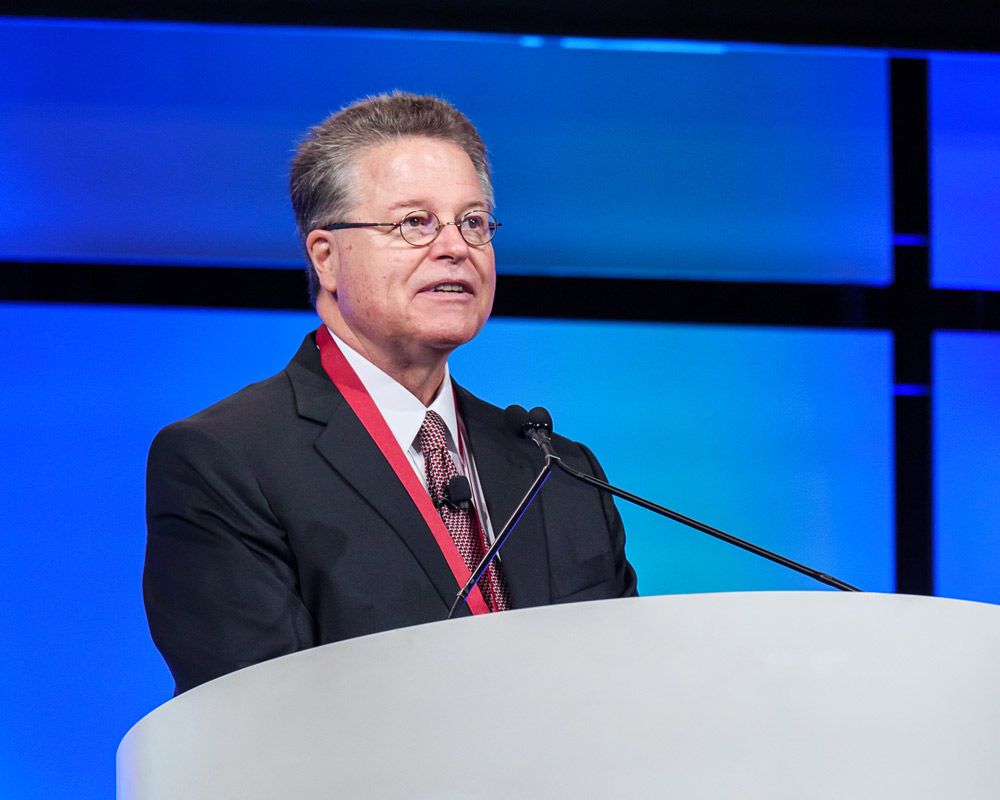
The Richard L. Lindstrom, MD, Lecture this year was given by Warren Hill, MD, on the topic of “Accuracy for IOL power selection … Are we there yet?” The lecture is part of the Lindstrom Symposium and took place on April 24 at the 2022 ASCRS Annual Meeting
Cataract surgery is a growth industry, but one of the problems is it has a limited capacity, Dr. Hill said. How can we be more efficient? Dr. Hill said avoiding complications is the overall goal, and an unanticipated refractive outcome is the most common complication of routine cataract surgery. He went on to discuss IOL power selection, noting that anterior segment surgeons are being judged by patients and peers by refractive outcomes.
Source: ASCRS
In terms of accuracy standards, Dr. Hill questioned whether what’s most common should be good enough. A significant part of the accuracy of modern theoretical formulas depends on the correct estimation of the effective lens position before surgery.
Is there another way we can do this? Dr. Hill said this might be a case for the development and use of artificial intelligence. Artificial intelligence does not limit possibilities to situations that are already understood. It’s able to make the best of what’s available, bypassing the limitations of physical models. It’s also well suited to real-world problems where ideal models are not available. This has incredible sensitivity for identifying and unraveling complex, non-linear relationships, Dr. Hill said, and it’s free of calculation bias. He also discussed pattern recognition with artificial intelligence. Why shouldn’t this be used for IOL power? Artificial intelligence allows for the use of a tool that anticipates the accuracy of the calculation.
Ophthalmology is experiencing a convergence of technologies for IOL power selection accuracy, Dr. Hill said, noting ray tracing, advanced vergence formulas, artificial intelligence, and intraoperative aberrometry. The method with the greatest sensitivity and flexibility will give the greatest accuracy as technology advances, he said.
Reay Brown, MD, presented on cataract surgery for angle closure glaucoma. He referenced the 2009 landmark glaucoma study showing that cataract surgery lowers IOP in open angle glaucoma.1 The key insight, he said, was to stratify by preoperative IOP. This inspired Dr. Brown to look at angle closure. It makes sense that cataract surgery is effective in angle closure. Cataract surgery opens the angle to almost a normal depth.
Dr. Brown went on to share several cases. The first was a woman with a clear lens who had multiple laser treatments and closed angles for 6 years. She had more cupping in the eye with higher pressure, and it was clear she was getting worse despite maximal treatment. The choices in 2008 were either a trabeculectomy or tube shunt. Dr. Brown thought cataract surgery would be a better choice, but he called it a “radical decision” because she had a clear lens. With 14 years of follow-up, “it’s like she doesn’t have glaucoma,” he said.
Dr. Brown wrote this case up with several others in a study.2 Clear lens extraction showed greater efficacy and was more cost effective than laser peripheral iridectomy and should be an option for first-line treatment.
Dr. Brown also brought up the issue of toric IOLs and premium lenses in glaucoma. Even glaucoma patients having cataract surgery want the best possible outcome. He concluded by saying that phaco is effective in glaucoma treatment in angle closure at all stages.
Steven Dell, MD, presented on late laser vision correction (LVC) enhancements. Surgeons are accustomed to operating on Baby Boomers, but a lot of Generation X patients are starting to appear in the office. Generation X are presbyopic or becoming so, and they grew up with soft contact lenses, some had RK, many had LVC in their 20s, they have a high desire for spectacle independence, and many have lens changes or an outright cataract.
IOL calculations are advancing but doing them in the post-LVC patient is still tough, Dr. Dell said. Residual refractive error is a major cause of post-IOL dissatisfaction. The weak link is often finding the actual corneal power.
He then discussed options for late LASIK enhancements. Surgeons know that relifting old flaps is associated with risk for epithelial ingrowth. He suggested a new side-cut only or a larger, deeper flap could be helpful, but these options also have limitations.
Most do PRK for late enhancements. Epithelial mapping can be extremely useful in these situations, he added. The epithelial thickness in prior laser vision correction patients may be highly variable, and the epithelium itself may make a positive, negative, or neutral contribution to the overall corneal power. Removing the epithelium during PRK may unmask this contribution. The degree of lensing effect is somewhat proportional to the amount of the original laser vision correction.
What is there to do? Dr. Dell said you could wait and see if the epithelium grows back the same way (which takes many months and is somewhat unpredictable). The best option, he said, may be to split the difference of the epi “lens” effect.
This is a common scenario-post IOL. Any PC-IOL strategy must include a bail-out scenario. If LVC is fraught, IOL exchange may be preferred in some cases, he added. This is a strong argument for the Light Adjustable Lens (LAL, RxSight).
Clara Chan, MD, presented “Are we seeing more inflammatory corneal events?” She noted some variables to consider because of COVID-19: patients missing follow-up visits, prescriptions not being renewed, fear of steroids causing “immune compromise,” fear of the hospital, and mass vaccination campaigns with vaccines with novel mechanisms of action.
Are we seeing more inflammatory corneal events? She presented cases to demonstrate this and how the COVID-19 vaccine factors in.
She shared a case of a DMEK rejection in a 69-year-old Hispanic male. The patient had DMEK for Fuchs dystrophy, and the graft failed in 2019. He had a second DMEK that was uneventful in 2020. He was doing well postop, but 4 months after surgery, he presented with a red eye that started 3 weeks after his first COVID-19 vaccine. Given his history, Dr. Chan was more aggressive in adding oral steroids and stepped up topical steroids, and the case resolved. Rejection after all forms of COVID-19 vaccines has been reported in the literature, she noted. Dr. Chan also shared cases where patients came in following the first and second doses of the vaccine with various issues.
Dr. Chan said that the mRNA vaccine delivers specific genetic information to host cells to produce foreign proteins, so the immune system is upregulated. Inflammatory events have been reported with all of the COVID-19 vaccines. She said it’s important to counsel patients about signs and symptoms of ocular inflammation. Increase topical steroids to QID 2–4 weeks after vaccination before returning to baseline prophylaxis dose in high-risk grafts or in those with a history of HSV/HZV immune keratitis. Completing the COVID-19 vaccination series prior to corneal transplantation is also recommended.
Dimitri Azar, MD, presented “Convergence of roles of physicians and industry in ophthalmic innovation.” Many physicians are part of the leadership of some of the top pharmaceutical companies. All are playing a critical role in this industry that’s supporting us and innovation, he said.
One point that Dr. Azar stressed is the opportunity in digital ophthalmology. He shared a scheme of how to join the digital ophthalmology revolution, whether a physician has an idea and wants to have their own startup or if they have an interest in joining ongoing programs that are focused on this purpose.
Among the drivers of growth in the global digital health market, Dr. Azar said there are several factors including rising smartphone utilization, integration of and connectivity among advanced digital technologies, as well as successful implementation of mobile health technologies for self-management, primarily outside of ophthalmology.
Just a couple of decades ago, ophthalmic devices were large and provided scarce data. Time between doctor visits is more relevant for disease prevention, he said. Artificial intelligence is big in this. Ophthalmologists will be playing a significant role. There are many remaining challenges in artificial intelligence, he said, but also a lot of opportunities for anyone who wants to join this industry.
About the physicians
Dimitri Azar, MD
President and CEO
Twenty Twenty Therapeutics
South San Francisco, California
Reay Brown, MD
Atlanta Ophthalmology Associates
Atlanta, Georgia
Clara Chan, MD
Assistant Professor
Department of Ophthalmology and Vision Sciences
University of Toronto
Toronto, Canada
Steven Dell, MD
Dell Laser Consultants
Austin, Texas
Warren Hill, MD
East Valley Ophthalmology
Mesa, Arizona
References
- Poley BJ, et al. Intraocular pressure reduction after phacoemulsification with intraocular lens implantation in glaucomatous and nonglaucomatous eyes: Evaluation of a causal relationship between the natural lens and open-angle glaucoma. J Cataract Refract Surg. 2009;35:1946–1955.
- Brown RH, et al. Clear lens extraction as treatment for uncontrolled primary angle-closure glaucoma. J Cataract Refract Surg. 2014;40:840–841.
Relevant disclosures
Azar: Santen, Twenty Twenty Therapeutics, Verily Life Sciences
Brown: Sight Sciences
Chan: Pfizer
Dell: Allergan, Bausch + Lomb, Johnson & Johnson Vision, LENZ Therapeutics, Lumenis, Ocular Therapeutix, Optical Express, RxSight, Tracey Technologies
Hill: Haag-Streit
Contact
Azar: dimitri.azar@twentytwenty.com
Brown: reaymary@comcast.net
Chan: clarachanmd@gmail.com
Dell: steven@dellmd.com
Hill: hill@doctor-hill.com