
Cataract: Digital Momentum
Summer 2026
by Liz Hillman
Editorial Co-Director
“This could potentially scale and democratize cataract surgery on a global level.”
David F. Chang, MD
Imagine this: A patient is undergoing cataract surgery, but the surgeon, who traditionally would be seated inches from them, is a few meters away or someday even thousands of miles away. He or she is operating via a robotic system intended to increase precision, safety, and access to care.
Uday Devgan, MD, FACS, had this experience performing the first-in-human robotic cataract surgery in 2025.
“Since the instrumentation was modeled after our currently used cataract surgery tools, it was very natural. Even the shape of the joystick is the same as a traditional phaco probe,” Dr. Devgan said of performing the procedure with the Horizon Surgical Systems Polaris platform. “For an experienced surgeon, the learning curve will be very natural and intuitive.”
Horizon and ForSight Robotics are two companies making headway in robotic cataract surgery, but surgeons say this technology is still a long way from becoming fully autonomous and mainstream.
“Everything takes time. It was many years from Dr. Kelman’s first phaco until widespread adoption, and yet now we cannot even imagine a cataract surgery without ultrasonic phaco. The same will apply to robotic-assisted cataract surgery. This is just the beginning, and the future may be far brighter than any of us can currently imagine,” Dr. Devgan said.
“Right now, robotic surgery is taking over in many other specialties, so why not ophthalmology?” said Rodrigo Quesada, MD. “There has been some robotic surgery done in retina. … If you compare the robot and the human, the robot is better in many parts of the surgery, it’s more exact, more precise. … I still think you will need the ophthalmologist to be behind it to manage the robot. It’s something that is inevitable and coming in the future. … It’s something that is going to essentially be the way we perform more precise surgery in the future.”
Why robotic cataract surgery?
Cataract surgery is already widely considered to be one of the safest and most effective elective procedures, so how could a robotic system improve upon that?
Kevin Waltz, MD, OD, said his first impression of robotic cataract surgery was “Why bother? … We’re already good.” But then he thought further. “As you look at the universe of results, we’re not as good as we need to be,” he said. “As a profession, we’re not as good and safe with cataract surgery as we would like.”
And while improving safety and efficacy is the primary goal of such a robotic system, the possible benefits go beyond that. David F. Chang, MD, said in an email to EyeWorld that while he was initially skeptical about the idea of autonomous and semi-autonomous robotic cataract surgery, he thought it was a concept worth pursuing, due in part to the worsening global shortage of cataract surgeons.
“Even the highest income countries, such as the U.S., will face this shortage because we don’t graduate enough residents to replace the number of retiring ophthalmologists every year. I’ve been extremely impressed by the current robotic hardware, which I’ve used to perform surgery in animal eyes located 15 feet away from my workstation,” said Dr. Chang, who has worked with the ForSight Robotics system as chairman of its Clinical Advisory Board. “You operate using a 3D heads-up monitor, just like we currently can with systems such as the NGENUITY [Alcon]. It is quite plausible for machine learning AI software to learn from surgeons manipulating the same robotic arms to eventually be able to perform routine cases autonomously. This could potentially scale and democratize cataract surgery on a global level.”
Creating a competent cataract surgeon takes an incredible amount of time and resources. “It’s decades of effort,” Dr. Waltz said. “You have this highly skilled system to do cataract surgery that’s expensive to replicate and support, so what if you could make it so that the surgeon could be more efficient and safer by providing a robot to assist them? The robot’s not going to make the decisions, but if you had an ophthalmologist making the decisions, and they’re supervising the robot, you could potentially get to a place that would be very interesting for the ophthalmologist, the patient, and the system.”
Dr. Quesada said he thinks robotic cataract surgery could someday extend ophthalmologists’ careers as they age. “You’re going to have the opportunity to be a surgeon for many more years because your abilities with time go down, but with the robot, it will be getting better each time. The machine also has artificial intelligence, so it keeps learning really fast. You can study and you can practice, but you cannot learn as fast as the robot,” he said.
Dr. Chang said robotic-assisted cataract surgery is the first step, where surgeons perform the procedure by controlling robotic arms. “This might offer improved ergonomics for the surgeon,” he said. “We might discover tactile benefits to operating without gloves, and the workstation would have features to steady our hands, dampen microtremors, and enable more precise maneuvers with our non-dominant hand.”
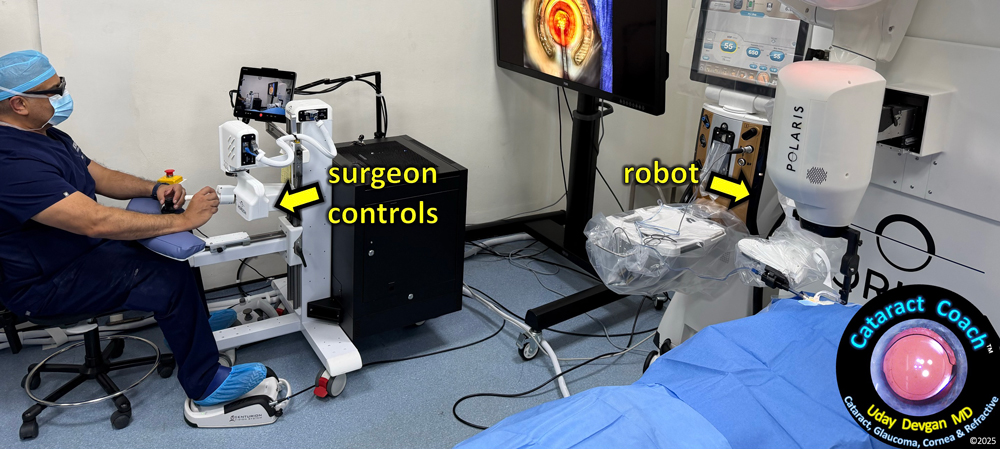
Source: Uday Devgan, MD, FACS
The economics of robotic cataract surgery
When the economics for robotic cataract surgery was considered, a common reference that was brought up was femtosecond laser-assisted cataract surgery (FLACS).
“I think as a first step, robotic surgery will be introduced as something like a premium feature for cataract patients,” said Boris Malyugin, MD, PhD. “Following that, I think there will be a need to understand and assess the benefits of the technology in real-world scenarios with multicentered randomized clinical trials,” he said. “If these benefits are proven, I think the next step for robotic surgery will be wider adoption for regular cases covered by insurance.”
“There will be a time and a place when we’ll learn how to fit this sophisticated surgical device into our cost structure,” Dr. Waltz said, comparing it to when he used to make LASIK flaps with a microkeratome. He was hesitant to switch to a femtosecond laser because he was doing well with the microkeratome, however, once he tried it and saw the difference, he couldn’t go back, even though use of the laser cost him more to do the procedure. “We’ll make those decisions as the parameters become clear. It’s not clear how much a robot is going to cost. It’s not clear what the insurance industry is going to think about that.”
From a cost standpoint, Dr. Chang said that robotic-assisted procedures would need to reach critical volumes for the cost to come down.
The first-in-human robotic cataract surgery
Dr. Devgan performed the first-in-human robotic cataract surgeries at the Clinica Quesada in El Salvador in 2025. He said the procedure felt natural because the instrumentation of the Polaris system was modeled after current cataract surgery tools.
Beyond what felt natural, Dr. Devgan said he was able to perceive things he normally could not see, such as using OCT to judge the depth of the phaco groove while sculpting the nucleus and to determine if the IOL haptics were both in the capsular bag. Overall, he said the technology created “more precision within the eye … beyond the level that I could achieve on my own.”
“The surgeon is in control the entire time. [It’s] important to emphasize that this is robotic-assisted cataract surgery where the robot will make me, the surgeon, a better version of myself,” Dr. Devgan said.
The Polaris system, according to Dr. Devgan, is designed to perform the entire cataract surgery. During the first-in-human procedures, standard OR staffing was used, but he envisions a future where fewer staff would be needed because the robot could reduce certain needs.
Dr. Waltz said he was brought in to help with safety, compliance, and in gaining clinical evidence, getting the system from “strong lab work to operating on people safely. … I’m not an expert in robotics. I’m an expert in getting safe experiences in humans.”
During the first cases, Dr. Waltz said the surgeon sat at a pilot station to drive the robot performing the surgery; the next cases had the surgeon doing most of the surgery while driving the robot but also allowed the robot to do a little bit of sculpting. “We had the robot make some decisions because we wanted to see how well it made decisions,” he said.
Dr. Quesada was involved in the screening of candidates for the procedure and postop care. He said he felt confident offering the opportunity to be part of the first robotic cataract surgeries after seeing the procedure safely performed in many cadaver eyes. He said the postops for the first-in-human cases looked amazing. “It performed 10 cases, and all 10 were perfect surgeries with 20/20, 20/25 vision. All of the patients were happy with the result,” he said.
While he got to be involved with this stage of the research, Dr. Quesada acknowledged the decades of work that has brought the robotic system to this point. “One of the main inventors of this robot was almost crying when he saw his baby perform an actual cataract surgery in a human. It’s a wonderful team to work with. They’re very professional, and safety was the main priority.”
From these first cases, Dr. Waltz said the research team collected data that will be analyzed to see how the robot can be improved. “We’ll make sure it’s safe. We’ll come back and do it again and again,” he said.
For the ForSight Robotics system, Dr. Malyugin, who consults for the company, said it has been used in several hundred cataract procedures in animal eyes, and the first-in-human has been completed. “I was able to do all the steps of the surgery from incision to IOL implantation to incision sealing,” Dr. Malyugin said. “The system is very robust and allows me to provide all these steps in a very consistent manner.” The system was recently used to perform 12 in-human cases from start to finish at a center in Manila, Philippines.
Dr. Malyugin said the core of every robotic technology is its micromanipulator, which depends on precision and the degree of freedom allowed to the manipulator performing the surgical maneuvers. Dr. Malyugin said the ForSight Robotics platform has 14 degrees of freedom for the delicate tasks of cataract surgery.
What’s next
All the physicians interviewed said it’s still a long way off before robotic cataract surgery (especially a fully automatized version) is mainstream. Even then, such technology will never replace the human surgeon.
Dr. Malyugin said he thinks the rollout of robotic cataract surgery in the future will be staged where the surgeon is controlling the systems more at first before the technology transitions to be more autonomous.
“Like the idea of a self-driving car, there are some self-driving cars around already, but we’re still driving cars by ourselves; we think that at some point these cars will be driven by artificial intelligence,” he said, envisioning a similar process for robotic cataract surgery.
Even if robotic systems become autonomous to perform cataract surgery, this won’t eliminate the need for the surgeon.
“You will still need an ophthalmologist to oversee and back up a group of fully autonomous robotic stations,” Dr. Chang said. “Drivers and pilots can override and resume control of a self-driving car or airplane on autopilot. Perhaps the surgeon would confirm proper completion of each major step (e.g., capsulotomy) prior to permitting the next step to occur. Imagine a high-volume surgeon needing to perform twice as many cases per day to meet the increasing surgical backlog. Having robot ‘assistants’ simultaneously performing the steps would be a way to increase each ophthalmologist’s capacity. Ophthalmologists would still do the more complex cases.”
Dr. Malyugin also said the human surgeon will be needed for complex cases. “We still have quite a number of cases with complicated scenarios, where something unexpected happens, and the condition of the eye does not allow us to do the surgery as planned. This change of plan will require a human to be around and to be ready to do the job,” Dr. Malyugin said.
“Longer term, I am hoping that fully autonomous robotic surgery could mitigate the growing burden of cataract blindness and disability in low- to middle-income countries, which already have critical shortages of well-trained surgeons,” Dr. Chang said. “For the governments of these countries, this could be a much faster, efficient, and cost-effective way to scale the volume of quality cataract surgery. The same hardware and software would be used to achieve similar outcomes whether the procedure was performed in a low-income country or in the U.S.”
Dr. Waltz also pointed to phacoemulsification developed by Charles Kelman, MD, in the mid-1960s and how it took 30 years before it was common practice. A similar refinement and adoption period would take place for robotic cataract surgery, he said.
“The robots are going to have to prove that they’re at least as good as humans, if not better, and safer. And we’re going to have to prove that patients will trust them,” Dr. Waltz said. “What we’ve shown is that in the right circumstances, the robot can work. We haven’t shown that the robot will work at a high enough efficiency and safety yet, but we got through 10 patients with no complications, so that’s a positive sign.”
Article Sidebar
A symposium on this topic, “Robotic Surgery: How Soon and How Good Will It Be?,” was presented at the 2026 ASCRS Annual Meeting in April. Scan here to read a recap of the symposium on www.EyeWorld.org.
About the physicians
David F. Chang, MD
Altos Eye Physicians
Los Altos, California
Uday Devgan, MD, FACS
Devgan Eye Surgery
Los Angeles, California
Boris Malyugin, MD, PhD
Professor of Ophthalmology
Joan & Jerome Snyder Endowed Chair in Cornea Diseases
Assistant Medical Director
UCLA Stein Eye Center Santa Monica
Santa Monica, California
Rodrigo Quesada, MD
Clinica Quesada
San Salvador, El Salvador
Kevin L. Waltz, MD, OD
Partner
Central American Ophthalmic Research Consultants
Indianapolis, Indiana
Relevant disclosures
Chang: ForSight Robotics
Devgan: Horizon Surgical Systems
Malyugin: ForSight Robotics
Quesada: Horizon Surgical Systems
Waltz: Horizon Surgical Systems
Contact
Chang: dceye@earthlink.net
Devgan: devgan@gmail.com
Malyugin: boris.malyugin@gmail.com
Quesada: rquesadaeyemd@yahoo.com
Waltz: kwaltz56@gmail.com