
Cornea: Rewind. Refresh. Refine.
Fall 2026
by Liz Hillman
Editorial Co-Director
Blepharitis diagnosis and treatment have shifted in recent years. From the ability to diagnose blepharitis subtypes to the ability to treat those subtypes specifically, there are the established, over-the-counter options like lid hygiene and warm compresses, procedural treatments, and FDA-approved prescription options.
Overall, blepharitis is becoming a more treatable ocular surface disease, and Kendall Donaldson, MD, MS, Stephen Pflugfelder, MD, and Gerami Seitzman, MD, have something to say about it.
Source: Gerami Seitzman, MD
Source: Gerami Seitzman, MD
Blepharitis diagnosis and classification
While Dr. Donaldson finds it clinically useful to think of blepharitis as subtypes, she thinks blepharitis is best understood as a multifactorial spectrum disease with overlapping drivers. It doesn’t necessarily fit into rigid categories, but when it is categorized, these are the main ones: anterior blepharitis (staphylococcal or seborrheic), posterior blepharitis (meibomian gland dysfunction [MGD]), and parasitic (Demodex-associated collarettes as pathognomonic).
“In practice, precise subtyping is less important than identifying the dominant mechanism, and all of the following should be considered: bacterial load/inflammation, biofilm, meibomian gland obstruction, and Demodex infestation. Subtype labeling may help guide therapy, but treatment should be mechanism-driven, not label-driven,” Dr. Donaldson said.
Dr. Seitzman said most of her blepharitis patients are refractory referral cases, which frames her treatment approach. “When I think of blepharitis, I think more like a dermatologist. I am frequently asking myself questions like: Is this rosacea? Is this atopy? Is this contact dermatitis? Is this seborrhea?” she said. “I think subtyping anterior and posterior blepharitis is important. In our field it’s almost Pavlovian to think ‘blepharitis’ and have the reflex treatment be lid scrubs and warm compresses. But in my opinion, this is not always a great approach.”
Treating by type
As Dr. Seitzman said, she doesn’t always recommend scrubs and warm compresses for blepharitis. She thinks that treating by subtype can yield more effective results.
“If there is eyelash debris (anterior blepharitis), then an eyelid scrub makes sense. But if there is only meibomian gland clogging, lid scrubs don’t make sense to me. Conversely, if the lid margin is inflamed, and there is no eyelash debris, lid scrubs can further irritate the lids,” Dr. Seitzman said. “Commonly, the rebuttal to this opinion is that we want to uncap the glands, so we ask patients to scrub their lashes. This doesn’t make anatomic sense to me because we do not ask patients to run their fingers across their lid margins (where the meibomian glands are), and it’s unclear to me how a traditional eyelid scrub would help unroof a meibomian gland. Heat and anti-inflammatories make sense to me for clogged and inflamed glands.”
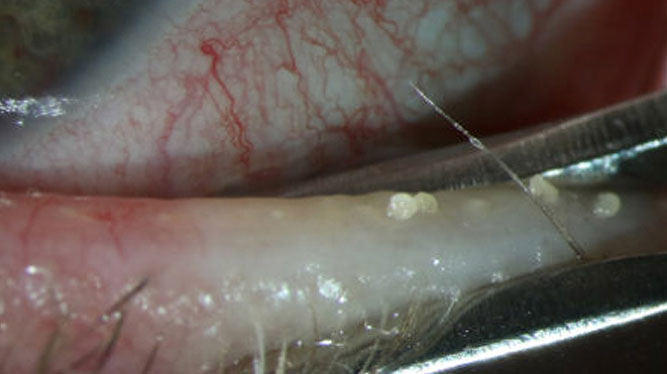
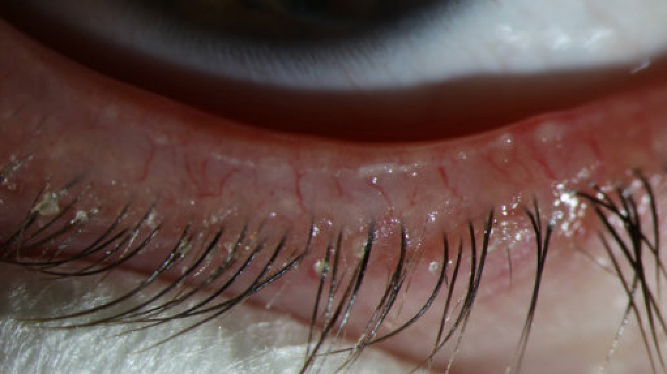
An eyelash scrub is beneficial when there is a lot of anterior blepharitis, Dr. Seitzman said. She noted that in her referral practice, most of her patients have already failed over-the-counter methods. “This is where subtyping anterior blepharitis is helpful. There are different opinions on the names we give the objective findings in anterior blepharitis—collarettes, sleeves, scurf—but in general, we agree there can be staphylococcal overgrowth. This commonly looks like large, lacy, flaky debris. Here, a targeted antibiotic lid scrub may be required if over-the-counter measures are ineffective,” she said.
When there are circumferential, tube-like lash debris present, which Dr. Seitzman said are called a “sleeve” in textbooks but marketed as a “collarette” by Tarsus Pharmaceuticals, Demodex are present. This is where “XDEMVY [lotilaner, Tarsus Pharmaceuticals] works great,” she said, adding that some use off-label topical ivermectin or tea tree oil. The latter “is not a bad idea” but can be a better idea for maintenance after a medicated round has more markedly decreased the Demodex.
Dr. Pflugfelder said he’ll also treat Demodex with tea tree oil, lotilaner, and alternatively, with ivermectin cream.
If the cause of blepharitis is seborrheic debris, which Dr. Seitzman said “can be quite inflammatory,” then a prescription steroid as a scrub can be helpful.
Iatrogenic worsening of blepharitis is possible as well, if patients aren’t improving with attempted treatments. “Maxitrol [neomycin/polymyxin B/dexamethasone] is cheap, but neomycin can be irritating. The same can be true for tobramycin or other topical aminoglycosides. Especially for atopic patients, preserved drops can worsen eyelid inflammation, and preservative-free medications should be considered,” Dr. Seitzman said.
When it comes to mechanical procedures like intense pulsed light therapy or LipiFlow (Johnson & Johnson Vision), Dr. Seitzman said that her academic tertiary care practice doesn’t offer these (often because their patients have already tried and failed to improve on them), but “we fully appreciate these technologies may be standard of care in many practices, including private practices.”
Dr. Donaldson said if collarettes are present, indicating Demodex, she’ll treat the patient with lotilaner twice daily for 6 weeks. “Many of these patients are already using an eyelid hygiene regimen that may include tea tree oil,” she said. “I generally encourage them to continue the eyelid hygiene because I think developing that healthy habit may reduce recurrence over the long term.”
Dr. Donaldson cautioned against higher dosages of tea tree oil, which can cause irritation. “I also think that use of eyelid wipes is not essential for success with lotilaner but is strictly for long-term maintenance. The key to this treatment is to treat the underlying cause (the mites), as opposed to simply treating the resultant inflammation,” she said.
Dr. Donaldson said lotilaner dramatically changed her treatment regimen. “Before XDEMVY, we treated with various forms of tea tree oil and witnessed variable efficacy, poor tolerance, and poor patient compliance,” she said. “We also spent significant clinic time pulling lashes and examining them under the microscope in an attempt to make a diagnosis. Now, we have a clear first-line therapy for Demodex with more consistent eradication and better patient adherence and comfort. This is one of the rare cases where we’ve moved from management to a true targeted treatment.”
If the cause of blepharitis is staphylococcal, the focus should be reducing bacterial load and inflammation, Dr. Donaldson said. “Treatment for anterior blepharitis includes lid hygiene (hypochlorous acid, wipes), topical antibiotics (short-course azithromycin or bacitracin), and occasional mild steroid/antibiotic combination products in short courses for flares,” Dr. Donaldson said. Dr. Pflugfelder said he’ll treat Staph-related blepharitis with antibacterial lid wipes, hypochlorous acid spray, and antibiotics; he’ll culture if there’s no response to these.
Posterior blepharitis caused by meibomian gland dysfunction can benefit from heat, lid hygiene, lipid-based tears, oral omega supplements, topical azithromycin, short courses of topical steroids, and procedural treatments, Dr. Donaldson said.
“In-office procedures are very helpful for the management of MGD-driven disease,” she said. “These procedures include thermal pulsation (LipiFlow), which helps to improve gland outflow; intense pulsed light, which targets telangiectasia, inflammation, and Demodex (secondarily) and is helpful for rosacea-associated disease; manual expression, which can be used to alleviate gland obstruction; and microblepharoexfoliation, which reduces the biofilm and allows glands to function more optimally. These procedures can be helpful for chronic disease and surgical preparation of the ocular surface.”
For patients with meibomian gland disease experiencing blepharitis, Dr. Pflugfelder said he’ll prescribe warm compresses and massage, thermoexpression treatments (LipiFlow, Thermal 1-Touch [OcuSOFT], TearCare [Sight Sciences]), nutritional supplements, such as omega-3 and omega-6 essential fatty acids, oral doxycycline or azithromycin, and/or intense pulsed light therapy. When it comes to mechanical treatments, like thermal pulsation or automated heat and forceps, he finds symptomatic improvement lasts weeks to months.
Dr. Pflugfelder noted that while the treatments are different, some patients have both anterior and posterior disease, so combined therapy is needed.
A key point for blepharitis treatment is early intervention. “Chronic inflammation leads to gland dropout, chronic changes in lid architecture, lid margin vascularization, and lash loss,” Dr. Donaldson said.
Despite the progress that’s been made for more effective and targeted blepharitis treatment, Dr. Donaldson said gaps remain in the following areas: treatment of durable disease modification and prevention strategies, treatment of mixed-mechanism disease, and treatment of severe gland atrophy.
“We also need a better solution for patient adherence/compliance (chronic care fatigue) and earlier detection tools (preclinical MGD). Standardized treatment algorithms that provide the best results (TFOS DEWS III and the ASCRS Preoperative OSD Algorithm) have helped with this, but we’re still working on making this routine and easier for the average ophthalmologist to incorporate into everyday practice,” Dr. Donaldson said.
Looking ahead
Just as there have been some advances in blepharitis treatment options in recent years, Dr. Donaldson said she sees major shifts for it in the future, “including a change for more targeted treatments focusing on treatment of Demodex, the biofilm, direct treatment of inflammation, and MGD,” she explained.
“I also see more of a focus on early intervention and screening before cataract or corneal-based refractive surgery,” she continued. “Additionally, there has been a shift toward preventing progression rather than reacting to end-stage damage. I think there will be more routine office-based treatments in combination with specifically targeted medical treatments. Pharma treatments will continue to expand, including targeted treatments like XDEMVY and AZR-MD-001, and there will likely be more combination regimens for optimizing results.”
AZR-MD-001 (selenium sulfide ophthalmic, Azura Ophthalmics) is a multi-mechanism drug; it serves as a keratolytic, is anti-Demodex, and reduces biofilm.
Dr. Donaldson called AZR-MD-001 “exciting due to its multi-mechanism activity.” “Many cases of chronic blepharitis have keratinized lid margins, and for that reason we are looking forward to trialing agents like AZR-MD-001,” Dr. Seitzman said. Dr. Pflugfelder envisions AZR-MD-001 being “used as an adjunct therapy to remove orifice plugging that may make other therapies more effective. It remains to be determined if it will be a standalone therapy,” he said.
NCX 4251 (fluticasone propionate, Nicox) works through a novel anti-inflammatory pathway with potential to reduce neurogenic inflammation and to address symptoms beyond surface disease, Dr. Donaldson said. Dr. Seitzman said she hasn’t heard much about NCX 4251 but said she hopes it will be preservative free. “In general, most chronic blepharitis requires a steroid at some point (or at many points), and this will be another interesting medication to watch,” Dr. Seitzman said. Dr. Pflugfelder thinks that NCX 4251 has the potential to be a safer, more convenient method of steroid delivery than drops or conventional ointments.
“It’s exciting that we are seeing more of a shift toward mechanism-specific and combination therapy and moving beyond ‘lid scrubs forever,’” Dr. Donaldson said. Dr. Pflugfelder said some mechanisms have yet to be discovered, such as for MGD. “The pathogenesis of most types of MGD has not been established,” he said.
In general, Dr. Seitzman said it’s important to remember that blepharitis doesn’t go away. “For most subtypes, this is a chronic, recurring process,” she said. “Some patients do well with episodic treatment; others require chronic treatment, and here, identification of the lowest-frequency, lowest-potency, least-toxic regimen that controls their symptoms is key.”
About the physicians
Kendall Donaldson, MD, MS
Medical Director
Bascom Palmer Eye Institute, Plantation
Plantation, Florida
Stephen Pflugfelder, MD
Professor and James and Margaret Elkins Chair in Ophthalmology
Baylor College of Medicine
Houston, Texas
Gerami Seitzman, MD
Clinical Professor of Ophthalmology
Medical Director
Francis I. Proctor Foundation
H. Bruce Ostler Chair in International Ophthalmology and Prevention of Blindness
University of California, San Francisco
San Francisco, California
Relevant disclosures
Donaldson: AbbVie, Alcon, Bausch + Lomb, Dompé, Science Based Health, Tarsus Pharmaceuticals
Pflugfelder: None
Seitzman: Dompé, Kedrion Biopharma, Tarsus Pharmaceuticals
Contact
Donaldson: KDonaldson@med.miami.edu
Pflugfelder: stevenp@bcm.edu
Seitzman: Gerami.Seitzman@ucsf.edu