ASCRS News: EyeSustain Update
Spring 2026
by Stephanie Chen, MD
Cataract surgery in the U.S. currently emphasizes disposable single-use supplies, creating a system marked by increased costs, excessive waste, and a growing carbon footprint. In this EyeSustain Update column, Stephanie Chen, MD, dives into the cost and waste reduction achieved from transitioning to a reusable phaco platform and reusable diamond knives, from her recent study published in the Journal of Cataract & Refractive Surgery (JCRS).1Dr. Chen also highlights the recent multi-society position paper published in JCRS advocating for access to multiuse phaco cassettes.2
Emily Schehlein, MD
EyeSustain Update Guest Editor

Much of the environmental footprint in ophthalmology comes from operating room waste, particularly in cataract surgery. With more than 4 million cataract procedures performed annually in the U.S., even small changes in per-case resource use can translate into meaningful reductions in cost, waste, and emissions. Like many surgeons, we have long felt that the volume of disposable supplies used in cataract surgery is needlessly excessive. But what can be done?
Regulatory restrictions and liability risk are often cited as the major barriers to broader adoption of reusable products in the U.S. Many surgical supplies are labeled “single use” not because of evidence proving the dangers of reusability but because manufacturers have not separately validated reuse for FDA approval, an expensive and time-consuming process. Current CMS regulations effectively prohibit off-label reuse, despite extensive international data demonstrating safety in high-volume settings, for example, from the Aravind Eye Care System in India. Moreover, phaco “day” cassettes, which allow the same cassette to be used for multiple consecutive procedures without reprocessing, are already commercially available in more than 60 countries, yet the U.S. is not among them.
Understanding that regulatory changes take time, we conducted a study to quantify the real-world impact of adopting reusable alternatives that are already approved and available to U.S. surgeons. Our multi-surgeon ASC in Mountain View, California, focuses exclusively on anterior segment procedures, with a large emphasis on cataract surgery. We evaluated two categories of commonly used surgical supplies: phacoemulsification tubing and cassettes, and surgical blades. Our goal was to compare the financial cost, waste generation, and carbon footprint of using reusable devices against their single-use counterparts using formal life cycle analyses (LCA) and actual clinical data derived from our center.1
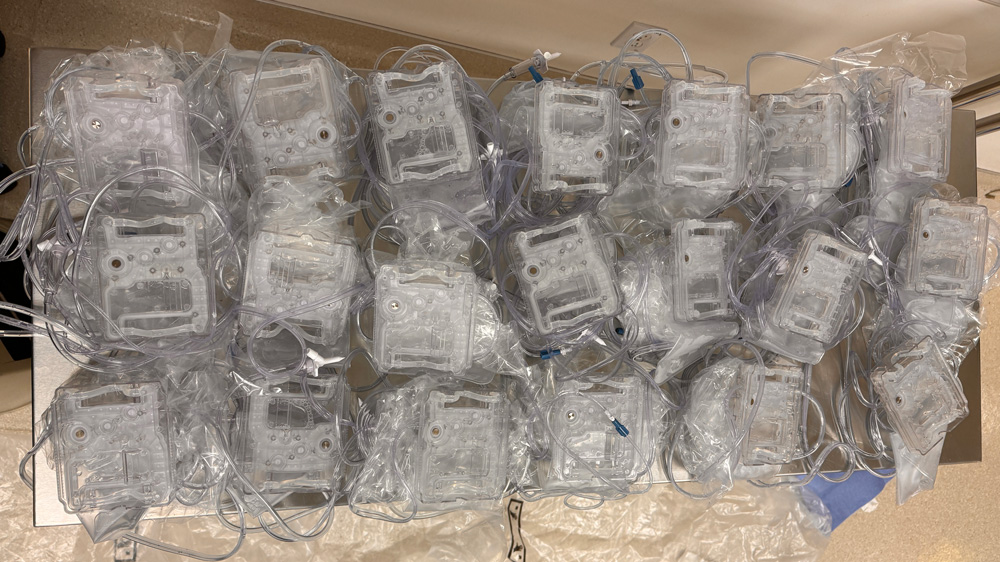
Source: David F. Chang, MD
Beginning in mid-2024, the two highest- volume surgeons at our ASC transitioned from a single-use phaco platform for tubing and cassettes (Whitestar Signature Pro, Johnson & Johnson Vision) to a system that offers the only FDA-approved reusable option (Compact Intuitiv, Johnson & Johnson Vision). The reusable tubing and cassette are approved for up to 20 uses when processed according to the manufacturer’s instructions. From July 2024 through June 2025, we performed approximately 2,700 cataract and IOL-related procedures using this reusable system.
The cost difference was immediate and substantial. Using the manufacturer-suggested baseline pricing, reusable tubing and cassettes cost approximately $15 per case when amortized over 20 uses, compared with $45 per case for single-use packs. This resulted in a 66.7% reduction in tubing and cassette costs, saving more than $80,000 in 1 year for just two surgeons. Importantly, we observed no cases of toxic anterior segment syndrome or endophthalmitis, no decline in phacoemulsification performance, and no reduction in daily surgical volume. While additional staff time was required for cleaning and sterilization, this did not meaningfully disrupt daily workflow.
Environmental benefits were equally compelling. LCA demonstrated that reusable tubing and cassettes reduced plastic waste and carbon emissions by approximately 90% per case compared with single-use systems. For every 1,000 procedures, the reusable system prevented more than 320 kg of plastic waste and nearly 940 kg of CO2-equivalent emissions, comparable to more than 2,200 miles of automobile travel. This data was highlighted in a recently published EyeSustain position paper, endorsed by the four major multinational societies of cataract and refractive surgeons.2 Representing cataract surgeons worldwide, the four societies endorsed the position that all phaco platforms should offer the option of multiuse cassettes, which is a critical unmet need with current machine technology.
We also examined our decade-long experience using reusable diamond keratomes and paracentesis blades in place of disposable metal knives. From July 2015 through June 2025, more than 50,000 cataract and related procedures were performed using communal sets of diamond blades shared among multiple surgeons. Although diamond blades have a higher upfront cost, their durability with proper handling and care resulted in a per-case cost of less than $1 for keratomes and approximately $0.50 for paracentesis blades. In contrast, single-use metal blades cost roughly $19 and $13 each, respectively. The long-term cost savings were substantial, amounting to more than $1.5 million saved over the decade.
From an environmental standpoint, reusable diamond blades generated less than 1% of the waste and carbon emissions associated with disposable metal knives. LCA revealed that the plastic handle, rather than the metal blade itself, accounted for approximately half of the environmental impact of single-use knives. This suggests that even for those hesitant to switch to diamond blades due to concerns over handling or reduced cutting performance after multiple uses, using a disposable metal blade paired with a reusable handle can still have significant environmental savings.
Our experience shows that reusable surgical devices can meaningfully reduce cost, waste, and carbon emissions without compromising patient safety and outcomes. While options like day cassettes exist in other parts of the world, we have incorporated solutions that can be implemented immediately, with currently FDA-approved devices. As pressure mounts to improve sustainability in healthcare, we think surgeons, manufacturers, and regulators should re-examine the default reliance on single-use devices and prioritize practical, evidence-based pathways to safely reuse in cataract surgery.
Editors’ note: The two papers mentioned were published in the February issue of JCRSand can also be accessed at www.eyesustain.org.
About the author
Stephanie Chen, MD
Altos Eye Physicians
Los Altos, California
References
- Chen SP, et al. Quantifying the reduction in economic and environmental waste from multi-use phacoemulsification tubing/cassettes and diamond blades. J Cataract Refract Surg. 2026;52:124–130.
- Chang DF, et al. The unmet need for multiuse phacoemulsification machine products: multisociety position paper. J Cataract Refract Surg. 2026;52:117–123.