
- Inaugural SightLine at ASCRS kicks off
- ‘Successfully Leading Through Challenging Situations’
- Paying for enhanced diagnostic technologies
- The ‘silent epidemic’ of myopia and the opportunity it presents
Inaugural SightLine at ASCRS kicks off
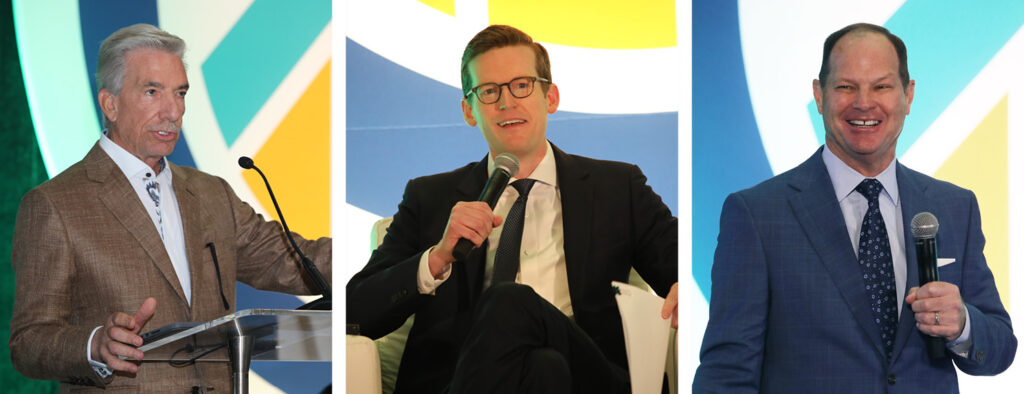
The inaugural SightLine at ASCRS took place on April 24 ahead of the ASCRS Annual Meeting in Los Angeles, California. ASCRS Executive Director Steve Speares kicked off SightLine at ASCRS, first thanking the sponsors of the meeting.
The purpose of this meeting, Mr. Speares said, is to inform the key stakeholders in commercial ophthalmology of the near, intermediate, and distant challenges and opportunities that exist. Coming out of COVID-19, it feels like there are numerous challenges, but there are opportunities, too, he said.
ASCRS is uniquely positioned to serve as a collaborator for various stakeholders, he added, and these stakeholders include those who help keep practices running (like managers and the ASOA organization) and industry partners, as well as the surgeons.
Mr. Speares questioned the financial condition of commercial ophthalmology, first defining “commercial ophthalmology.” “We think it’s everything that touches a commercial interaction inside of a practice,” he said, adding that it’s incredibly important that commercial ophthalmology is healthy and thriving in this country. Stakeholders of commercial ophthalmology encompass a variety of players, including surgeons, office managers, and industry partners.
‘Successfully Leading Through Challenging Situations’
Jim Mazzo, Executive Chairman of Neurotech, led a panel discussion titled “Successfully Leading Through Challenging Situations,” with panelists sharing some of the situations they’ve navigated. “When things are good, everyone looks good,” Mr. Mazzo said. “But when things are bad, you see who folds.”
Brent Saunders, with Bausch + Lomb, discussed handling a product recall. “After my almost 30 years in healthcare industry, I always define the best days and worst days.” The best day is when you get a new product approved, and the worst is when you have to recall a product because risks/benefits were not as intended, he said.
The recall of the enVista lens platform (because of an increased number of reports of TASS) was one of those moments where you see a signal of a product that’s not working as intended in safety data, and you start to see divergence in the signal and have to make a decision. “The decision was easy for us, but repercussions were difficult,” he said. We were not going to sell a product used by surgeons who trust us and patients who rely on us that isn’t working as we intend it to work, so we voluntarily decided to recall the product, he said.
Ultimately, through diligent work, the company was able to interrogate the data and find the source of the problem, and Mr. Saunders noted that it was a supplier issue. We put in enhanced procedures to make sure it wouldn’t happen again, and enVista will be back on the market imminently, he said.
This is the greatest community of doctors, companies, innovators, and smart people, he said, noting that he was reassured by the support during this difficult situation. Even competitors rose to help and support us, he said, adding that it made him proud to be part of ophthalmology. Doctors and surgeons wanted to help as well.
Paying for enhanced diagnostic technologies
“Medicare’s inability to pay for everything should not inhibit innovation,” Matt Jensen said, quoting former congressman Chris Cox, who was on a SightLine at ASCRS panel in a prior session about building the premium IOL payment category, using this quote as a segue into a session he moderated on the topic of paying for enhanced diagnostic technologies.
Mr. Jensen, a “recovering administrator” (his words), said payors don’t decide the value for a patient, rather whether they’re going to cover it from a budgetary standpoint.
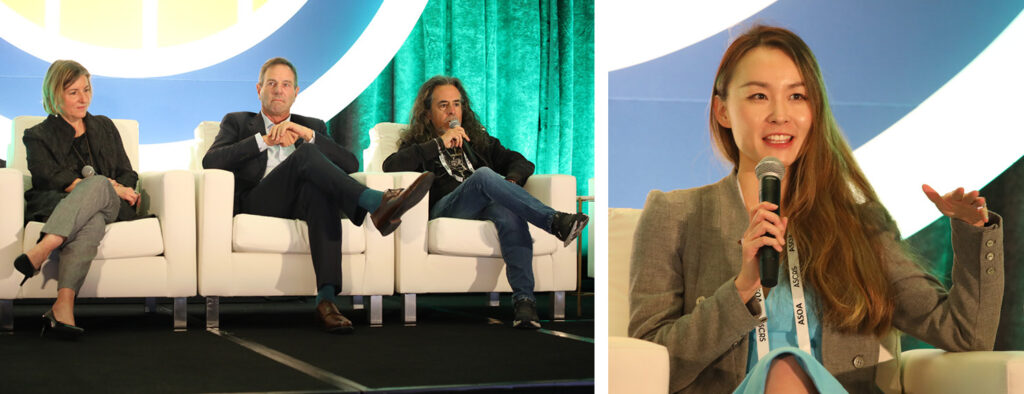
Mr. Jensen asked Dagny Zhu, MD, Nicole Fram, MD, and administrator Melissa Ciccarelli, COE, to talk about how their practices have implemented alternative payment models.
Dr. Zhu said she represents the “extreme” of patient-pay models with her practice being an entirely self-pay, cash-pay practice that has opted out of taking insurance. “We focus on delivering the best service and experience to our patients. … I can give them the best outcome without having to think of being reimbursed,” Dr. Zhu said. “We make patients see the value of every technology we’re using to screen them for cataract surgery or dry eye. Patients are willing to pay out of pocket because they see that value.”
Dr. Fram said that her practice does accept insurance but also tries to use the most innovative technology. “There’s not a machine that I don’t love, so I had to figure out a way to pay for that,” she said. Dr. Fram’s practice has adopted a model where patients can have standard surgery that’s insurance covered or they can opt for a refractive package that has elements they will pay for out of pocket but will take them to the next level in terms of visual outcomes and incorporates more hands-on care through the process, including postop. Dr. Fram also said they have an administrative fee that’s charged to patients for the concierge-type services patients expect, which covers the cost of the administrative employee who answers calls, helps with prior authorizations, etc.
Ms. Ciccarelli, who works in the practice of Steven Dell, MD, said they have an advanced diagnostic testing services model. These, she explained, are built based on the appointment the patient is coming in for—cataract, refractive, or dry eye. “This revenue stream gives us the freedom to explore these new technologies and bring them into our practice,” she said.
The ‘silent epidemic’ of myopia and the opportunity it presents
More than half of the population globally will be myopic by 2050, said Eric Donnenfeld, MD, the moderator of “Myopia Management: The Business of Ophthalmology or Optometry” at SightLine at ASCRS, calling it a “silent epidemic” that’s taking place right now.
There is significant morbidity associated with myopia, and myopia management and prevention as a new category makes sense economically, Dr. Donnenfeld said. However, the number of ophthalmologists in the U.S. continues to decline (Dr. Donnenfeld noted that there are three times more optometrists, a growing field, than ophthalmologists). In addition, refractive surgery, which has “never been more vital, more vibrant, more effective, safer than it is today,” has been decreasing.
“Myopia represents an enormous opportunity for our doctors and our industry,” Dr. Donnenfeld said, setting the stage for discussion among Gary Gerber, OD, Treehouse Eyes, Patrick Johnson, PhD, Sydnexis, Nancy Sabin, STAAR Surgical, and Kerry Solomon, MD.
EyeWorld Onsite is a digital publication of the American Society of Cataract and Refractive Surgery (ASCRS).
For sponsorship opportunities or membership information, contact: ASCRS • 12587 Fair Lakes Circle • Suite 348 • Fairfax, VA 22033 • Phone: 703-591-2220 • Email: ascrs@ascrs.org
Opinions expressed in EyeWorld Onsite do not necessarily reflect those of ASCRS. Mention of products or services does not constitute an endorsement by ASCRS.
Click here to view our Legal Notice.
Copyright 2025. All rights reserved.