ASCRS News
Spring 2024
by Steve Speares
ASCRS Executive Director

Is the keeping and telling of History still a relevant pursuit? Not surprisingly, the answer to that question varies by the respondent’s age. Multiple studies have found the older the respondent, the higher the importance placed on the study of History.
Why on earth does it matter what happened long ago to people we never knew? The answer is that History is inescapable. It studies the past, the legacies of the past, and how those legacies impact the present. Far from being a ‘dead’ subject, it connects things through time and encourages its students to take a long view of such connections. All people and peoples are living histories.
As ASCRS celebrates half a century, we have made significant effort and investment to capture the definitive history of the organization’s founding, its evolution, and key mileposts across the five decades of existence. Ultimately, what we hope to achieve is a shared sense of history and establish how this history frames the association’s aspirations as we look to the future.
“If you want to understand today, you have to search yesterday.”
Pearl S. Buck, American novelist (1892–1973)
The impact of the organization on the subspecialty is universally recognized. There are countless societies of “Cataract & Refractive Surgery” around the globe built in the mold of ASCRS. The evolution of the society has closely mirrored the evolution of the field of cataract and refractive surgery. IOLs were the first drivers but soon followed by ECCE and phaco along with the development of OVDs and incisional architecture.
Corneal refractive surgery morphed from handheld incisional instruments to exceptionally accurate lasers. As technologies and techniques evolved, ASCRS was there to drive education at the same rapid pace.
The big questions facing us today center around the need, relevance, and opportunity to forge the next 50 years with a similar level of impact. But there will be plenty of time to assess those measures. The biggest question is “Why should ASCRS members care that the society is turning 50 years old?”
Celebrating and documenting history has become a dynamic and complex exercise in many walks of life. As groups and individuals question the validity and perspective of those who shaped or documented history, a troubling question has emerged. Does history even matter? Is it relevant? Is History, for lack of a better term, becoming history?
There is no more credible authority to look to in assessing the attitudes people have on the relevance of history than the American Historical Association. In late 2020, the AHA and Farleigh Dickinson University conducted a survey of 1,816 U.S. adults to assess the pulse of Americans attitudes toward history. The work was funded by a grant from the National Endowment for the Humanities.
The survey found how essential history education is, relative to other fields such as engineering and business. The results were encouraging: 84% felt history was just as valuable as these other pursuits.
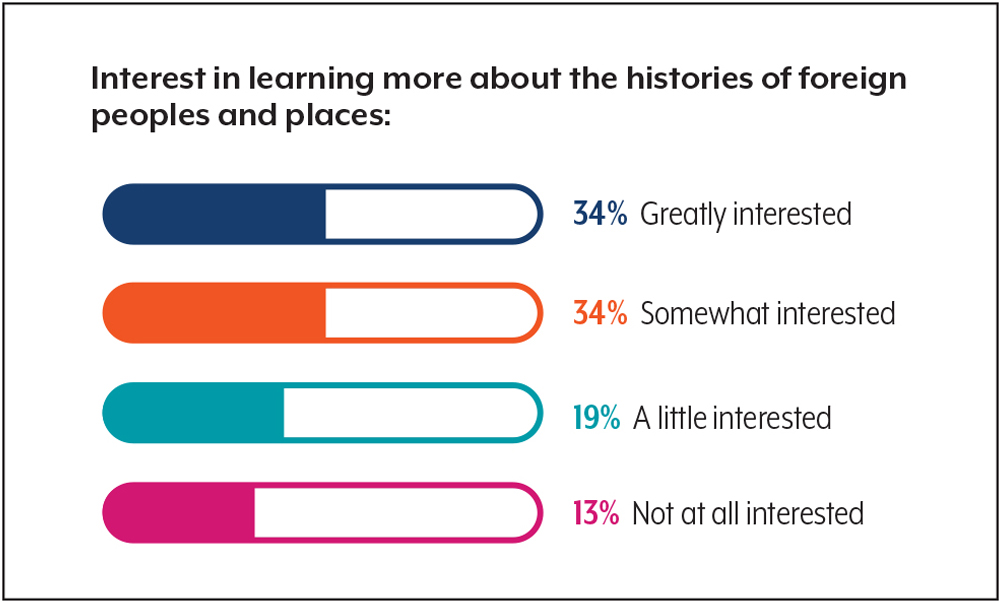
Most encouraging were the responses when asked about interest in learning more about the histories of foreign peoples and places as a function of perceptions of what history is.
For most Americans, history really does matter. It’s the context of how it is told that correlates to interest level.
In the AHA survey, the top three sources for historical education were documentary film/TV, fictional film/TV, and TV news.
Americans like their history to come alive.
The English author Rudyard Kipling was well ahead of the curve when he wrote, “If history were taught in the form of stories, it would never be forgotten.” My hope would be that Mr. Kipling would approve of our efforts at the ASCRS Annual Meeting in Boston. In video, print, and static display, we have made an effort to tell the story of our organization’s first 50 years in a comprehensive yet entertaining manner.
Ultimately, the controversy of telling history often rests in who is doing the telling. Mark Twain once wrote “The very ink with which history is written is merely fluid prejudice.” While there are countless examples of this truth, we are extremely fortunate to have a number of our early leaders still with us to give first-hand accounts of the creation of AIOIS, which was renamed to ASCRS. There is also video footage of interviews captured with a host of early ASCRS leaders going back to 1994.
Is our account 100% accurate and perfectly told? Likely not. We are at the mercy of individual recollection and technologies that simply did not lend themselves to seamless instantaneous capture 40 and 50 years ago. But over several months, we have endeavored to build the complete narrative of the first 50 years of ASCRS. We are confident, at a minimum, our storytelling captures the spirit of this society’s incredible journey.
Now, to the important question, does any of this matter? I am but one person with what would likely be considered a strong bias on the matter, but I am confident in declaring that the story of ASCRS is compelling, intriguing, and constantly evolving. All the attributes you would want in an entertaining story.
In 1746, a group of publishers approached English writer and lexicographer Samuel Johnson with the idea of creating an authoritative dictionary of the English language. Unable to achieve perfection or finality, he compared his plight to the ancient Arcadians chasing after the sun. For, try as they did, whenever they reached the crest of the hill upon which the sun appeared to sit, they found that it was still the same distance away.
I found this anecdote a nice analogy in looking to the next 50 years of ASCRS. The sun will never be caught, but the pursuit will guarantee a vibrant, healthy medical society with much more history to be captured and retold. In the end, History matters.