Practice Management
Summer 2024
by John Pinto and Corinne Wohl, MHSA, COE
We all live a little bit like hermit crabs, those delightful tide pool creatures who swap out their shells as they grow up and need more space. When the shell he’s wearing gets a little too pinched, all that Mr. Crab has to do is crawl out of the current premises, find the next, larger shell, and climb on in—no architects to engage, no permits to pull, no wrangling with the general contractor.
In the same way, but with considerably more hassle and cost, we change homes as our families grow and expand offices as our practices build.
Facility expansion is an especially vexing process in the current environment. While most practices are still growing strongly, profit margins are generally declining, while building and financing costs are sky high, making it more difficult to accommodate this growth.
Here is a starter list of a few basic points to assure that your facility development efforts are in lockstep with your wider development goals. This list originally ran in the March 2021 issue of EyeWorld in the article “Facility development in the peri-COVID era.” However, we think the topic is more important than ever in the current environment, and we wanted to reinforce the concepts here.
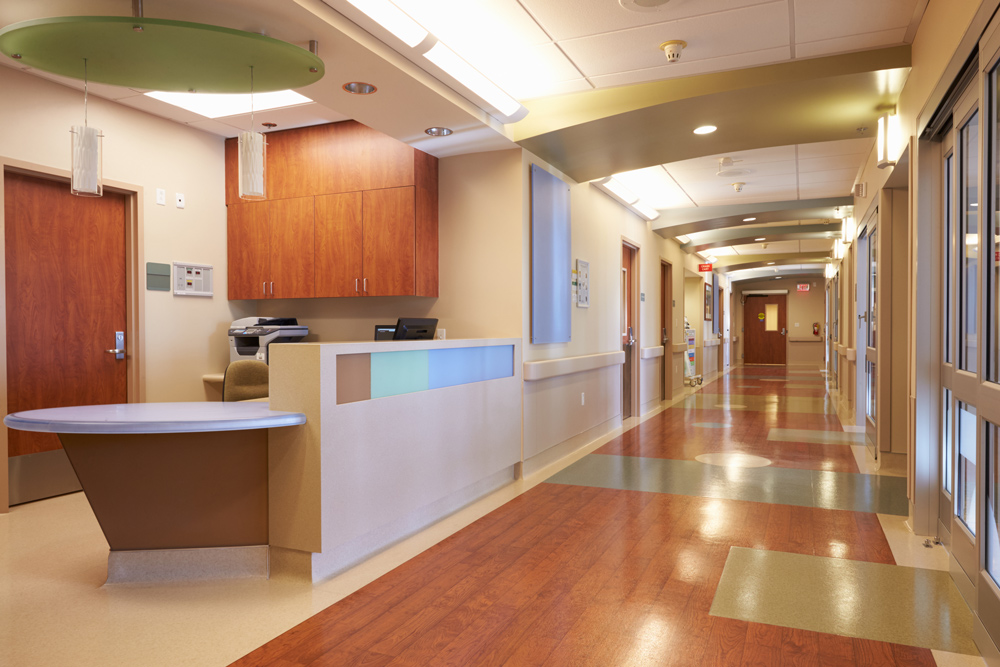
1. Know your facility utilization numbers. The best gauge of whether you need more space or not is to count the number of active, fully equipped exam rooms, multiply by 173 (the nominal number of hours your clinic is open each month), and divide that figure into the number of patients seen in the average month. The resulting figure should be about 1.0, with units of “patient visits per exam room hour.” Here’s an example:
- Your practice has 5 exam rooms.
- So you have 5 x 173 = 865 room hours per month.
- You serve 800 visits per month.
- Divide 800 visits by 865 room hours to get 0.9 patient visits per exam room hour.
If your practice has these statistics, your facility is running at only about 90% of potential capacity, and you don’t need additional space. This is obviously a gross, first-pass calculation. Depending on your subspecialty, the availability of optical or special testing space, pace of growth or general layout flaws, you may still be needing more space. You may also need more space if your providers only want to work during prime hours in the day or week, reducing the number of room hours available per month.
2. Always explore a “temporal” expansion before adding facilities—that’s to say, think about expanding office hours rather than adding facility space and cost. If you are trying to make just four exam rooms stretch to serve two doctors who both want to work in “prime time,” Monday through Thursday from 9:00 a.m. to 4:00 p.m., shift clinic hours around so that the providers are a little less bunched up. For example, one doctor can work on Friday in alternate weeks, or run from 8:00 a.m. to 5:00 p.m.
3. Let’s say you absolutely need to expand, but have to do so on a tight budget:
- Eliminate non-essentials. Do you need a private washroom for every doctor? (Over the course of an average year, this owner perk may cost you up to $5 per bathroom break.)
- The same goes for private doctor office space—a group office with a meeting table and separate cubicles not only costs less but facilitates communication.
- Use cubicles for business staff rather than erected, fixed walls.
- Fit out a “wow” waiting/reception area, but leave the back clinical space more industrial. Consider doing what Hampton Inn and similar mid-grade hotel chains do with a plush foyer and serviceable but plain guest rooms.
- Leave out the crown molding, premium carpet, custom wall treatments, and original artwork.
- Make sure your builder takes a second pass through your architect’s plans to “value engineer” the final project.
- Don’t under build. If you build for today’s needs in a growing practice, the second phase of near-term construction will be far more costly per square foot than being right-sized the first time around.
- Unless you feel you must, don’t try to win architectural awards with off-beat, expensive designs. Build a box, and leave out the curves, both on the shell and on the interior buildout of the practice.
- Don’t buy more land than you need but leave room for any obvious, future expansion. Very few ophthalmologists should take the entrepreneurial approach of building the 10,000 square feet they need today, plus another 30,000 square feet to rent to other users.
- In most cases, create a new facility rather than redesigning an existing structure.
- Don’t try to save money by buying cheap, out-of-the way land. The appreciation of your facility in the coming years will be far lower, and you’ll lose the promotional value of being on a major thoroughfare.
- If you’re in solo practice and have no solid succession plan, don’t build a new facility if you plan to work for any less than 10 more years. If you plan to practice for 10 years or longer, try not to rent, unless you work in a high-priced inner-city environment.
4. Don’t overlook exterior appeal. Your senior patients may be avid gardeners who will frown at your dying shrubbery and may project their first impression of your landscaping on the quality of your medical and surgical care. Keep up the parking lot resurfacing. Purchase the largest/brightest signage local zoning will allow.
5. Don’t pursue any significant expansion or building project without first preparing a realistic pro-forma showing the cost-benefit of the project in the years ahead. There are many factors to consider here:
- Will your total facility costs, as a percent of total collections, be at or under 10% immediately post-project and fall to 6% or less within 5 years?
- Are you realistic in your projections of how fast practice collections will grow with a new facility?
- Do you possess the risk tolerance to handle the prospect of having facility costs escalate as a percent of collections if payment reform leads to materially lower professional fees?
- What will be the future appreciation on your new property? Will you be able to find a buyer when the time comes, or is your area overbuilt with professional space?
- Are you properly hedged and able to carry higher facility costs in the event of a temporary disability, loss of a key provider, or similar difficulty?
- Will your personal net worth be higher or lower in 10 to 20 years if you expand or develop a new facility?
About the authors
John Pinto
President
J. Pinto & Associates
San Diego, California
Corinne Wohl, MHSA, COE
President
C. Wohl & Associates
San Diego, California
Contact
Pinto: pintoinc@aol.com, 619-223-2233
Wohl: czwohl@gmail.com, 609-410-2932