ONLINE EXCLUSIVE
Glaucoma
March 2023
by Liz Hillman
Editorial Co-Director
“A fundamental and unanswered question concerning all MIGS devices is whether they have any measurable ability to help POAG patients retain their vision.”
The authors of a study published in the American Journal of Ophthalmology sought to answer this question.1
The study is a post-hoc visual field analysis of the 5-year HORIZON trial, which was a multicenter, randomized, controlled trial that compared cataract surgery with the Hydrus Microstent (Alcon) to cataract surgery alone for patients with glaucoma. The trial is considered the largest MIGS trial to date, including 556 patients with glaucoma (369 of whom received cataract surgery plus Hydrus and 187 of whom had cataract surgery alone) with 5 years of follow-up.
This recent analysis included 352 eyes from the Hydrus group and 165 in the cataract surgery alone group, with 2,966 visual fields analyzed. The rate of progression was –0.26 dB/year in the Hydrus group and –0.49 dB/year in the cataract surgery alone group. The authors reported this to be a statistically significant difference and noted that “the difference in IOP only explained 17% of the effect.” The paper also reported an increased probability of visual field worsening by 5.5 dB, which they wrote “[indicates] a greater proportion of fast progressors.”
“[Cataract surgery plus Hydrus Microstent] has a significant effect on VF preservation in glaucoma patients compared to [cataract surgery] alone, reducing the proportion of fast progressors,” the authors concluded.
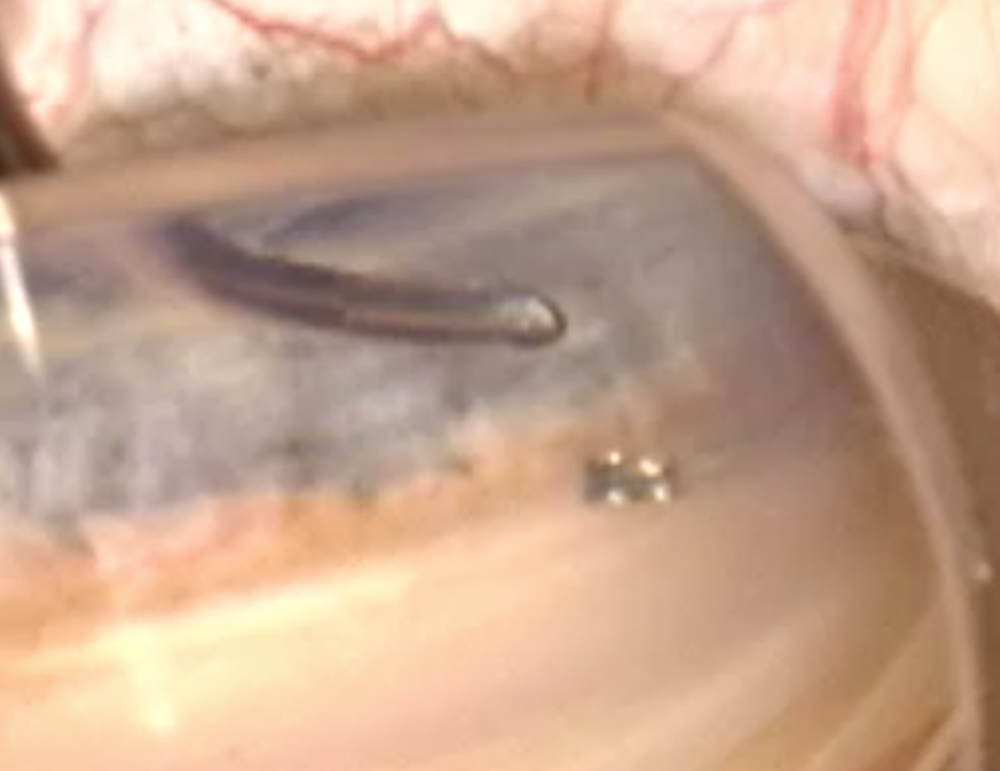
Source: Robert Noecker, MD
In the discussion, the authors described how other MIGS trials consider mean IOP reduction and medication reduction evidence of efficacy. The authors wrote that preventing visual loss, however, is “the true goal of glaucoma treatment.” The paper described the potential improved quality of life implications of preserved visual fields and reduced rates of progression.
The preliminary findings were reported at the 2021 American Academy of Ophthalmology Annual Meeting. At that time, a press release about the findings reported that Hydrus plus cataract surgery lowered visual field loss by 47%, compared to cataract surgery alone.
“This is a game-changer,” Ike Ahmed, MD, said in a statement at the time. “Since the inception of MIGS, the impact narrative has been largely restricted to surrogate endpoints—IOP lowering and medication reduction. At three years, we saw that Hydrus was impacting the rate of invasive secondary surgery, which was exciting. Now at five years, we have data indicating the Hydrus is affecting the underlying disease itself, which alters forever how we think of MIGS.”
More long-term analysis from the HORIZON trial was published in earlier papers. The original 5-year data was published in 2022, reporting that 66% of the eyes that received Hydrus were medication-free, compared to 46% in the control group.2 The study also suggested a reduced risk for future incisional glaucoma surgeries in the group that received Hydrus (2.4% compared to 6.2%).
Hydrus, originally from the company Ivantis, which was acquired by Alcon in January 2022, received FDA approval in 2018 for use in combination with cataract surgery for patients with mild to moderate open-angle glaucoma. The implant is the size of an eyelash and fits within 90 degrees of Schlemm’s canal with the goal of reestablishing natural outflow of aqueous through the canal with access to multiple collector channels.
Separately, a retrospective case series (2013–2021) published in 2022 reviewed change in Humphrey visual field and other clinical parameters of various MIGS (iStent [Glaukos], XEN Gel Stent [Allergan], and Hydrus) combined with cataract surgery.3 The study included 44 eyes from 39 patients with 12- to 18-month postop visual field measurements. The study showed that visual acuity improved from 0.23±0.17 to 0.10±0.14 logMAR, glaucoma medications were reduced from 2.68±1.06 to 1.46±1.32, and IOP decreased from 17.08±4.23 mm Hg to 14.92±3.13 mm Hg. The authors reported that “differences across devices were negligible.”
The authors of this paper concluded that “minimally invasive glaucoma surgery combined with cataract surgery appears to be effective at stabilizing visual field function, reducing intraocular pressure, reducing number of glaucoma medications, and improving visual acuity over a 12- to 18-month follow-up period across MIGS devices.”
References
- Montesano G, et al. Five-year visual field outcomes of the HORIZON trial. Am J Ophthalmol. 2023. Online ahead of print.
- Ahmed IK, et al. Long-term outcomes from the HORIZON randomized trial for a Schlemm’s canal microstent in combination cataract and glaucoma surgery. Ophthalmology. 2022;129:742–751.
- Turner ML, et al. Clinical and visual field outcomes following minimally invasive glaucoma surgery combined with cataract surgery. Clin Ophthalmol. 2022;16:3193–3203.