Glaucoma
July 2023
by Ellen Stodola
Editorial Co-Director
Creating an effective treatment plan for a patient with uveitic glaucoma requires the ophthalmologist to consider and balance evolving, multiple, and sometimes competing disease processes. Several physicians discussed what to look for and how to manage these patients.

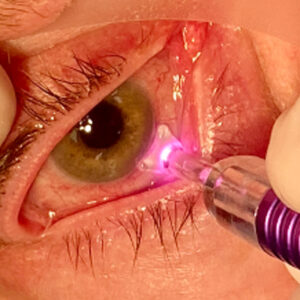
Source: Jonathan Eisengart, MD
In uveitis, uveitic glaucoma is common, according to Ninani Kombo, MD. In most cases, the pressure increases very slowly, so patients may be asymptomatic. “What helps is frequent follow-ups and monitoring so you can catch problems early,” she said. However, some cases may have a rapid onset, with a dramatic rise in pressure; for example, a patient can have angle closure where the pressure goes up very rapidly. “Those patients will come in immediately because the acute increase in pressure can cause brow ache, nausea, vomiting, pain, redness, light sensitivity, and blurry vision. They come in much earlier because of the dramatic symptoms they experience,” she said.
A literature review demonstrates a wide variety of estimates as to the prevalence of glaucoma in uveitis, said Jonathan Eisengart, MD, but it is reasonable to say 10–20% of people with uveitis develop glaucoma. With severe uveitis or with certain sustained-release steroid implants used to treat uveitis, the prevalence can reach nearly 50%. Most often, patients with glaucoma experience no symptoms until the late stages of the disease, Dr. Eisengart said, adding that this is true for glaucoma in uveitis as well. However, patients with uveitis are more likely to have complications resulting in rapid rises in intraocular pressure that can cause pain, blurred vision, red eye, nausea, and vomiting.
The goal of treatment is to lower the intraocular pressure, Dr. Eisengart said, and that is achieved most commonly with topical medications. However, there are important additional considerations when treating glaucoma in uveitis. “First, one needs to balance the need to lower the intraocular pressure with the need to treat the uveitis,” he said. “In particular, most uveitis patients are on steroids, which can raise the intraocular pressure. While decreasing steroid treatment may help lower the eye pressure, that can cause the uveitis to flare. Steroids need to be carefully titrated to the lowest effective dose, but many times steroid dosing cannot be safely reduced. In these cases, it is important to treat the glaucoma aggressively. Earlier surgical intervention may be needed.”
Dr. Eisengart added that uveitis patients are also more likely to have complications such as peripheral anterior synechiae, pupillary block with iris bombe, or fibrin membranes that lead to elevated intraocular pressure. These complications need to be treated promptly, often with laser or incisional surgery. Eyes with uveitis can have a profound inflammatory response to surgery, so surgical planning must be done carefully and often requires a surge in steroid dosing around the time of laser or incisional surgery.
While uveitic glaucoma is less common than primary open angle glaucoma, Aubrey Tirpack, MD, said it is an important cause of morbidity and vision loss in this patient population. “The literature says that up to 20% of uveitis patients will present with elevated intraocular pressure, which can result in optic nerve damage and irreversible vision loss,” she said. The underlying causes for intraocular pressure rise can vary, with both open and closed angle mechanisms. Open angle mechanisms include inflammation causing trabecular meshwork dysfunction or obstruction and steroid-induced pressure rise. Closed angle mechanisms include a slow, progressive synechial closure of the angle or a secondary angle closure from posterior synechiae of the iris to the lens.
Treatment of uveitic glaucoma necessitates control of both intraocular inflammation and pressure, Dr. Tirpack said. Because the intraocular pressure rise is often driven by inflammatory mechanisms, aggressive treatment of the inflammation is required. “I manage these patients with my uveitis partners, who use steroids to treat the inflammation, and often involve a rheumatologist for initiation of systemic therapy,” she said.
When to involve a uveitis/rheumatology specialist
“Involving rheumatology is often necessary to complete a workup for underlying systemic disease and initiate systemic immunosuppression, if appropriate,” Dr. Tirpack said. “Since steroids often drive intraocular pressure rise, finding steroid-sparing, long-term options for these patients is often necessary.”
Dr. Kombo said that it’s important to have a team-based approach. You want to know the cause of the uveitis. Is it an infection? Is it autoimmune? Is it associated with a systemic condition? Some glaucoma specialists are comfortable doing the investigative work to get to the bottom of the cause. If not, referral to a uveitis specialist is appropriate. When uveitis becomes chronic, and you can’t get the patient off steroids, that’s the time to refer to a uveitis specialist and a rheumatologist.
Dr. Eisengart said that this will vary depending on the glaucoma specialist’s access to other subspecialties and comfort in managing uveitis. “I would recommend a glaucoma doctor involve a uveitis specialist when the etiology of the uveitis is uncertain, when there are posterior segment complications, such as chronic macula edema, or when the disease is progressing despite treatment,” he said. “Rheumatology should be consulted when there are signs or symptoms suggestive of systemic involvement or if immunosuppressive drugs are required to control the uveitis.”
Treatment and management
Dr. Tirpack said that first-line treatment for intraocular pressure control is typically initiation of topical glaucoma medications. “I tend to avoid the use of prostaglandin analogs in uveitic patients given the increased risk of worsening inflammation and cystoid macular edema,” she said. “I also caution against the use of miotics in these patients given the risk of posterior synechiae formation and further disruption of the blood-aqueous barrier.” She added that beta blockers, carbonic anhydrase inhibitors, and alpha agonists can be used based on patient-specific comorbidities and tolerances. In cases of open angle uveitic glaucoma, selective laser trabeculoplasty can be considered for intraocular pressure control. Since this laser is pro-inflammatory, Dr. Tirpack said she will coordinate with her uveitis colleague to ensure adequate uveitis control prior to using it.
“Uveitic glaucoma refractory to medications and selective laser trabeculoplasty will require incisional surgery to control the intraocular pressure,” she said, adding that angle-based surgery is a great option for patients without synechial closure and has the benefit of sparing the conjunctiva for future surgery, if needed. Goniotomy and gonioscopy-assisted transluminal trabeculotomy are effective angle-based surgeries in these patients. For patients with synechial closure or extremely elevated IOP, filtering surgery should be done, she said.
Trabeculectomy is traditionally avoided in uveitic patients given the high risk of failure secondary to inflammation. Tube shunt remains the most common filtering surgery for uveitic patients, and Dr. Tirpack said that both valved and non-valved tubes can be considered. “Uveitic patients are at higher risk for postoperative hypotony, and therefore, I will often choose a valved tube shunt to help mitigate this risk,” she said. In young, well-controlled uveitics, an unvalved tube shunt can be a good option. Regardless of the surgical procedure, these patients need good control of the inflammation pre-, intra-, and postoperatively.
Unfortunately, Dr. Kombo said, it can be complicated to treat uveitic glaucoma because there are two disease entities. “You have glaucoma, you have uveitis, and the more complicated cases are the cases where inflammation persists.” It’s very important to monitor these patients closely, she said.
Otherwise, Dr. Kombo said the treatment is similar to what is done for other types of glaucoma. You want to make sure you bring down the pressure. Aqueous suppressants like beta blockers and carbonic anhydrase inhibitors are the go-to medications, she said, and with more severe glaucoma, you would escalate to surgical options.
While MIGS may be an option for these patients, Dr. Kombo said there is limited published data. Some has shown that Trabectome (MicroSurgical Technology) has about a 75% success rate, but we don’t know what the safety profile is or what the long-term results are, she said. In pediatric patients, goniotomy is first line, she said. The concern with uveitic glaucoma and MIGS is that devices like the iStent (Glaukos) and Hydrus (Alcon) may become clogged from fibrin or affected by inflammation, making the device ineffective. Dr. Kombo added that for a well-controlled uveitis patient with no active inflammation, the jury is still out on the effectiveness, and more data on MIGS in these cases is needed.
Tube shunts and glaucoma drainage devices have shown great results, she said. Depending on the study, there is a 70–80% success rate with tubes, and there is some long-term data (3–5 years), with the caveat being the better the control of the inflammation, the better the success. Success drops when there’s active inflammation to about 50%. Similarly, with trabeculectomy, Dr. Kombo said it will fail half the time if inflammation is present.
In terms of the pressure that can be expected after treatment, Dr. Kombo said it will vary from patient to patient. “You want the lowest or optimal pressure you can get to prevent progression of optic nerve damage,” she said.
She added that it’s important to realize that there are multiple mechanisms that create glaucoma in uveitis patients. “One of them is the treatment itself that we need to give the patients to reduce inflammation, the steroids. This is called steroid-induced glaucoma,” Dr. Kombo said. “Another mechanism is that the inflammation causes significant fibrin deposits and scarring, and the inflammatory cells can clog the trabecular meshwork, resulting in an open angle glaucoma type where outflow is damaged from inflammation. The other mechanism is where patients develop either anterior or posterior synechiae and there is angle closure, so the normal flow of aqueous from the anterior chamber to the posterior chamber is obstructed, causing acute elevation of pressure.”
Dr. Kombo also addressed the use of laser procedures for uveitic glaucoma patients. There have been some studies that have shown that in well-controlled uveitis, this is a successful treatment. Cyclodestructive procedures may be used in select cases, but Dr. Kombo said you need to be careful because they can exacerbate inflammation, and the ciliary body can develop fibrotic membranes and result in hypotony.
Dr. Eisengart said that while aqueous suppressants like beta blockers, carbonic anhydrase inhibitors, and alpha-2 agonists are effective in both typical glaucoma as well as uveitic glaucoma, prostaglandin analogs are considered “last line” in uveitic glaucoma, as they may promote inflammation or macular edema. Miotic agents like pilocarpine are generally contraindicated in glaucoma, he added. “There is some emerging data that rho-kinase inhibitors may be effective in steroid-response glaucoma, but I think more data is needed to say this definitively.”
As for surgical options, Dr. Eisengart said that tube implants have traditionally offered the best success in patients with uncontrolled uveitic glaucoma. More recently, glaucoma doctors have come to understand that many of these patients with controlled anterior segment inflammation are best served with angle-based procedures such as goniotomy or GATT, he said. “These later procedures have made a tremendous impact in our practice because they are faster, safer, and often more effective than tube implants in these patients,” he said.
In patients with vision-threatening uveitis, preserving vision requires liberal use of topical, intravitreal, and/or systemic steroids, Dr. Eisengart said. “My job as the glaucoma specialist is to control the intraocular pressure so that my uveitis colleagues may apply these steroids as aggressively as needed to protect the patient’s vision,” he said. “If my uveitis specialist colleague can formulate an appropriate treatment plan for the patient without worrying about the intraocular pressure, I have done my job.”
About the physicians
Jonathan Eisengart, MD
Glaucoma Service Director
Cole Eye Institute
Cleveland Clinic
Cleveland, Ohio
Ninani Kombo, MD
Assistant Professor of Ophthalmology and Visual Science
Yale School of Medicine
New Haven, Connecticut
Aubrey Tirpack, MD
Cincinnati Eye Institute
Cincinnati, Ohio
Relevant disclosures
Eisengart: None
Kombo: None
Tirpack: None
Contact
Eisengart: EISENGJ@ccf.org
Kombo: ninani.kombo@yale.edu
Tirpack: ATirpack@cvphealth.com