Refractive
June 2022
by Ellen Stodola
Editorial Co-Director
Source: Allergan
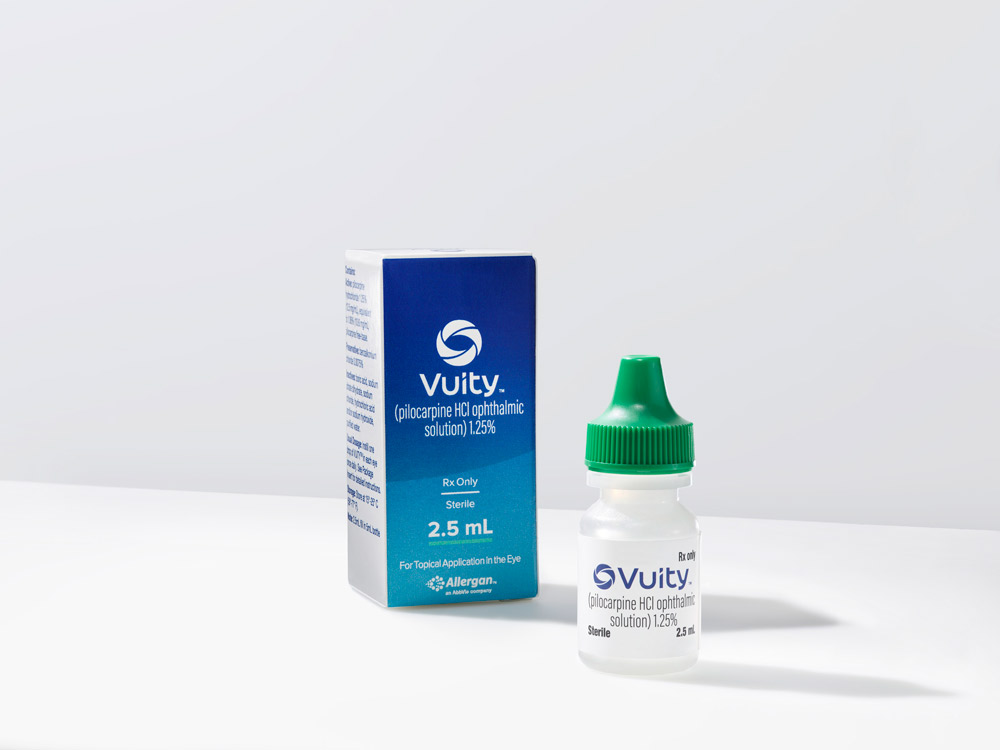
Drops that temporarily relieve the symptoms of presbyopia are an exciting new technology, with the first product approved in this space late last year. Two physicians shared their early experience with Vuity (pilocarpine hydrochloride ophthalmic solution, Allergan).
George Waring IV, MD, started using Vuity in his practice earlier this year. Prior to that, he served as principal investigator for the GEMINI 1 and GEMINI 2 FDA clinical trials.
Vuity, Dr. Waring said, is approved for those with age-related, blurry near vision. Presbyopia is a common progressive condition that affects most adults over age 40, and this is the first and only FDA-approved eye drop to treat it.
As the aging lens changes, we now have more and more treatments for the various stages of lens dysfunction, he said, adding, “Vuity falls into treatment for the mild/earliest forms of presbyopia and lens dysfunction.”
The drop is currently approved for once-a-day dosing, and it has a rapid onset of about 15 minutes. Vuity improves near vision without reducing distance vision for up to 6 hours with a single dose. “We anticipate that some patients may elect to use the drop more often, but that has yet to be studied formally and is considered off label,” he said.
Y. Ralph Chu, MD, has been using the product since being involved in the Phase 3 clinical trial. “We had early experience through the clinical trial, then we were one of the first sites to get it in December once it became available,” he said, adding that he has had a great experience with it in his practice.
Vuity is indicated for mild to moderate presbyopes (around J3 to J6). Those patients can be counseled appropriately and get excellent results, he said. Dr. Chu added that this a great bridging technology and way to expose patients to eyecare who may not have seen an eye doctor for some time. “This is a huge opportunity to engage these patients because as cataract surgeons, we know that these people will eventually be coming to our doors.”
Dr. Chu has found that a number of patients have come to him already seeking out Vuity because of what they’ve seen in the media. Presbyopia is a surgical market, he said, and there has not been a good procedure for the mild to moderate presbyope in their 40s, and people have been looking for that.
One important factor is setting patient expectations. Dr. Chu suggested that physicians start with the patients who are mild to moderate presbyopes, with J5 or better near vision. It makes sense, he added, because the clinical trial showed 3 lines of improvement for 6–10 hours.
He noted that these patients may not be the ones calling in to initially inquire about the product. “The first ones to call in are usually the older patients who have been suffering the longest,” he said. “They’re in their 60s, and they have very poor Jaeger vision, and it’s a different counseling process.” It’s not that the drop doesn’t work for them, Dr. Chu added, but they may not get to that functional range without reading glasses.
Pilocarpine formulation
The Vuity drop uses pilocarpine that has been specifically formulated for the treatment of presbyopia. “Pilocarpine has been around for more than 100 years, so it’s a well-known ophthalmic therapeutic,” Dr. Waring said. The concentration was carefully studied, as was the proprietary vehicle with the pHast technology, which he said made a difference in the efficacy and tolerability.
“Relative to historic formulations of pilocarpine, the pHast technology allows the molecules to rapidly equilibrate to the natural pH of the eye, reducing side effects and increasing the onset of action and efficacy, thereby being able to use a lower concentration and keeping a favorable side effect profile but still achieving efficacy,” Dr. Waring said.
Dr. Chu said that Vuity has a dual mechanism of action. It’s 1.25% pilocarpine, he said, adding that it works by contracting the ciliary muscle and constricting the pupil. For most patients, it’s that pupillary constriction, the reduction in aperture size of the pupil, that increases the depth of focus.
“I think it’s important to understand that it has the dual mechanism because using the classification system, we found that if you use it in early presbyopes, people just turning 40 are noticing slight changes in focusing ability, and Vuity could cause myopia and affect distance in those patients,” Dr. Chu said. “But if you use it in the older patient population, whose focusing ability has been compromised by age, they don’t have that side effect of the myopia induction from ciliary body constriction, so it’s just the aperture effect.”
Dr. Chu said some may suggest it’s not really new because it’s pilocarpine. But he thinks the pharmacology of Vuity is different. Pilocarpine has to be stored acidic, which burns the eye. “I think it’s important to note that Allergan created the pHast technology, a buffered solution, to make it comfortable,” Dr. Chu said. “It’s stored acidic, but as soon as it hits the eye, it reaches physiologic pH to minimize burning and improve bioavailability.”
Early opinions
Vuity is first in class, and there is an exciting future for this class, Dr. Chu said, adding that it’s not for every patient and it’s important to set expectations. He has found the biggest pushback is some patients might not notice reading for as long. Dr. Chu said there have not been serious complications. Adverse reactions like headaches, blurriness, or redness have tended to be mild and generally improve after a few days of use.
Dr. Chu recommended that patients give the drops a week if they have any issues adapting. They may also try different lighting situations to determine what works best.
Dr. Waring has found Vuity to fill a niche in the refractive space for the earlier presbyope. “Vuity has been a wonderful addition to the pipeline of treatment,” he said. “As their presbyopia becomes more manifest and the lens becomes increasingly dysfunctional, we introduce the concept of lens replacement early on as the next step.”
For those who are either more hyperopic or have more manifest presbyopia in stage 1–2 lens dysfunction, he will talk more about custom lens replacement as the most appropriate solution for them, he said.
Concerns/contraindications
Dr. Waring noted that he will discuss with and document certain categories of patients who might be at a higher risk for other conditions. For example, in high axial myopes who have an increased risk for retinal detachment, he may consider other forms of vision correction such as implantable contact lenses or LASIK, as well as those patients with narrow angles, higher hyperopes, and shorter eyes. “For these types of patients, we might be thinking more about lens replacement,” he said.
Dr. Chu is also careful with high myopes. He stressed the importance of a recent full retinal exam. While the risk for retinal detachment is low, Dr. Chu takes a conservative approach in patients with a high degree of myopia.
Other thoughts
Dr. Waring said that it’s exciting to be able to incorporate Vuity into practice, especially since it’s a first-in-class product and was approved earlier than anticipated by the FDA. However, he stressed that the FDA clinical trials were short term, so it will be important to look at long-term data to see that it continues to support the safety and efficacy.
He added that there has also been some success with alternative off-label indications, such as dysphotopsia and improvement in distance and reading vision with various diffractive and monofocal IOLs. “That’s been a wonderful addition to our armamentarium,” he said, adding that this is worth further evaluation and exploration.
Dr. Chu said that “it’s exciting to see how it evolves in the marketplace.” He thinks the success of Vuity will be driven by consumers and their interest. “As eyecare providers, I think we need to educate ourselves and embrace this new option for our presbyopic patients.”
About the physicians
Y. Ralph Chu, MD
Chu Vision Institute
Bloomington, Minnesota
George Waring IV, MD
Waring Vision Institute
Mt. Pleasant, South Carolina
Relevant disclosures
Chu: Allergan
Waring: Allergan
Contact
Chu: yrchu@chuvision.com
Waring: gwaring@waringvision.com