All articles from EyeWorld.org on the topic of cataract surgery. EyeWorld is the award-winning member publication of ASCRS. The magazine provides news and updates from the Society as well as clinical features in the areas of cataract, refractive, cornea, glaucoma, and practice management. It publishes quarterly with editorial direction from its medical editorial board and staff.
➤ Whole-eye transplant 1 year later
➤ Phase 3 trial investigating new presbyopia drop therapy begins
➤ Study reports on multi-interventional glaucoma technique
➤ Topline results from Phase 3 trial for drug for active thyroid eye disease
➤ Pilot study complete for AMD treatment
➤ ASCRS news and events
➤ Rare Pediatric Disease designations granted for gene therapies
➤ Tentative FDA approval granted to generic drop for eye redness
➤ Acquisition news
➤ ASCRS news and events
➤ FDA approves expanded access for retinitis pigmentosa gene therapy
➤ Generic steroid receives FDA approval for inflammation
➤ AI-powered smart glasses provide visual help to patients with AMD
➤ ASCRS news and events
➤ FDA 510(k) clearance granted to cataract surgery system
➤ Laser for POAG receives CE Mark
➤ Collaboration to develop dry eye treatment
➤ First patients enrolled in Phase 3 wet AMD trial
➤ New open-access textbook on lens power calculations
➤ ASCRS news and events
In this op-ed, Vance Thompson, MD, Chair of the ASCRS Business of Refractive Cataract Surgery Summit (BRiCS), discussed the opportunities that practices have with advanced-technology IOLs and how BRiCS will give practice teams the confidence they need to increase growth in these IOLs.

This is a photo of a patient with ABMD and cataract. Note the irregular lines that resemble a coastline (map), small punctate opacities (dot), and thickened epithelial ridges (fingerprint)—hence the name map-dot-fingerprint dystrophy. This patient had both irregular astigmatism and recurrent epithelial erosions. Superficial keratectomy with diamond burr polishing was performed to prepare the cornea for future cataract surgery.
Source: Rahul Tonk, MD, MBA
“My eyes are irritated … they weren’t before cataract surgery.” “My vision fluctuates … it goes in and out.” These just a couple of phrases an ophthalmologist might hear when ABMD is missed prior to cataract surgery, causing them to wish they had found and treated it preoperatively.
➤ Prospective trial reveals impact of home OCT in wet AMD management
➤ Devices receive FDA 510(k) clearance
➤ Review date set for BLA for treatment of macular telangiectasia type 2
➤ FDA grants IND to gene therapy for patients with geographic atrophy
➤ Acquisition news
➤ ASCRS news and events
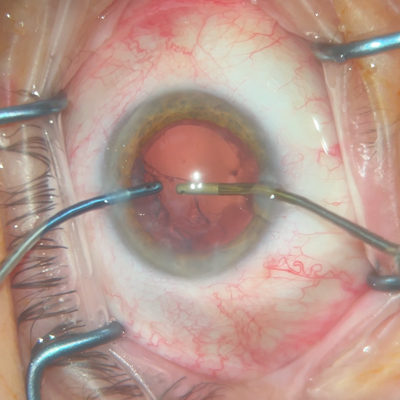
The choice between using bimanual or coaxial I/A depends on a number of factors, including physician preference and the type of case. Two surgeons discussed what they use and what may be beneficial in certain cases.
The Scheie Eye Institute residents reviewed “Visual outcome and postoperative complications of cataract surgery in patients with ocular surface disorders” from the Journal of Cataract & Refractive Surgery.
Since its approval, femtosecond laser-assisted cataract surgery (FLACS) has divided cataract surgeons into frequent users of the technology and those who do not think that it brings value to their practice. EyeWorld spoke with two surgeons who say they consistently benefit from FLACS in their practice.