ASCRS News
Spring 2025
by Ellen Stodola
Editorial Co-Director
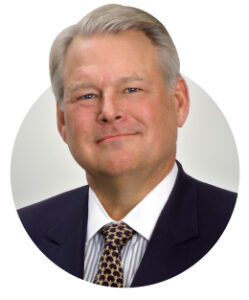
Richard Lindstrom, MD, has been a member of ASCRS for decades, almost since the Society’s inception, serving in various leadership roles for 40 years, including as ASCRS President from 2007–2008. This year, Dr. Lindstrom is stepping down from leadership and will be inducted into the ASCRS Ophthalmology Hall of Fame. He spoke to EyeWorld about his legacy with ASCRS.
Dr. Lindstrom’s first ASCRS meeting was at the Century Plaza Hotel in 1978, when the Society was still known as the American Intra-Ocular Implant Society (AIOIS). “I was still a fellow in training, and one of my mentors, William Harris, was active in early ASCRS,” Dr. Lindstrom said. Attending his first meeting, Dr. Lindstrom had done some research on combined keratoplasty and extracapsular cataract extraction and posterior chamber lens implants, which he said was unusual at the time. He submitted his research to present at a free paper session and was accepted.
“Immediately, it felt like home,” he said. “As a young surgeon still in training, I was given the opportunity to meet with and interact with very prominent, established ophthalmologists. They were interested in my work, they were friendly, they were supportive, and it was a great educational experience.” After that, Dr. Lindstrom returned to the ASCRS Annual Meeting every year. “The following year, I came back as a practitioner,” he said. “I found it to be a very welcoming environment.”
Dr. Lindstrom also got heavily engaged in teaching and noted that he was active in many early innovations, like phacoemulsification, posterior chamber lens implants, keratoplasty, refractive surgery, and glaucoma surgery. “I found it an inviting place to share my thoughts with colleagues and also to teach ophthalmologists who were interested in learning new things,” he said.
Dr. Lindstrom noted that he was asked to participate in ASCRS leadership in 1985. “I found that to be rewarding,” he said. He also was a member of the Editorial Board of the Journal of Cataract & Refractive Surgery from its early days.
“As a young surgeon still in training, I was given the opportunity to meet with and interact with very prominent, established ophthalmologists. They were interested in my work, they were friendly, they were supportive, and it was just a great educational experience.”
Richard Lindstrom, MD
“When we decided to create a Foundation, I was one of the founders. Howard Fine, MD, was the first chairman, and I was the head of corporate gifts,” he said, adding that he accompanied former ASCRS Executive Director David Karcher to raise early funds from corporations because he had worked closely with industry as a consultant. “I later became chair of the Foundation myself.”
Dr. Lindstrom said he kept coming back to the ASCRS Annual Meeting because of the value it provided. “It was a great place for personal learning and developing my surgical skills that I could bring home and help patients with,” he said. “It was the leading source of new and interesting information for me, especially from a surgical perspective. Although medical education was there as well, it’s where I stay tuned as a surgeon.”
Dr. Lindstrom served in a variety of capacities, including in academia, as well as at surgical centers. “I was an academician but also served as chair of the Anterior Segment Service at a large academic center, University of Minnesota, and chief of the Minneapolis VA Hospital, which was a very busy surgical VA, so that taught me a lot about practice management and sharing ideas with colleagues,” he said. “They were positioning their practices for success, and it helped me as an academician and a director of a large government hospital. I later founded a group called Minnesota Eye Consultants, which started as me alone to now 33 doctors, five offices, and five ASCs. ASCRS was the most important source of valuable information for me and for my administrators.”
Dr. Lindstrom said ASCRS goes beyond the practice of ophthalmology and helps cultivate relationships in the field. “Probably the most valuable thing was the personal relationships. It was where a lot of my lasting friendships in the field of ophthalmology came from, interactions at ASCRS Annual Meetings, going back to 1978.”
Being committed to teaching, Dr. Lindstrom has trained around 80 fellows in his career and said this is one of the more rewarding things he’s done. “I’ve introduced them to ASCRS as well, and it’s been fun to see them gain the same benefits that enhance their patient care, enhance their practice management, and help develop strong friendships,” he said. “Personally, I love ASCRS. It’s been a very important part of my life.”
While Dr. Lindstrom will be moving out of official leadership positions in the Society, he still plans to attend the meetings and be involved. He noted several close peers and friends that he’s worked with and attended meetings with through the years, including Samuel Masket, MD, Douglas Koch, MD, and Robert Osher, MD. “There’s still a role for us, in nurturing our friendships, in supporting the Society from a philanthropy perspective, which is becoming ever more important, and in being available to the younger doctors. They are always interested in hearing about the past but also in learning from us.”
Ophthalmology is a unique specialty, Dr. Lindstrom said. “I hear that all the time when people, particularly from industry, move from other specialties into ours. I think partly the reason is that vision is so important. We have a partnership among ourselves.” This is not just U.S. based, but global. “I traveled a lot for decades and participated in other society meetings around the world, and I think there’s a camaraderie because vision is so important, with a collaboration among industry and the physicians as well for that reason.”
Dr. Lindstrom also praised ASCRS advocacy, which he has participated in through the years. “I’ve done my share of advocacy as well, and those challenges will always be with us,” he said. “ASCRS has punched above its weight in that regard.” The Society has helped to represent ophthalmology’s interests in Washington, D.C., and has worked to collaborate with other medical societies on these issues as well.
“For the anterior segment surgeon who does cataract surgery, lens implantation, refractive lens-based surgery, refractive corneal surgery, glaucoma, and cornea, ASCRS has a lot to offer,” Dr. Lindstrom said, adding that ASCRS and ASOA also provide tools and education in practice management, helping to give surgeons all the skills and knowledge in many areas to maintain and sustain their practice.
Dr. Lindstrom’s legacy at ASCRS will have a lasting effect. Notably, the ASCRS Foundation launched its Lindstrom Legacy Gift Club last year, and the Richard L. Lindstrom, MD, Lecture is presented annually on the Main Stage at the ASCRS Annual Meeting.
This year, Dr. Lindstrom is being inducted into the ASCRS Ophthalmology Hall of Fame. He called this a great honor. “I’m humbled that my colleagues … would be willing to give me that honor,” he said.
Article Sidebar

W. Barry Lee, MD, EyeWorld Cornea Editorial Board member, shared what he is excited for at the ASCRS Annual Meeting:
“I always look forward to attending the ASCRS Annual Meeting. It provides me with cutting-edge technology updates from lectures and hands-on wet labs, as well as an incredible floor of all the ophthalmic industries to demo products and learn what I need to enhance my practice.”
About the physician
Richard Lindstrom, MD
Minnesota Eye Consultants
Minneapolis, Minnesota
Contact
Lindstrom: rllindstrom@mneye.com