
- ‘Not your typical weekend meeting’
- The why, the what, and the how
- Patient experience
- Pricing considerations
- Prepping for the premium practice journey
- The premium practice journey
- Educating patients in their refractive cataract surgery journey
- Navigating implant technologies
- The advanced-technology implant surgery
- Aftercare and the postop journey
- Premium optics: tear film for the advanced lens
‘Not your typical weekend meeting’

The inaugural ASCRS Business of Refractive Cataract Surgery (BRiCS) Summit took place over the weekend, offering attendees the knowledge and tools they need to successfully and confidently offer advanced-technology IOLs in their practice.
“This is not your typical weekend premium IOL meeting,” said ASCRS Executive Director Steve Speares. “This is about transforming the practice and building the necessary foundation for success as a business entity in addition to the delivery of excellent clinical care.”
Vance Thompson, MD, ASCRS President and Chair of the BRiCS Summit, said he doesn’t think there has been a meeting that offers the concentrated information on the business of refractive cataract surgery in the way this course has.
“There is an equal respect for the doctors and their teams that deliver the care and the business leaders of their team who administer and provide structure to the practice,” Dr. Thompson said. “In the ASCRS and ASOA world, we have too many meetings, great meetings, apart, and to be even greater we need to be in the same room more often. … I simply hope and pray that at the end of this 2-day course you have something valuable—the knowledge, the tools, the comfort—to go home and go next level … to deliver advanced-level cataract surgery in your practices.”
The why, the what, and the how
William Wiley, MD, kicked off the programming, with a discussion on the theme of financial sustainability in the practice, presenting information on how reimbursement has changed over the years, in addition to volume, efficiency, overhead, facility fees, and other practice costs that factor into the overall procedure cost.
With ongoing cuts to Medicare overall, the bottom line is getting worse. It’s not only threatening our lifestyle, but it’s also threatening the way we want to treat patients, he said. Prices for equipment and diagnostics are also going up.
But Dr. Wiley said premium refractive cataract surgery can be the solution for this problem. Patients want technology, and a course like BRiCS helps you learn how to market, how to talk to patients, finance market strategies, and more. Without refractive cataract surgery, we currently aren’t financially sustainable, but thankfully patients want this, too, Dr. Wiley said.
Patient experience

Carrie Jacobs, COE, William Trattler, MD, Jaime Johannesen, Debbie Davis, COE, and Richard Tipperman, MD, participated in a panel discussion about the patient experience cycle, discussing the doctor’s role and the team’s role in various aspects of the patient experience.
Identifying the doctor’s role and the team’s role is the foundation of what will take you forward in the rest of the discussion, Ms. Jacobs said. The patient experience cycle includes various steps in the patient journey from start to finish. This begins when the patient calls to set up an appointment and continues to the postop period (if the patient needs enhancements or follow-up care). Panelists discussed who in the practice is involved in each step of this cycle and shared specific things their practices are doing to make this journey the best experience for the patient.
Educating the patients in the process is critically important, and panelists highlighted various ways that their practices communicate with patients through their journey, including before they even step foot in the practice for the first time and important information to share with them to ensure success.
Pricing considerations
Matt Jensen led a session on refractive cataract pricing considerations with Patti Barkey, COE, Dagny Zhu, MD, and Nicole Fram, MD.
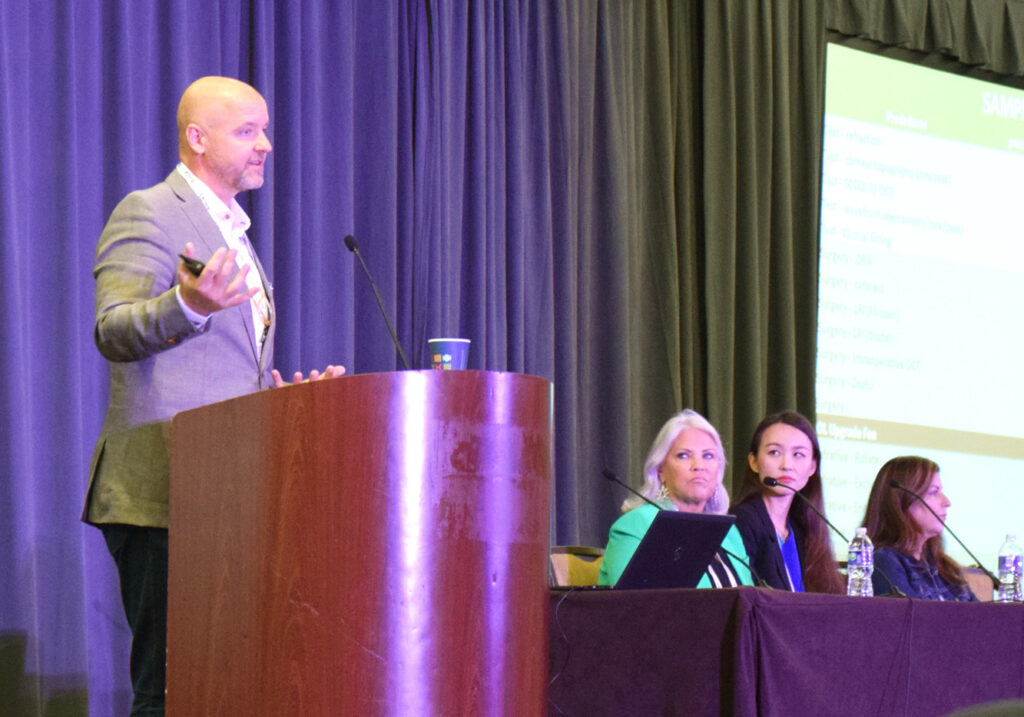
Mr. Jensen stressed that a fundamental unit for success is time, and you must figure out how to appropriately price advanced-technology lenses in your practice. It’s important to know what you can charge for, he said. Ms. Barkey noted that it’s also important for the whole team to understand why you’re charging what you’re charging. Pricing considerations include incorporating the number of visits needed, refractions, diagnostics and tests being used, where the surgery is performed, and more.
Dr. Fram expressed that it’s important to ensure patients know that you’re going to get them to the outcomes they want in this model. “If we don’t hit our targets, and if we don’t have an outcome you like, I’m not going to leave you. I’m going to help you, and that’s built into this model,” she said.
“We’re wildly undercharging for our services that people are willing to pay for, as long as they understand their options,” Mr. Jensen said, and he also shared a spreadsheet example of various factors and potential prices that go into these premium services that attendees could use in their own practices to add up all expenses and including services to find the best price for their practice.
Panelists also shared information on how their specific practices price various premium lens packages.
Prepping for the premium practice journey
This session was split into several discussions that involved the team experience and its influence on the subsequent patient experience, setting up effective internal and external marketing, and the elements of the patient experience before surgery.
Dr. Thompson and Mr. Jensen took the lead on the topic of a team-first patient experience.
“It’s amazing how these things that make a great family make a great work family and make a great environment for the patient,” Dr. Thompson said. He said later that the practice can be transformed if its members love and care for each other, and this is the first step of the patient experience.
Dr. Thompson and Mr. Jensen went into the details that help create a thriving team environment, offering ideas for helpful books on the topic, how to align the team on customer motivators that will improve their experience, the fun that can drive a closer-knit team, and the structure and mindset that’s needed to implement.
Jennifer Loh, MD, presented on internal and external marketing principles that would energize practices. The goal of marketing is to boost patient engagement, increase retention, and acquire new patients into the practice.
Internal marketing, she said, energizes or reinvigorates the practice’s current patient base to build loyalty, enhance their experience, and drive word-of-mouth referrals. External marketing is aimed at attracting new patients through various channels.
Dr. Loh and the panel talked extensively about what they do for internal and external marketing, including review management, strategies, and tactics that are necessary for the internal team to ensure success of all marketing efforts.
Rounding out the second session, Blake Williamson, MD, shared with the audience how his practice handles the patient experience pre-surgery, from the moment they schedule an evaluation to pre-visit outreach to testing and surgeon evaluation to when they’re being prepped for surgery and everything in between.
The premium practice journey
Dr. Loh moderated a session with Dr. Trattler, Ms. Davis, Mr. Jensen, and Richard Lindstrom, MD, which focused heavily on marketing strategies and developing a referral network and the importance of referrals in the practice, highlighting the importance of the preparation for the premium practice journey.
Panelists discussed the ways that they regularly communicate with referring doctors, practice and physician reputation, and monitoring and tracking practice performance.
Getting into the clinical side of the journey, Dr. Zhu led a discussion with Dr. Tipperman and Dr. Wiley, highlighting diagnostics to help match the advanced-technology implant to the patient. They discussed when to perform diagnostic testing during the patient journey, whether that’s before or after the physician sees the patient, and they highlighted what they consider some of the “must-have” diagnostics and what they use in their practices.
Dr. Tipperman, Dr. Trattler, and Dr. Loh discussed why a monofocal implant is not a “no brainer” and the importance of educating a patient on exactly what a monofocal lens is.
Educating patients in their refractive cataract surgery journey
Beyond lens selection, Dr. Thompson and a panel discussed the importance of patient education in terms of expectation setting and understanding that both the optimization (potential fine tune, YAG laser capsulotomy, tear film treatment) to crisp 20/20 in the first 4–6 months followed by neuroadaptation in the second 4–6 months is important for the success of advanced-technology IOLs.
Among many items in his presentation, Dr. Thompson shared that when patients describe seeing glare and/or starbursts postop, that suggests something physiological (for example, residual refractive error, posterior capsule opacity, or dry eye) is going on that the surgeon can take care of. If the patient is seeing halos, he said that is likely from a multifocal IOL. He emphasized that it is the combination of glare, starbursts, and halos that are most bothersome to patients, and it is the doctor’s job to optimize the patient’s optical system, so it is just the halo from the multifocal implant they are dealing with, and that is when their brain can neural adapt best for the highest chance of patient satisfaction.
Ms. Jacobs, on the panel, said the key is for patients to understand it’s a journey, it’s a process, and to not have the expectation that they’ll have perfect vision on day 1.
Navigating implant technologies
Dr. Zhu led a presentation on the many different implant technologies that are available.
“Presbyopia IOLs as a category have come a long way,” Dr. Zhu said.
She presented the various advanced-technology IOLs on the market that are diffractive, non-diffractive, and enhanced monofocal and monofocal plus. She and the panel shared how they aim their EDOFs. Dr. Zhu brought up the considerations involving IOLs materials and the benefits/limitations with these materials in certain patient situations.
There were several cases presented with significant discussion on the best IOL for the patient.
“We have these expanded IOLs options in terms of presbyopia correction, more than we’ve ever had before. Basically, we’re able to expand our patient pool,” Dr. Zhu said.
The advanced-technology implant surgery
Presentations within this session focused on surgical pearls for success with advanced-technology implants and optimizing and working with the patient postop.
“There is always something unique about surgery when you choose these advanced implants,” Dr. Wiley said, noting that the procedures come with high expectations, the need for short- and long-term stability, possibility of lens removal, and minimal margin of error.
The panelists—Dr. Wiley, Dr. Fram, and Dr. Lindstrom—discussed how their surgery is different with advanced-technology implants compared to basic monofocal surgery.
Dr. Tipperman, Dr. Williamson, and Dr. Thompson later gave their thoughts on the topic of optimizing and finishing. The discussion involved what they do in the early postop visit, how to improve patient perception when the patient is 20/unhappy, sources of patient dissatisfaction, elements of the patient optimization journey, real problems vs. hassles, the various factors that go into managing residual refractive error, and what to do even after you’ve optimized the patient as much as possible.
Aftercare and the postop journey
Some of Saturday’s content focused on aftercare and the postop journey, with faculty sharing various keys to success in different areas like forms and checklists, keeping in touch with patients, and dealing with the unhappy patient.
Ms. Davis, Dr. Williamson, Ms. Johannesen, and Mr. Jensen went through some of the forms, checklists, videos, and other tools to use in the patient experience cycle. They spoke about each step of the cycle and discussed how their practices interface and communicate with patients from before surgery to postop.
Some of the things they highlighted were scripts/talking points to use and details to share about the technology, the process, and patient expectations. They also highlighted forms that may be needed and important patient history/questionnaire information to obtain. Physicians, technicians, those working in the call center, and other practice employees, as well as the practice website and other communications tools, are all important in the whole patient experience cycle.
Dr. Fram, Dr. Thompson, and Ms. Johannesen discussed keeping in touch with the patient and maintaining the connection for a “therapeutic relationship.” Dr. Fram went into detail and stressed the importance of assembling a team to address each step in the journey and provided some tips for making good on the commitment to a good outcome.
Dr. Zhu tackled the topic of the frustrated patient, with panelists Dr. Lindstrom, Dr. Tipperman, Ms. Johannesen, and Dr. Williamson weighing in. Dr. Zhu went through reasons for patients to be unhappy after cataract surgery. She said there are higher stakes in premium cataract surgery, and you can do a perfect surgery and have an imperfect result. She offered common reasons for dissatisfaction and shared several cases and top tips for managing unhappy patients.
Premium optics: tear film for the advanced lens
Dr. Fram, along with Ms. Barkey and Dr. Lindstrom, emphasized the importance of optimizing the ocular surface when using advanced-technology IOLs.
“All too often it seems like the ocular surface is left out of the process,” Ms. Barkey said, noting that patients who are making an incredible investment expect incredible outcomes, which are more likely to be achieved when the ocular surface is managed throughout the process.
Dr. Lindstrom said there are four stages where the ocular surface is the surgeon’s responsibility: in preparation for surgery, during surgery from an ocular surface protection standpoint, ocular surface rehabilitation postop, and getting the patient on a long-term maintenance plan. The panel discussed what to look for, management options, and the ongoing treatment that is necessary for these patients.
“Pay attention to tear film so we can have excellent postop outcomes,” Dr. Fram said, cautioning to postpone biometry and surgery until the Placido imaging and topography is stable. “If you rush it, you’re going to be in a world of hurt.”
The meeting also included CME presentations, interactive role-play sessions, small-group roundtable workshops, and information from industry supporters.
Editors’ note: The speakers listed their financial interests within each session. Find all of their financial interests here.