Refractive: Best practices
July 2023
by Ellen Stodola
Editorial Co-Director
When performing one of the many refractive procedures available today, the surgical experience doesn’t end when the surgery is over. Surgeons often have to follow up with patients, helping them through the postop experience, and sometimes providing touch-ups. Two physicians discussed how they handle the refractive postop experience, how to manage patient expectations, and diagnostic tools that help them.
The postop experience begins right at the end of the surgery, said James Loden, MD. The doctor should be communicating with the patient that the procedure went well, if it did. If it didn’t, you need to share that as well, he said. “Part of setting the preliminary postop experience is by saying ‘You did great’ or ‘We did have a little complication, but we fixed it,’ or in those rare cases, ‘We broke a capsule and we’re going to have to do a second surgery.’” Being very communicative is key, he said.

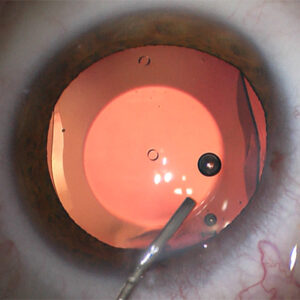
Source: Joseph Ling, MD
The second step is providing instructions before the patient leaves the surgery center, Dr. Loden said. It’s important to give clear and concise instructions of expectations and what the patient will experience over the next 2–3 hours and what they experience the next morning when coming in for the day 1 visit.
The postop visit depends on the procedure, and Dr. Loden said he won’t always see each patient immediately after surgery, though he does prefer the chance to see the patient and set expectations. He added that it’s also important to identify if the patient may be harder to satisfy. In those cases, you can have them see the operating surgeon and set the expectations and timelines to get the patient happier quicker.
With LASIK, he said that almost every patient is 20/20 on the day 1 postop exam, but it’s still important to set expectations for the next week. There could be a little glare or halo, but those will usually go away.
Joseph Ling, MD, said he likes to see most patients 1 day after a refractive procedure because there are many things that can occur over the day after surgery.
For LASIK specifically, he said it’s important to ensure that the flap isn’t mispositioned, and for LASIK, PRK, and SMILE, he said you want to make sure that the interface is clear. DLK can occur in the first 24 hours when there’s a lot of inflammation, he said. These are things that can easily be treated early on, but if you don’t see patients at 1 day out, these can get worse.
For ICLs, he said it’s important to make sure the pressure looks good the day after surgery. It’s an intraocular surgery, so he’s concerned about inflammation, TASS, and infection, he said, adding that these are things the surgeon would want to catch early. “The sooner you see it, the sooner you can treat it, and the better the outcome,” he said.
Most of these patients are quite functional the next day, Dr. Ling said, so it’s also a good time for celebration and to see if they’re happy. For those who aren’t seeing well at day 1, it’s about reassurance so they’re not sitting at home wondering why they’re not seeing great.
“For all my patients, I counsel them about the most common things to expect,” Dr. Ling said. “You want to focus on the relevant expectations and not go over every possible thing. The consent can cover everything else.”
He said that the common things for LASIK are the potential need for a second treatment, accuracy, residual refractive errors, and common side effects. The same goes for SMILE.
“For PRK, I counsel patients that they will need to wear a contact lens for the first week, and the vision will gradually get better,” he said.
With ICLs, Dr. Ling said you can expect the patient to be functional starting at day 1 following surgery. Vision dramatically improves with the ICL due to the fact that we’re not touching the cornea, he said. “The cornea is pristine, even immediately after surgery. Almost all my patients are 20/40 or better immediately after ICL surgery. The next day is when they get to 20/20 or 20/15,” he said. Side effects may include glare or halo, and Dr. Ling said most patients will notice these issues, but they generally disappear over the course of the first month.
He added that patients should be aware of residual refractive error, and he will also mention possible issues with positioning of the lens or exchanging the ICL for a different size.
Dr. Ling finds that patients are most concerned about potential side effects. For patients who had LASIK or SMILE, they are also concerned about quality of vision. If vision is fluctuating, he explains that the tear film is a big part that is recovering after laser vision correction. Artificial tears need to be used frequently, Dr. Ling said. With PRK, this requires a longer period for the vision to stabilize, as the surface of the epithelium needs to heal.
Diagnostic tests
In terms of diagnostic tools and tests that can be used to help patients after surgery, Dr. Loden said he uses OCT to ensure the patient does not have any CME that needs to be treated. This is generally for the cataract and lensectomy patients, he said.
Another postop issue is uncorrected refractive error. It’s the number one cause of complaints and dissatisfaction, whether it’s spherical or cylinder. Dr. Loden said he will put the patient in a trial frame with their best correction and ask how it looks to determine how to best proceed with a touch-up procedure.
Dry eye is another common problem post-surgery, Dr. Loden said. It might be necessary to use Placido disc topography. Dr. Loden also likes to use the Visiometrics HD Analyzer to measure objective scatter index. Any of the tear film analyzers are helpful to see whether the patient has dry eye or a poor quality tear film that needs to be addressed, Dr. Loden said.
When there is an unexpected refractive error in laser vision correction, Dr. Ling said he checks the Pentacam (Oculus) to make sure the cornea appearance is as expected and there is no ectasia or abnormalities. He also checks patients for dry eye with fluorescein tests to make sure they are using artificial tears frequently enough.
Dr. Ling suggested checking the refraction at 1 week and 1 month in order to have a comparison. Patients will see a change from the 1-week refraction, but this gives him a sense of where they are and the types of issues they might be having. He typically waits until 3 months after surgery to decide if the patient will need an enhancement.
“For laser vision correction, if any touch-up needs to be done, we will usually know by 4–8 weeks out because the refraction stabilizes around that time,” Dr. Ling said, adding that the range for that enhancement is low, around 1–2%, depending on the type of surgery and how high the prescription is. “The higher the prescription you’re treating with laser vision correction, the higher the chance that there may be a need for enhancement,” he said.
With ICL procedures, Dr. Ling said he looks closely at the vault of the ICL. “You can check that at the slit lamp by using a diagonal beam to see the space between the ICL and the natural lens and compare that to corneal thickness,” he said. It’s important to check the vault to ensure that the ICL size is suitable. If you’re not sure about the vault through slit lamp, you can get an anterior segment OCT (Optovue Avanti) and measure the exact vault of the ICL over the crystalline lens.
“For ICLs, we’d typically be looking at laser vision correction touch-ups and would figure out at about 1 month what the refraction stabilized at,” Dr. Ling said. “You want to have more than one refraction to base that off of.”
If a patient’s vault is too low (if there’s less than 100 microns of space between the lens and ICL), there might be a risk of earlier cataract formation, Dr. Ling said. He usually likes to size up for that patient. If the vault is too high (above 750 microns and you have trouble seeing the trabecular meshwork angle on gonioscopy), he’d want to size down. That would allow the trabecular meshwork angle to open up, so you don’t run the risk of having angle closure, he said.
Taking care of patients postoperatively is an art, Dr. Ling said. “There are many reasons why a patient might not be happy after their vision correction surgery,” he said. “We try to head off a lot of the concerns preoperatively by matching the right patient to the right technology.” There will still be patients who are not 100% happy, and that can be due to many non-surgical reasons. “You want to address expectations upfront to help ensure happier patients. If problems arise after surgery, empathize with the patient’s concerns, reassure the patient’s worries, and reaffirm that you are going take care of them every step of the way,” he said.
About the physicians
Joseph Ling, MD
Laser Eye Center of Silicon Valley
San Jose, California
James Loden, MD
Loden Vision Centers
Nashville, Tennessee
Relevant disclosures
Ling: None
Loden: Johnson & Johnson Vision
Contact
Ling: josephjling@gmail.com
Loden: lodenmd@icloud.com