ONLINE EXCLUSIVE
ASCRS News
May 2023
by Liz Hillman
Editorial Co-Director
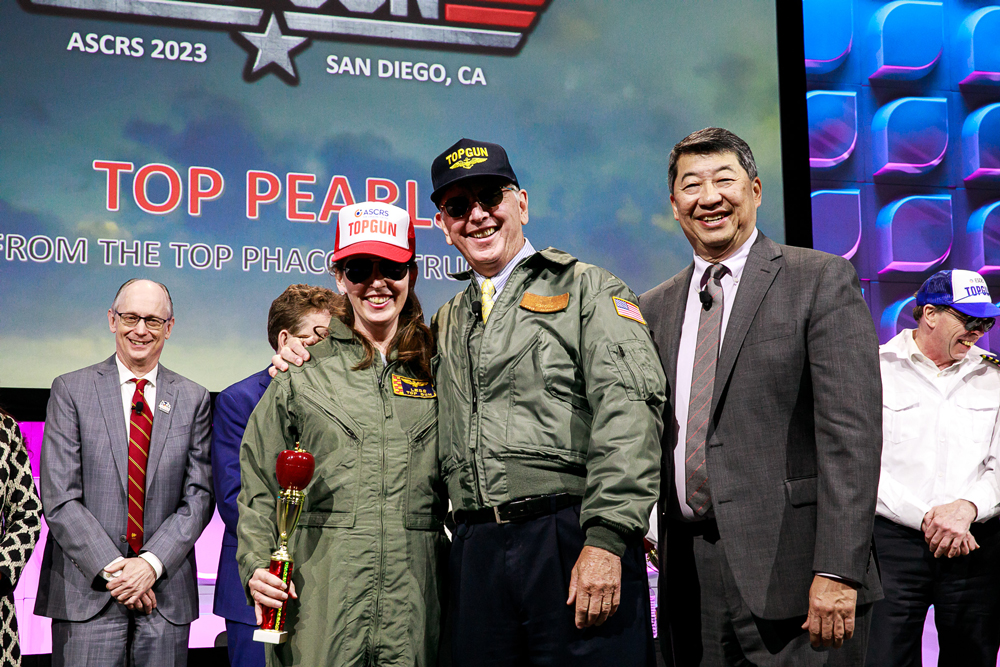
The purpose of Top Gun is to train the U.S. Navy’s best pilots, but the purpose of “TOPGUN: Phaco Mavericks,” said David Chang, MD, is to have the world’s top phaco instructors provide their best pearls in cataract surgery. The symposium, which took place at the 2023 ASCRS Annual Meeting, included two teams—ASCRS members and an international team with members from ESCRS, APACRS, and LASCRS.
“We want them to present practical trade secrets that you can incorporate into the operating room next week,” Dr. Chang, moderator of the session, said of the competing teams. “This is a rapid-fire video session, extremely fast paced. That’s because we know the audience feels the need … for speed!”
Here is a look at the winners and a recap of some of the presentations from each section.
Source: ASCRS
Phaco pearls
Julie Schallhorn, MD, took home the top prize in this section, presenting on the management of capsular rents in two scenarios. One scenario had a posterior capsule rent when she intended to place a toric IOL, and another was a case involving dropped lens fragments. In both cases, Dr. Schallhorn employed the optic capture technique to maintain stability of the IOL.
Other presentations in the section included a lesson on the importance of maintaining chamber stability when managing a posterior capsule rupture from Jeff Pettey, MD. Abhay Vasavada, MD, gave his tips for rotating the nucleus, which included looking for cortico-capsular adhesions, avoiding stressful rotation, using proper directional forces, and performing multi-quadrant hydrodissection. Rudy Nuijts, MD, PhD, showed a case of combined phakic IOL explantation and phaco. He described using two incisions: one for explanting and one for phaco. For phaco he employed a divide and conquer technique, followed by bimanual I/A. He said in these cases to use a combination of dispersive and high viscosity OVDs to protect the corneal endothelium. He also said to lower IOP settings and apply lidocaine in highly myopic eyes to avoid distention of the lens-iris diaphragm and pain. Use a meticulous suturing technique for the corneal incision to avoid a high surgically induced astigmatism (or perform a corneoscleral incision).
IOL pearls
Claudio Orlich, MD, produced what panelist Kevin Miller, MD, called a video with “cinematic flare.” It showcased rotation of IOLs in myopic eyes and took home the honor for this category. Dr. Orlich’s preferred technique to prevent rotation and ensure stability in these eyes is reverse optic capture.
Other presentations in this section included one from Mitchell Weikert, MD, who discussed avoiding misalignment of toric IOLs. For stability, he said to unfold the haptics of these IOLs fully, remove OVD completely, maintain anterior chamber stability, leave the eye soft, and have the patient rest for at least 1 hour postop. Dr. Weikert also advised double checking your measurements, confirming the alignment of the IOL and determining the actual alignment postop, and optimizing your marking methods.
Sumitra Khandelwal, MD, described IOLs for irregular corneas. The first tip is to not miss it. She said to screen with topography, a careful history, and counseling. Keratoconus is more common than you might think, Dr. Khandelwal said. From there, optimize your keratometry measurements by making sure to have the patient out of corrective contact lenses for a period of time (timing dependent on type of contacts) and making sure there is repeatability in measurements before proceeding with surgery. Dr. Khandelwal also said to use the best IOL formulas for these eyes. Some specific IOLs could be helpful in these eyes as well, with Dr. Khandelwal mentioning the Light Adjustable Lens (RxSight) and the IC-8/Apthera (Bausch + Lomb) as examples.
This section also had a presentation from Filomena Ribeiro, MD, PhD, about everything that can go wrong with IOLs and how to explant them.
Complex surgery pearls
Soon Phaik Chee, MD, was voted the winner in this category for her simple technique to remove a Soemmering’s ring. Her technique included performing an adequate anterior vitrectomy and using an IOL cartridge to keep the corneal incision rounded to enable infusion pressure to hydro-express the entire ring in a controlled manner into the cartridge.
Another presentation in the session came from Manjool Shah, MD, who showed a case of a white cataract. He performed a bimanual capsulotomy and used a deep trench centrally for phaco to avoid rotation. Keep the phaco tip at the iris-capsule plane, he said, and use the chopper to keep everything down and protect the cornea. In these cases, a good anterior vitrectomy is important, Dr. Shah continued. From there, he showed how he scleral sutured the lens.
Marjan Farid, MD, showed how to manage a traumatic cataract with sectoral zonular loss. In this case, she centered the capsulorhexis on the lens (not the pupil, which was damaged), employed iris hooks for adequate visualization, and used the miLOOP (Carl Zeiss Meditec) for phaco-less chopping. At the end of the case, she created a round pupil to help minimize glare.
Roberto Zaldivar, MD, shared his advice for IOL extraction of different IOL material types in a presentation.
Overall, the international team was voted by the audience as having the best teaching cases and pearls.