Refractive: YES Connect
April 2023
by Liz Hillman
Editorial Co-Director
In this YES Connect column, we wanted to highlight the webinar “Refractive Surgery 101” moderated by Dagny Zhu, MD. In the webinar, the speakers will discuss how to learn refractive surgery after training. Attending refractive fellowships, joining like-minded groups, and attending virtual and live meetings are important tools. It has become much more important for young eye surgeons to learn refractive surgery because cataract surgery at times will require corneal refractive procedures postoperatively (such as LASIK, PRK, or PCRIs) to achieve excellent visual outcomes, especially in the premium population.
—Zaina Al-Mohtaseb, MD, YES Clinical Committee Chair
While Dagny Zhu, MD, is well entrenched in refractive cataract surgery and refractive surgery in her practice now, this was not always the case. In fact, she had zero refractive surgery experience in residency, and her experience with refractive cataract surgery was limited. She said this experience is common for most coming out of training.
How to break into refractive surgery as a young eye surgeon is the topic of the April YES Connect Webinar, and EyeWorld spoke with Dr. Zhu to hear her personal experience and insights ahead of the online event.
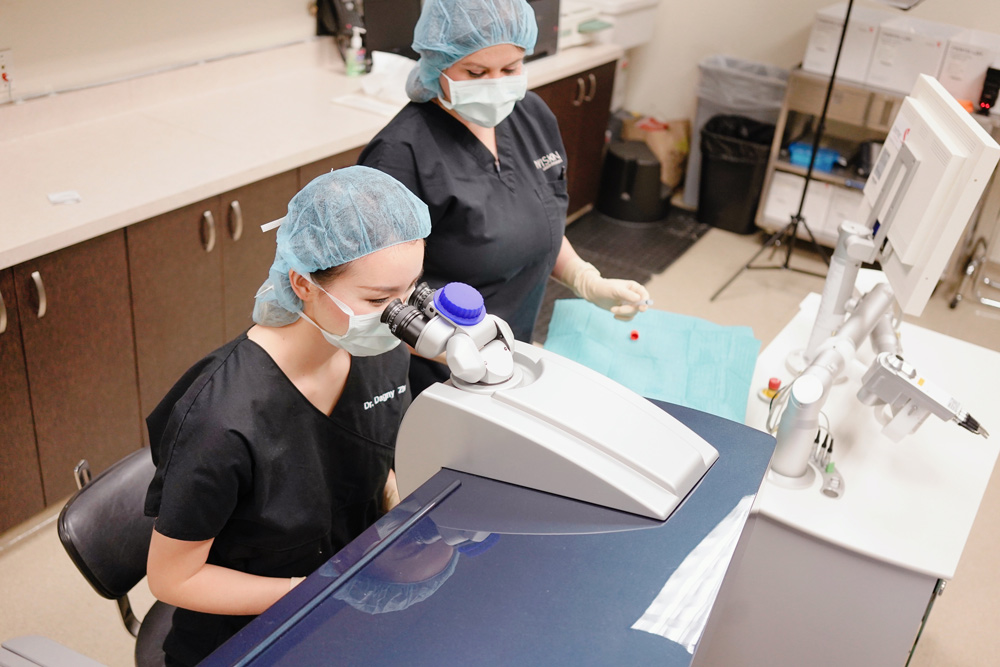
Source: Dagny Zhu, MD
EyeWorld: If you didn’t have refractive surgery experience in residency, how did you decide to get into this area in practice? How did you gain experience?
Dr. Zhu: I fell into the world of refractive surgery by chance. It was never anything I had intended for my career. I thought I was going to do a cornea fellowship, and I was going to practice either in academia or private practice doing mostly comprehensive ophthalmology, cataract, and cornea transplants. As luck would have it, I was accepted into a combined cornea and refractive fellowship at Bascom Palmer, and there I was first introduced to the world of refractive surgery under the mentorship of renowned experts, Sonia Yoo, MD, Kendall Donaldson, MD, William Culbertson, MD, and Terrence O’Brien, MD.
When I was looking for a job, there was a large practice in my hometown that was for sale. It happened to be a high-volume refractive cataract and refractive surgery practice. By taking the risk and buying into that practice as a new grad, I was able to quickly build upon the fundamentals of refractive surgery I had learned in fellowship from day 1. My first 1 or 2 years in practice were like an additional mini refractive fellowship. I learned from the surgeon who I bought the practice from. She took me under her wing, and that’s where I learned the nuances of refractive surgery.
EyeWorld: What do you think of the current state of refractive surgery exposure for those in training?
Dr. Zhu: Because we have so little exposure to refractive surgery in residency, I think most of us come out knowing little about refractive surgery and having little interest in it, at least in a typical, traditional residency program. … We almost have the feeling that refractive surgery isn’t fixing real eye disease, that refractive error is not real eye disease. We want to take care of sick eyes. That’s the mindset we have as residents, and our attendings are the same way. Many of them don’t perform refractive surgery.
I’m so grateful to be in this field because refractive surgery is what most patients consider eye surgery. The difference you make in people’s lives is just tremendous. I’m fortunate to have gotten into this subspecialty.
EyeWorld: If an ophthalmologist wants to incorporate refractive surgery offerings into their practice, and they think they need more knowledge in terms of preop counseling, postop care, and the hands-on components, how would you suggest they gain this experience?
Dr. Zhu: I think we still have a major shortage in the area of providing adequate and sufficient refractive surgery education. The usual offerings are weekend courses at the national meetings. The easy part is the hands-on training. The hardest part is the diagnosis, the preoperative testing, and the postoperative management of complications. That can’t be learned in a few hour-long courses. If you want to be a good refractive surgeon, you should consider investing in one of the many refractive surgery fellowships that are now available in both academic and private practice settings.
When I was training, there were very few refractive-focused fellowships available, compared to just 5 years later. Whether you choose academia or a private practice setting, I think the best way to learn refractive surgery is under the apprenticeship of a refractive surgeon with real patient cases. … It’s all hands-on training, not didactics.
I know some practicing ophthalmologists don’t have time to dedicate to this. I have some colleagues who took a break to do a fellowship and come back.
The other option is to do something similar to what I did and learn it on the job. If you can find a practice to join where there is a high-volume refractive surgeon willing to take you under their wing, that would be a great substitute.
EyeWorld: There are several refractive surgery options: PRK, LASIK, SMILE, ICL, RLE, etc. Where do you think a young ophthalmologist interested in refractive surgery should get started?
Dr. Zhu: I think that most people start with an excimer laser. Quite a few cataract surgeons don’t do primarily refractive surgery, but as you’re offering more premium lenses, patients need enhancements, and having an excimer laser in-house means you can at least do PRK enhancements. … To do LASIK, you need two lasers—the femtosecond laser to make the flap and the excimer laser to do the ablation treatment. To do SMILE you need a whole different laser, but that laser also does LASIK flaps.
EyeWorld: Any final thoughts about resources for young ophthalmologists?
Dr. Zhu: The YES Connect Webinar will be great to watch because it’s providing resources and tips on how a handful of us young refractive surgeons got into it and how they can do the same. … I would also give a shout-out to the Refractive Surgery Alliance. The refractive surgeons who are part of this group form a great network; it’s a forum where we’re often presenting cases and we get to hear from refractive expert minds across the world.
About the physician
Dagny Zhu, MD
NVISION Eye Centers
Rowland Heights, California
Relevant disclosures
Zhu: None
Contact
Zhu: dagny.zhu@gmail.com