ASCRS News: 2022 ASCRS Annual Meeting recap
June 2022
by Liz Hillman
Editorial Co-Director
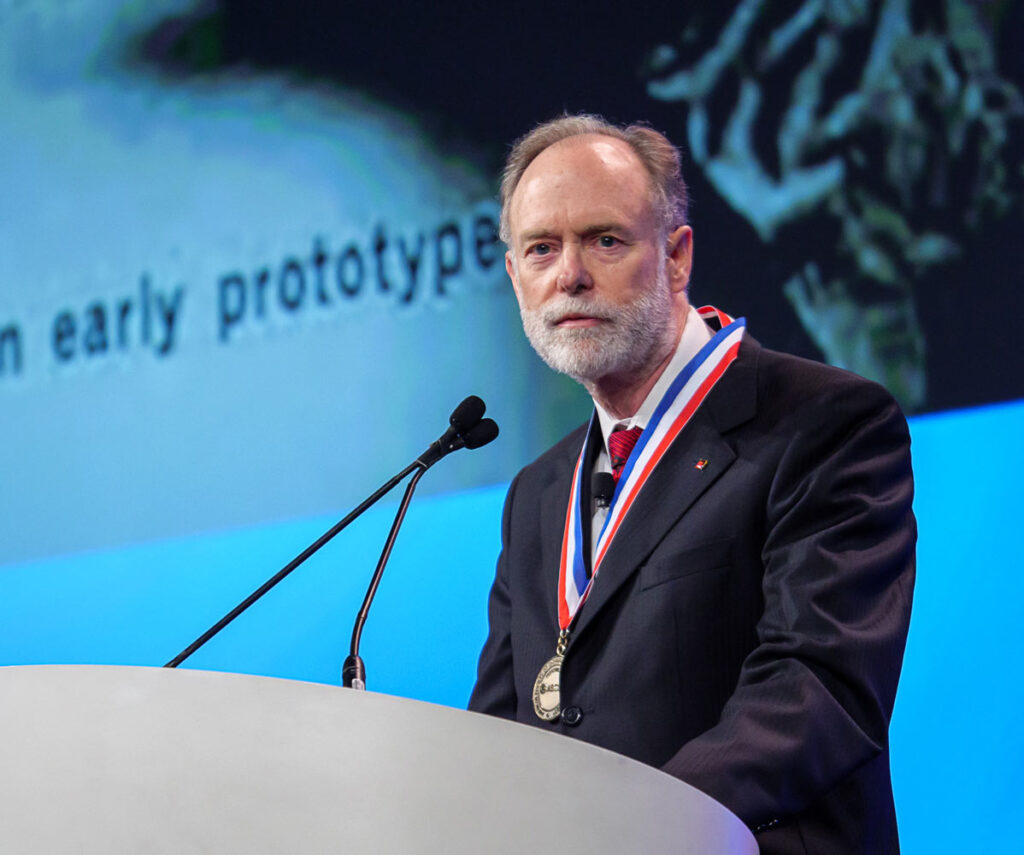
Francis Price Jr., MD, delivered the Charles D. Kelman, MD, Innovator’s Lecture during the Innovators General Session at the 2022 ASCRS Annual Meeting. There were also several other presentations on innovative ideas, techniques, and technologies.
Charles D. Kelman, MD, Innovator’s Lecture
Dr. Price spoke about improving patient care through innovation and tracking outcomes. He said that ASCRS is an association of innovators, founded to promote ideas and technologies that, while commonplace now, were initially controversial, such as phacoemulsification, IOLs, and refractive surgery. Innovators are not necessarily inventors, like Dr. Kelman, Dr. Price said, adding that not all innovations work. As innovators, he continued, we should share our ideas with others and strive to improve care and outcomes for our patients.
There needs to be a balance between innovation and regulation, Dr. Price said. Regulation can serve to protect patients, but it also can increase costs, be a barrier to entry, and delay development. Innovation can improve treatment outcomes, tailor treatments to patients, and disrupt the status quo. But unregulated or untracked innovations can lead to the “wild west.” The wild west can be controlled, if we’re responsible and we track our results, Dr. Price said, adding that when we’re not responsible, the result can be more regulation.
He went on to describe some of his early work, including the creation of the Cornea Research Foundation of America (CRFA) in 1988. The goal was to have a database for corneal transplants (prior to this, there was no tracking of grafts in the U.S.) with full-time researchers and the ability to conduct studies. At the time CRFA was founded, Dr. Price said non-profit regulations were different. Study regulations were also looser; retrospective studies didn’t require IRB approval, “off-label use” was not an issue, and there were little to no regulations for devices that were small volume and not marketed.
The work of CRFA allowed tracking and analyzing of corneal transplants, offering the ability to see the advantages of DSEK in 2003 and DMEK in 2008. The databases also enabled them to demonstrate the differences to PK for both patients, physicians, and at times, insurance companies, Dr. Price said.
Dr. Price also described a multicenter study that compared LASIK and contact lens wearers (the first study to track LASIK for 3 years and to compare LASIK to a control group). It found that LASIK outperformed contacts in terms of night driving, patient satisfaction, dry eye, and infections/abrasions.
Research and techniques from the CRFA helped change corneal transplants, providing the first prospective, randomized studies on topical steroid dosing after corneal transplants, a prospective study on stopping steroids after 1 year for DMEK, and it identified glaucoma tubes as the most significant risk factor for EK failure, Dr. Price said. He questioned whether large databases, which are commonplace now, will replace single-center databases. He thinks not because while large databases have the advantage of seeing what’s going on all over, single centers have more consistent data entry, highly skilled and experienced surgeons, potentially better follow-up, and may be better at determining cause and effect.
Dr. Price said the next data challenge is healthcare reform. He spoke about how the data can be used to show the effect of taking physicians out of the equation, the effect of pharmaceutical costs, and how preventative care and lifestyle modifications can improve health.
Source: ASCRS
Other presentations
Contact Lens Drug Delivery
Joseph Ciolino, MD, described technology developed by Mass Eye and Ear and licensed by TherOptix that would improve drug delivery to the eye through a contact lens platform. While this concept dates back to the 1960s, Dr. Ciolino said its challenges include needing to maintain a therapeutic level of drug over a certain release time with a lens that’s clear and comfortable. The new technology is based on a drug polymer film that provides elevated drug loading, controlled release, and consistent loading irrespective of contact lens parameters. The contact lens platform has been evaluated with dexamethasone, latanoprost, and moxifloxacin in animal models, showing success over drops in several areas.
OcuRing: The Future of Dropless Cataract Surgery
Kenneth Mandell, MD, PhD, shared information about a technology that could reduce/eliminate drops needed after cataract surgery. OcuRing (LayerBio) is an inside-the-eye NSAID (ketorolac) that is bioerodible for sustained-release treatment of inflammation and pain after cataract surgery. While NSAIDs are highly effective at reducing inflammation and pain, Dr. Mandell said, topical versions can delay healing and have the potential for corneal melts, with special precautions needed for certain types of patients. OcuRing has the efficacy benefits of topical NSAIDs with enhanced safety and tolerability, he said, adding that it guarantees compliance with improved outcomes and enhanced patient satisfaction.
EVO ICL
Roger Zaldivar, MD, described the history of the ICL, with the first being implanted by his father in 1994. In the years since, the ICL underwent “strong innovation,” Dr. Zaldivar said. The current design increased safety and efficacy with no cataract formation, pupillary block, or pigment dispersion observed. There are new technologies being used to predict vault more accurately, Dr. Zaldivar said. Surveys have shown a high degree of patient satisfaction with the ICL, with 92% scoring it at a 10 on a scale from 1–10, and the others scoring it at a 9. Dr. Zaldivar also noted that a higher degree of patient satisfaction was reported among patients with the ICL compared to patients who had LASIK.
Intrastromal Delivery of AAV-IDUA for MPS1
Parisa Zamiri, MD, PhD, said that while patients with mucopolysaccharidosis type 1 have had many of the negative, systemic effects of this genetic condition taken care of with enzyme replacement therapy and hematopoietic stem cell therapy, they are still going blind. Clouding of the cornea affects 98% of patients with this condition, she said. The only currently available treatment, corneal transplant, is difficult in this group due to anesthesia issues, high risk of postop inflammation, and risk for reoccurrence necessitating repeat procedures. Graybug Vision is developing GB-501, an AAV vector to deliver a functional IDUA gene into the stroma to clear the cornea. Dr. Zamiri said that once the functional gene is inside the stromal cells, they will continue to produce the functional protein to keep the cornea clear. The efficacy of this technology has been demonstrated in a canine model, and a Phase 1/2A data readout is expected in the fourth quarter of 2023.
Inside-Out: Using Cell Therapy to Replace Diseased Corneal Endothelium
John Berdahl, MD, described ophthalmology as being in the lead of cell therapy technologically. Shigeru Kinoshita, MD, PhD, started developing cell therapy in the 1990s. Decades later, there is now in-human, long-term data from Aurion Biotech and Emmecel showing safety and efficacy of this technique, which uses healthy cells from one donor that are multiplied for use in multiple treatments. In the procedure, the diseased endothelium is removed, and healthy cells are injected. Afterward, the patient lays prone for several hours. A couple of the benefits of this therapy, Dr. Berdahl said, are that it could resolve the issue of limited availability of donor corneas, and it could be carried out by less specialized surgeons.
About the physicians
John Berdahl, MD
Vance Thompson Vision
Sioux Falls, South Dakota
Joseph Ciolino, MD
Mass Eye and Ear
Boston, Massachusetts
Kenneth Mandell, MD, PhD
Founder and CEO
LayerBio
Boston, Massachusetts
Francis Price Jr., MD
Price Vision Group
Indianapolis, Indiana
Roger Zaldivar, MD
Instituto Zaldivar
Mendoza, Argentina
Parisa Zamiri, MD, PhD
Chief Medical Officer
Graybug Vision
Brookline, Massachusetts
Relevant disclosures
Berdahl: Aurion Biotech
Ciolino: TherOptix
Mandell: LayerBio
Price: None
Zaldivar: None
Zamiri: Graybug Vision
Contact
Berdahl: john.berdahl@vancethompsonvision.com
Ciolino: joseph_ciolino@meei.harvard.edu
Mandell: ken@layerbio.com
Price: francisprice@pricevisiongroup.net
Zaldivar: ZaldivarRoger@InstitutoZaldivar.com
Zamiri: pzamiri@graybug.vision