ONLINE EXCLUSIVE
ASCRS News
May 2022
by Liz Hillman
Editorial Co-Director
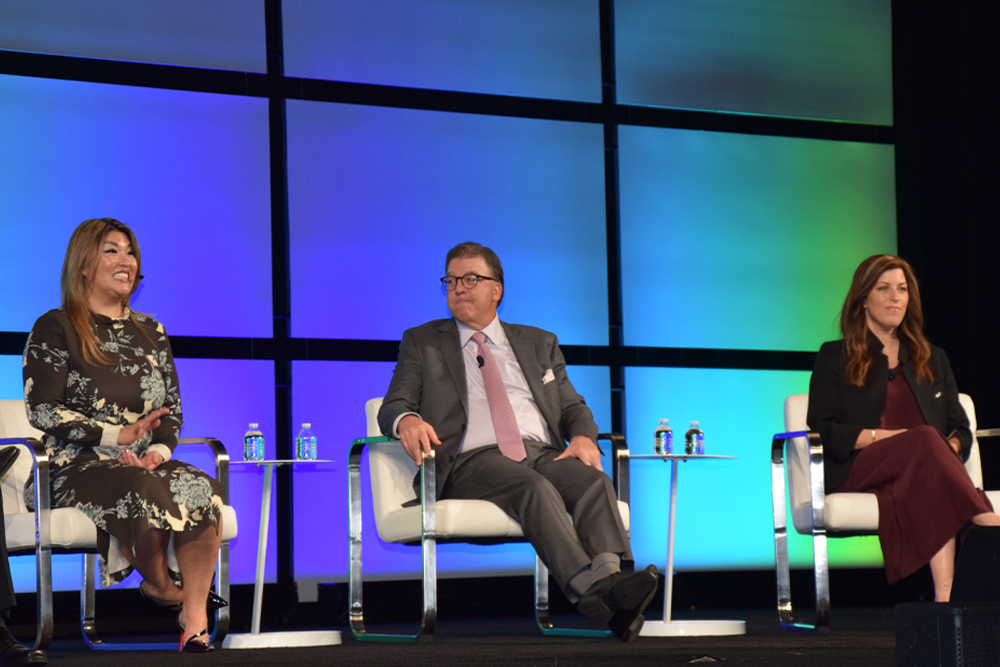
“X-Rounds: Refractive Cataract Surgery to the Max” is a fast-paced session at the ASCRS Annual Meeting where members of the panel presented their answer to a question or thoughts on a topic in 2.5 minutes or less. The audience then voted for their favorite in each section. Eric Donnenfeld, MD, moderated this session and was joined by Kerry Solomon, MD, John Hovanesian, MD, Elizabeth Yeu, MD, Edward Holland, MD, and Nicole Fram, MD, on the panel.
What am I doing differently this year?
Winner: Nicole Fram, MD
Dr. Fram said her focus is on ergonomics, or what she called “heads up, chest out.” Approximately 51% of ophthalmologists reported some neck or back pain, and 15% of ophthalmologists were limited in their work because of their pain,1 Dr. Fram said. Her practice investigated the different types of heads-up displays, finding that there are pros and cons. The winning technology, Dr. Fram said, is going to be the one with data integration and also the smallest footprint.
Other presentations in this section included Dr. Solomon saying he was “sleeping better” because he was using software that helps ensure predictable, optimal outcomes, and Dr. Hovanesian saying he was using more of the Light Adjustable Lens (RxSight).
Source: ASCRS
New technology on the horizon
Winner: Edward Holland, MD
Dr. Holland said he’s most excited about new corneal endothelial cell therapy being worked on by Aurion Biotech where cells from a healthy donor are cultured to make millions of new donor cells. The diseased endothelium of a patient is brushed off, then the healthy cells are injected, followed by the patient lying face down for a couple of hours. One donor could potentially treat hundreds of patients.
Other presentations included Dr. Solomon talking about virtual concepts, apps, and telemedicine in ophthalmology; Dr. Hovanesian shared that the IC-8 (AcuFocus) would hopefully soon come to the U.S.; and Dr. Yeu discussed the possibility of a truly accommodating IOL, like that being worked on by Juvene (LensGen).
Pearl for the management of astigmatism
Winner: Kerry Solomon, MD
Dr. Solomon said that that a paper by Steve Schallhorn, MD, and co-authors looked at more than 34,000 eyes and their postop spherical error and uncorrected DCVA. He said we were always taught to leave patients a little myopic. The data from Schallhorn et al. suggests that we should leave them a little hyperopic. Dr. Solomon presented that if the intention is to leave the patient emmetropic, it is better to err on the side of hyperopia than myopia for multifocal or monofocal IOLs. The research also showed that leaving a little with-the-rule astigmatism was correlated with increased patient satisfaction.
Other presentations included Dr. Hovanesian describing how important addressing dry eye is for assessing where the astigmatism truly is; Dr. Fram shared how she’s been looking at integrated Ks from three different devices, and Veracity (Carl Zeiss Meditec) has been “instrumental in changing our practice” from a data workflow standpoint; and Dr. Yeu said she’s thinking more about the IC-8 in these cases and how it could increase the number of patients having astigmatism corrected surgically because you don’t have to think about challenges like misalignment.
Favorite surgical or pharmacologic treatment of presbyopia
Winner: John Hovanesian, MD
Dr. Hovanesian spoke about UNR 844 (lipoic acid/choline ester, Novartis), which he said is a presbyopia-mitigating drop under investigation that “works differently.” Its mechanism of action is not shrinking the pupil, Dr. Hovanesian said. This drug is metabolized to lipoic acid and choline that is thought to break the disulfide bonds that limit lens flexibility, giving it back some of the presbyopia accommodation it had before.
In the other presentations, Drs. Solomon, Fram, and Yeu discussed newer EDOF technologies that have reduced or eliminated dysphotopsias, such as Vivity (Alcon), Synergy (Johnson & Johnson Vision), Eyhance (Johnson & Johnson Vision), RayOne EMV (Rayner), and mini-monovision with the Light Adjustable Lens.
Best surgical save of the year
Winner: Edward Holland, MD
Dr. Holland shared a case where a professional European football player suffered severe ocular injury after a firework explosion. His partner Jeffrey Nerad, MD, rebuilt the patient’s upper and lower lid, and a few months later, Dr. Holland did an ocular surface stem cell transplant. One of the patient’s siblings was an identical match, and conjunctiva and limbus was harvested from her eye and combined with keratolimbal allograft tissue from a deceased donor (Cincinnati Procedure). Once the ocular surface was successfully healed, Dr. Holland performed a PK. After total recovery, the patient had 20/40 vision in his worse eye and was back to playing football.
About the physicians
Eric Donnenfeld, MD
Ophthalmic Consultants of Long Island
Garden City, New York
Nicole Fram, MD
Advanced Vision Care
Los Angeles, California
Edward Holland, MD
Professor of Ophthalmology
University of Cincinnati
Cincinnati, Ohio
John Hovanesian, MD
Harvard Eye Associates
Laguna Hills, California
Kerry Solomon, MD
Carolina Eyecare Physicians
Mount Pleasant, South Carolina
Elizabeth Yeu, MD
Virginia Eye Consultants/Eye Care Partners
Norfolk, Virginia
Reference
1. Dhimitri KC, et al. Symptoms of musculoskeletal disorders in ophthalmologists. Am J Ophthalmol. 2005;139:179–181.
Relevant disclosures
Donnenfeld: None
Fram: Alcon, Beyeonics, Carl Zeiss Meditec
Holland: Aurion Biotech
Hovanesian: AcuFocus, Novartis, Ocular Therapeutix, RxSight, Sun Pharma
Solomon: Alcon, Carl Zeiss Meditec, Johnson & Johnson Vision
Yeu: AcuFocus, Alcon, LensGen, Johnson & Johnson Vision
Contact
Donnenfeld: ericdonnenfeld@gmail.com
Fram: nicfram@yahoo.com
Holland: eholland@holprovision.com
Hovanesian: jhovanesian@harvardeye.com
Solomon: ksolomon@cepmd.com
Yeu: eyeulin@gmail.com