- Steinert Lecture paints picture for the future of refractive surgery
- ASCRS/AGS Joint Symposium covers the latest in glaucoma therapy
- Glaucoma: medications, lasers, and lifestyle
- Examining options and what’s in development in artificial cornea technology
- Keratoconus management: crosslinking, CTAK, and more
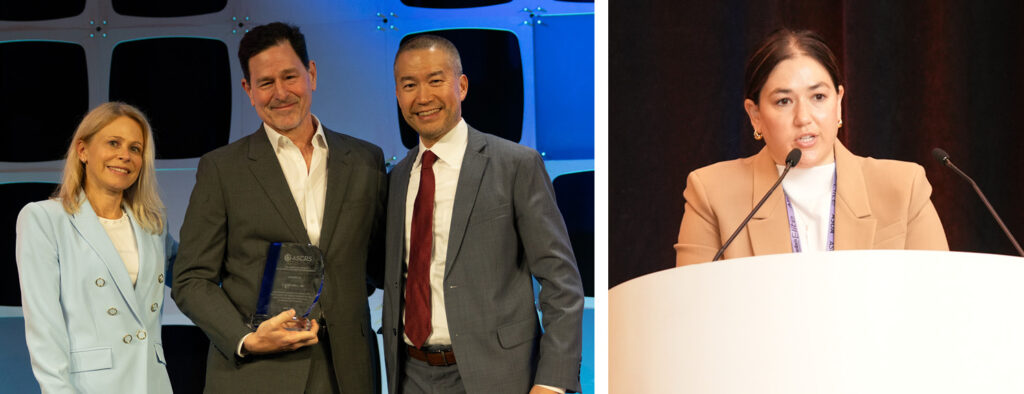
Steinert Lecture paints picture for the future of refractive surgery
The 9th annual Steinert Lecture was delivered by Steven Dell, MD, during ASCRS Refractive Day on April 10. Kendall Donaldson, MD, who introduced the lecture and speaker, called Dr. Dell a defining voice in refractive surgery for 3 decades.
Dr. Dell’s lecture, “The Evolution of Refractive Surgery: From Fringe to Forefront,” began with a time when “refractive surgery” wasn’t even part of the American Society of Cataract and Refractive Surgery’s name. It was added during the mid-1980s with the rise of RK and subsequent refractive procedures. Fast forward to present where surgeons are accustomed to seeing 20/20 results in the high 90th percentile on multiple LASIK platforms, with similar results being achieved with phakic IOLs and KLEx, Dr. Dell said.
ASCRS/AGS Joint Symposium covers the latest in glaucoma therapy
The ASCRS/AGS Joint Symposium at ASCRS Glaucoma Day, Friday, April 10, looked at everything from AI’s impact on glaucoma to MIBS to how innovations in cataract surgery are benefitting glaucoma patients and more.
Cecilia S. Lee, MD, addressed how AI could change glaucoma surgery in the future. At present, she said glaucoma patients have a lot of variability in their progression, making it easy to miss those who are rapid progressors and making surgical timing reactive rather than proactive or preventative. AI could help shift this in the future.
Glaucoma: medications, lasers, and lifestyle
A Friday morning Glaucoma Day session covered topics in medications, lasers, and lifestyle.
During the session, Erin Sieck, MD, shared practical tips for winning with drug delivery. We know from multiple studies that patients don’t use drops as reliably as we think they do, she said, adding that there are several drug delivery options available.
Examining options and what’s in development in artificial cornea technology
The first session on the Cornea Day program focused on surgical cornea topics, including presentations on artificial corneas, advances in endothelial disease, and avoiding or delaying transplantation.
Esen Akpek, MD, presented on artificial corneas and limitations of traditional transplants. She noted some of the key features needed for artificial corneas, which could be used in the case of donor cornea failure: flexibility, biointegration, and epithelization.
Keratoconus management: crosslinking, CTAK, and more
Karolinne Rocha, MD, PhD, and Beeran Meghpara, MD, moderated the second session of Cornea Day, which focused on keratoconus management.
William Trattler, MD, shared some data and take-home messages for epi-on crosslinking, which was approved in 2025. Dr. Trattler discussed some of the advantages of epi-on crosslinking, including no epithelial defect, fast visual recovery, virtually no risk of infection, you can perform bilateral procedures, less need for second procedure (this has been around 1%), less discomfort, a bandage contact lens is not needed, it avoids the risk of corneal haze related to epithelial removal, lower risk of inflammatory infiltrates, and reduction in postop visits.
EyeWorld Onsite is a digital publication of the American Society of Cataract and Refractive Surgery (ASCRS).
For sponsorship opportunities or membership information, contact: ASCRS • 12587 Fair Lakes Circle • Suite 348 • Fairfax, VA 22033 • Phone: 703-591-2220 • Email: ascrs@ascrs.org
Opinions expressed in EyeWorld Onsite do not necessarily reflect those of ASCRS. Mention of products or services does not constitute an endorsement by ASCRS.
Click here to view our Legal Notice.
Copyright 2026. All rights reserved.