Cataract: Digital Momentum
Summer 2026
by Ellen Stodola
Editorial Co-Director
Asymposium hosted by the combined societies of the American Society of Cataract and Refractive Surgery (ASCRS), the European Society of Cataract and Refractive Surgeons (ESCRS), and the Asia-Pacific Association of Cataract and Refractive Surgeons (APACRS) focused on topics in AI, robotics, and surgical simulation, with representatives from all three societies presenting. Kevin M. Miller, MD, Pannet Pangputhipong, MD, and H. Burkhard Dick, MD, moderated the session.
Katherine Talcott, MD, shared updates on AI in macular imaging. She said that imaging for retina specialists is critical to everyday care of patients, however, imaging modalities can be time intensive to review. OCTs generate hundreds of B-scans, and it can be hard to not miss subtle findings.
The burden of retinal disease is only increasing, Dr. Talcott said, and she thinks the field is ready for help from AI to manage retinal disease from an imaging perspective.
The biggest integration of AI is in diabetic retinopathy screening, Dr. Talcott said, mentioning the LumineticsCore (formerly IDx-DR, Digital Diagnostics). This can help address low screening rates in diabetes and lead to more appropriate referrals and earlier disease diagnoses.
Another example of commercially available AI technology is home OCT, which enables between-visit monitoring for nAMD progression and potentially earlier detection of disease activity and facilitation of personalized treatment. This could reduce treatment burden for patients and physicians, Dr. Talcott said.
She also mentioned the CIRRUS PathFinder (Zeiss), a platform that helps users see if there are abnormal findings on an OCT. This is a referral decision prediction tool based on B-scans of interest, and individual B-scans identified as abnormal are labeled by the program. The review highlights the location of the abnormal B-scan for the program and recommends an interval for referral to a more specialized provider.
Vance Thompson, MD, highlighted the next generation of ophthalmic robotics. What we do has complexities, but there’s a low variability in ocular anatomy compared to general surgery, he said. There’s also low variability in ocular geometry, and it’s a relatively consistent, routine procedure and high volume. All these things give robotics the potential to be a great contributor in this small, delicate space. With the right technology, cataract surgery is a good candidate for robotic surgery, he said.
What can be expected from robotic ophthalmic surgery? Dr. Thompson noted reduced training time, a lower dexterity threshold, enabling new procedures, improving ergonomics, improving surgical technique, improving refractive outcomes, and eventually the potential to automate a full or partial procedure.
David Cherwek, MD, presented “Intensive Virtual Reality Cataract Surgery Training: Unlocking the Next Generation of Skilled Phacoemulsification Surgeons in LMICs.”
When people talk about simulation, they think it’s a one and done, however, Dr. Cherwek thinks it’s part of a pathway, and you have to have structure around that pathway. A novice is not going to know what they don’t know.
The biggest mistake is saying simulators will make you surgically competent, Dr. Cherwek said. They’re going to make you surgically ready, so when you walk in the OR, you know the steps of the procedure, the task, and you have some micro-dexterity skill. A problem facing residencies today is faculty fatigue, he added, and this can be reduced by automating it with simulators.
Simulation is used by Orbis International to teach manual small incision cataract surgery. Dr. Cherwek thinks simulators should be used more and be part of a pathway. Simulators can help get through the basic science, he said, adding that no one should walk into the OR and not know the basic anatomy. Simulators are the best way to get people ready for the OR, he said, mentioning the Eyesi Surgical (Haag-Streit). Simulation is reaching everywhere, though Dr. Cherwek thinks the U.S. is lagging in the best way to adopt it.
Woong-Joo Whang, MD, presented on optimizing effective lens position prediction using deep learning with attention mechanisms. Attention mechanism for IOL power calculations identifies the relationship between input variables. It is dynamically weighing which inputs are most important for prediction and capturing complex interactions between many variables.
For example, in IOL calculation, axial length might be more significant when considered together with corneal power in certain scenarios, while in others, its relationship with anterior chamber depth could be more relevant. The attention mechanism automatically learns these contextual relationships.
Dr. Whang went on to discuss significant parameters for ELP, noting that since the contribution of each parameter to ELP changes depending on the axial length range, it is challenging to define a single equation that applies across the entire spectrum of axial length.
We need an alternative, he said, and one alternative is structural equation modeling. However, even with this approach, the optimal combination of variables and the best-fitting equations change depending on axial length.
The attention mechanism is ideal for understanding the relationship between various ocular parameters and finding the optimal combination. By combining with existing deep learning approaches, we can implement it for IOL power calculations, he said.
Dr. Whang went on to describe a study to compare the performance of standard deep learning models (5 types) with models enhanced by various attention mechanisms (30 combinations) in ELP prediction, and to evaluate whether attention-enhanced models demonstrate overfitting tendency. In the study, 1,120 patients underwent conventional cataract surgery at Yeouido St. Mary’s Hospital. Axial length, corneal power, anterior chamber depth, lens thickness, and WTW (corneal diameter) were measured by swept-source OCT, and ELP was calculated by vergence formula. Among the 35 deep learning models, 20 showed better results than traditional multiple regression analysis, and of the 30 deep learning models combined with attention modules, 22 demonstrated improved performance compared to standard deep learning models.
Yu-Hsuan (Alex) Huang, MD, PhD, presented on advances in robotic cataract surgery. Robotic surgery can be classified by the level of control, including robot-assisted tools, teleoperated systems, cooperative systems, and partially or fully autonomous systems. He mentioned several products in the robotics space. Micron (Carnegie Mellon University) is a robot-assisted tool for vitreoretinal microsurgery and features active tremor cancellation and force-controlled membrane peeling.
Preceyes (Zeiss) allows precise control of surgical instruments inside the eye through a teleoperated robotic arm. The Steady-Hand Eye Robot (Johns Hopkins) and MYNUTIA (KU Leuven) are cooperative systems where the surgeon and robot share control.
Dr. Huang discussed the Polaris (Horizon Surgical Systems), which was originally designed for partially automated cataract surgery with two robotic arms and multiple automated steps. However, in the first in-human procedure, the system was implemented as a one-handed teleoperated platform controlled by the surgeon, without automation, highlighting the gap between concept and clinical reality.
He also spoke about ForSight Robotics as another player in the cataract robotics space. This system is a teleoperated platform in which the surgeon operates remotely using hand controllers, and based on available demonstrations, it appears to adopt a bimanual surgical approach, closer to how surgeons perform cataract surgery today.
What’s next? Dr. Huang highlighted Xensur and the use of real surgical instruments and high-resolution motion tracking. This enables training of cataract surgery skills, both training surgeons and training robots how expert surgeons operate. High-quality data is key to the future, he added.
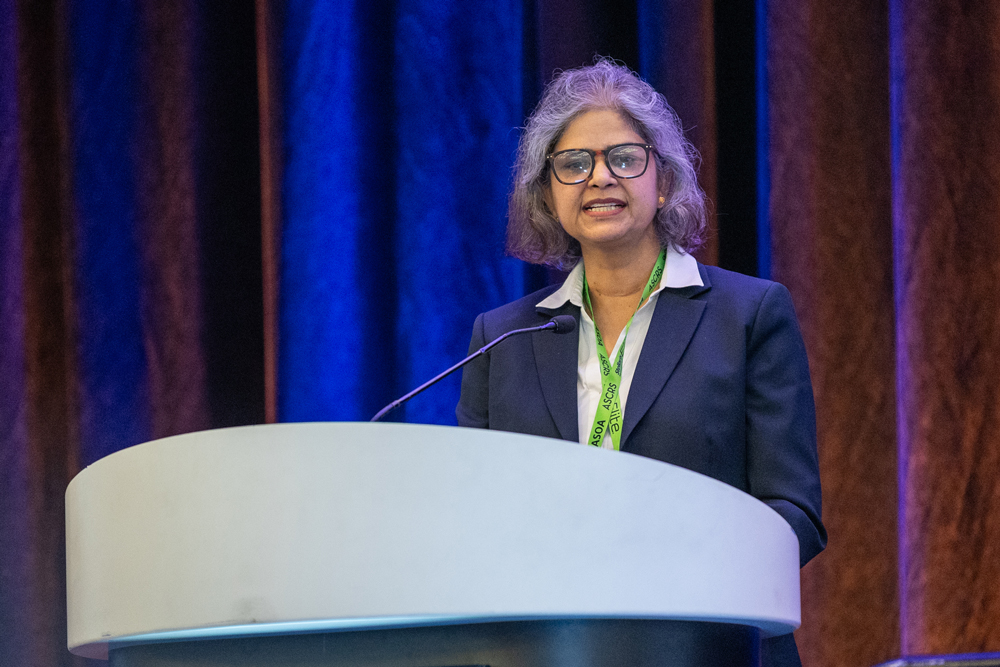
Anshu Arundhati, MD, spoke about simulator training surgery in her presentation. The old way of learning at the patient’s expense is no longer the way forward, she said. Simulation-based medical education prioritizes patient safety and improves trainees’ skills and surgical outcomes. The COVID-19 pandemic permanently accelerated adoption of digital education platforms and the need for high fidelity learnings, she said, adding that there’s also the workforce shortage to consider. AR/VR is a critical tool for scaling education efficiently.
Source: ASCRS
Dr. Anshu said simulation allows for quantifiable success, and there have been several papers to show that VR simulation improves basic cataract surgical skills and enhances surgical efficiency. It also helps with error reduction, and studies show reduced intraoperative errors and complication rates and improved surgical confidence, especially in novices.
Additionally, it allows for repeated practice of uncommon complications that a trainee may not encounter during a standard rotation.
Dr. Anshu mentioned several available simulator tools available where she works in the Singapore National Eye Centre (SNEC): Eyesi (for cataract and vitreoretinal modules) and the HelpMeSee surgery simulator (for MSICS and phaco surgeries, offering advanced haptics and tissue response modeling). The Eyesi module for cataract surgery is a pre-requisite for residents at SNEC before stepping into the OR besides doing wet labs. The slit lamp version by Eyesi is a useful tool to master slit lamp skills and is being used for optometry training locally and as a teaching tool for medical students; it is also a value add for new residents in ophthalmology, she said.
She discussed the VisioGen (Zeiss), which can compare resident performance against a database of thousands of expert surgeries. It gives real-time “smart” guidance, with AI models providing automated feedback on instrument path length and procedural duration. It utilizes machine learning to analyze surgical videos to track total path length, velocity of movements, and frequency of ineffective actions.
Pavel Stodulka, MD, PhD, presented on robotic platforms in cataract surgery and some early experience in Europe. He highlighted the levels of automation in cataract surgery: manual, FLACS, robotic positioning plus laser control, tool manipulation, and supervised autonomy.
He discussed the FemtoMatrix laser (Keranova), which enables OR integration. OCT-guided energy optimization enables us to shoot to different paths to use lower energy, Dr. Stodulka added.
He mentioned the ORYOM platform (ForSight Robotics), which is designed specifically for eye surgery. The surgeon sits at a console with 3D imaging and performs surgery. This offers real-time image guidance and advanced visualization, as well as motion scaling and tremor filtering.
The future will included supervised autonomy, Dr. Stodulka said, adding that robotic cataract surgery is on its way whether we like it or not, and real-world data is needed.
Joaquín Fernández, MD, PhD, discussed AI-assisted scientific publishing and improving efficiency without compromising integrity. He highlighted Aristotle’s virtue ethics, noting five key intellectual virtues essential for academic flourishing that may be weakened when artificial intelligence is relied upon to perform academic tasks.
The first is episteme (knowledge), knowledge of one’s academic field, its aims, methods, and the conclusions drawn from them. Instead of reading original papers, researchers may rely on AI to provide partial summaries. You may lose the depth of your knowledge, he said.
The second is nous (intuition). This is intuition based on episteme, knowing which ideas are good ideas, and making judgments within the field based on one’s expertise. Lack of sustained engagement with original research may diminish the researcher’s intuition about the validity of certain ideas and conclusions present in the work. You lose your ability to judge quality of science, Dr. Fernández said.
Next, he mentioned sophia (wisdom), a combination of episteme and nous, a higher form of wisdom that is not merely related to one’s field, but rather how one’s field relates to the rest of life and society. Sustained use of AI may diminish the researcher’s ability to discern the right relationship between research, life, and society. You may lose your ability to connect knowledge with life and society, he said.
Phronesis (practical wisdom) is the ability to decide how to reach a certain end and the ability of reason to determine what counts as a desirable end. Reliance on AI may lead to an increasing reliance on shortcuts to achieve certain ends and bring a sense of meaninglessness if the virtuous end of the academic life is overlooked. You may lose your sense of meaningful goals and good decisions, he said.
Finally, Dr. Fernández mentioned techne (craft/art), the ability to make something through the use of true reasoning. Across all domains of academics, scholars tend to be artisans of academic papers. Empirical evidence suggests that academics are increasingly using AI to write papers, favoring their publication metrics rather than advancing scholarly dialogue. You may lose your ability to create work through your own reasoning, he said.
Dr. Fernández noted that you must ensure the accuracy, comprehensiveness, and impartiality of all AI-generated output and that the manuscript represents the author’s authentic and original contribution and reflects their own analysis, interpretation, insights and ideas.
Authors must verify that AI tool terms ensure that the tool only has the right to use materials to provide the service and that no additional rights are granted over input materials. This includes ensuring that the AI tool is not granted rights to train on the provided materials. Authors must also ensure that the AI tool does not impose restrictions on the use of its outputs.
European perspective on surgical simulation.
Source: ASCRS
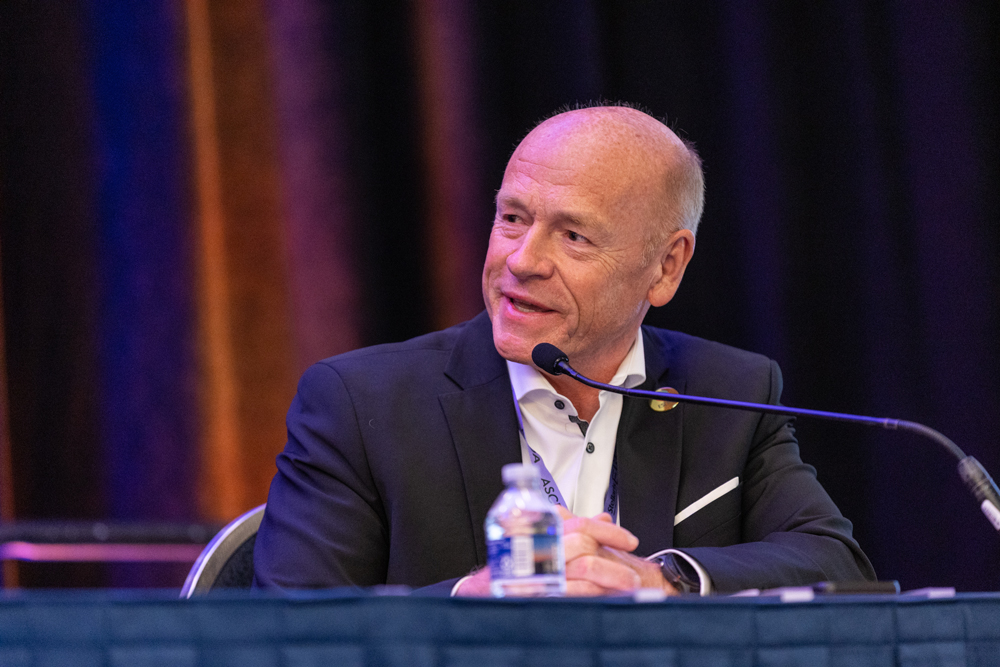
Dr. Dick wrapped up the presentations, focusing on different training cultures, and he gave a European perspective on surgical simulation. ESCRS is looking for a formal pathway for cataract and refractive surgery training, is reviewing evidence, and has differentiated between simulation vs. wet labs. Simulation improves surgical performance, Dr. Dick said, noting some of the mechanisms of skills transfers to live cataract surgery, such as motor skills, like bimanual coordination, microscope-based depth cues, and instrument tip control (tremor management), and cognitive task structure, like step sequencing, error recognition, and decision-making without time pressure. It could also be useful for complication preparedness, including PCR scenarios, anterior vitrectomy, and small pupil/weak zonules. It could play a role in human factors, like stress inoculation, standardized debrief, and communication and workflow.
Dr. Dick mentioned the ESCRS iLearn platform, as well as cataract educational programs, moving simulators that travel between cities in Europe (using the Eyesi simulator), and the ESCRS Recommendations for Cataract Surgery, which are based on a meta-analysis.
Dr. Dick then went into the ESCRS Cataract Surgery Simulation Curriculum, which aims to design a stepwise simulation curriculum aligned to cataract surgery steps and competency assessment. This would include the core design principles of transparent entry requirements and staged progression, mapping simulation tools to specific surgical steps, proficiency-based progression using validated assessment tools, continuous growth, costing specifications to support adoption, and maintenance of competency (e.g., periodic simulation-based refreshers and performance reviews). The implementation deliverables are to collate wet lab and VR options by cataract step, including indicative costs; link simulation steps to ESCRS educational content on the ESCRS platform; and embed feedback mechanisms to update the curriculum.
We also need to consider constraints and sustainability. That means you need to evaluate all the artificial eye models, he said.
Article Sidebar
To hear the complete presentations, 2026 ASCRS Annual Meeting attendees can access this session on ASCRS On Demand.
About the physicians
Anshu Arundhati, MD
Deputy CEO of Education
Singapore National Eye Centre
Clinical Director
Singapore Eye Bank
Singapore
David Cherwek, MD
Vice President of Clinical Services and Technologies
Orbis International
H. Burkhard Dick, MD, PhD
Ruhr University Bochum
Bochum, Germany
Joaquín Fernández, MD, PhD
Qvision, Department of Ophthalmology
VITHAS Almería Hospital
Almería, Spain
Yu-Hsuan (Alex) Huang, MD, PhD
Universal Eye Center
Taipei, Taiwan
Pavel Stodulka, MD, PhD
Gemini Eye Clinic
Zlin, Czech Republic
Katherine Talcott, MD
Associate Professor of Ophthalmology
Cole Eye Institute
Cleveland Clinic
Cleveland, Ohio
Vance Thompson, MD
Vance Thompson Vision
Sioux Falls, South Dakota
Woong-Joo Whang, MD
The Catholic University of Korea
Yeouido St. Mary’s Hospital
Seoul, South Korea
Relevant disclosures
Anshu: None
Cherwek: None
Dick: None
Fernández: None
Huang: None
Stodulka: Bausch + Lomb, Keranova
Talcott: 4DMT, AbbVie, Alimera, Apellis, Astellas, Bausch + Lomb, Boehringer Ingelheim, Eyepoint, Genentech, Harrow, Ocular Therapeutix, Outlook, Regeneron, Zeiss
Thompson: ForSight Robotics
Whang: PuzzleAI
Contact
Anshu: arundhati.anshu@singhealth.com.sg
Cherwek: dhunterc@yahoo.com
Dick: burkhard.dick@kk-bochum.de
Fernández: joaquinfernandezoft@gmail.com
Huang: yush.huang@gmail.com
Stodulka: stodulka@lasik.cz
Talcott: talcotk@ccf.org
Thompson: vance.thompson@vancethompsonvision.com
Whang: olokl@nate.com